

If your vehicle weighs 26,000 pounds or less, hydraulic brakes give you precise, immediate stopping power using incompressible fluid. This makes them ideal for lighter loads and frequent stops.
For heavier vehicles above 26,000 pounds, air brakes offer reliable force with fail-safe features using compressed air. They are suited for commercial and heavy-duty use.
Each system demands different maintenance: fluid checks versus air quality management. Additionally, balance upfront costs with operational needs.
Discover how these differences affect your braking choice.
Key Takeaways
- Hydraulic brakes use incompressible fluid for precise, immediate braking, ideal for vehicles up to 26,000 pounds GVWR.
- Air brakes use compressed air with built-in fail-safes, making them reliable for heavy-duty vehicles over 26,000 pounds GVWR.
- Hydraulic systems require fluid maintenance and occasional flushing; air systems need air quality checks and moisture removal.
- Air brakes have dual circuits and automatic engagement on pressure loss, enhancing safety in commercial and heavy vehicles.
- Hydraulic brakes provide shorter stopping distances in lighter vehicles, while air brakes excel in heavy towing and load scenarios.
Hydraulic Brakes vs Air Brakes Comparison Table
| Feature | Hydraulic Brakes | Air Brakes |
|---|---|---|
| Ideal Vehicle Weight (GVWR) | Up to 26,000 lbs | Over 26,000 lbs |
| Primary Force Medium | Incompressible brake fluid | Compressed air (70–120 PSI) |
| Braking Response | Immediate and precise | Slight delay due to air compressibility |
| Stopping Power | Excellent for lighter vehicles | Superior for heavy-duty loads |
| Fail-Safe Mechanism | No automatic engagement on failure | Automatically engages if air pressure drops |
| Typical Applications | Light trucks, SUVs, passenger vehicles, small machinery | Medium & heavy-duty trucks, commercial vehicles |
| Maintenance Requirements | Fluid level checks, fluid replacement, brake bleeding, line flushing | Air tank draining, moisture removal, compressor and valve inspection |
| Repair Complexity | Requires full system flush if opened | Easier segmented repairs without full system flush |
| System Design | Sealed fluid system | Dual air circuits with redundancy |
| Safety Advantage | Precise control under normal operation | Built-in fail-safe redundancy for heavy loads |
| Upfront Cost | Lower initial cost | ~$2,500 higher initial cost |
| Long-Term Cost | Higher fluid maintenance over time | Durable components, lower long-term downtime |
| Noise Level | Quieter operation | Noisier due to air release |
| Environmental Impact | Fluid leaks can contaminate soil/water | Less chemical leakage risk, but requires air system upkeep |
| Best For | Daily driving, light towing, frequent stops | Commercial logistics, heavy towing, long-haul operations |
Hydraulic vs Air Brakes: Which System Is Right For Your Vehicle?
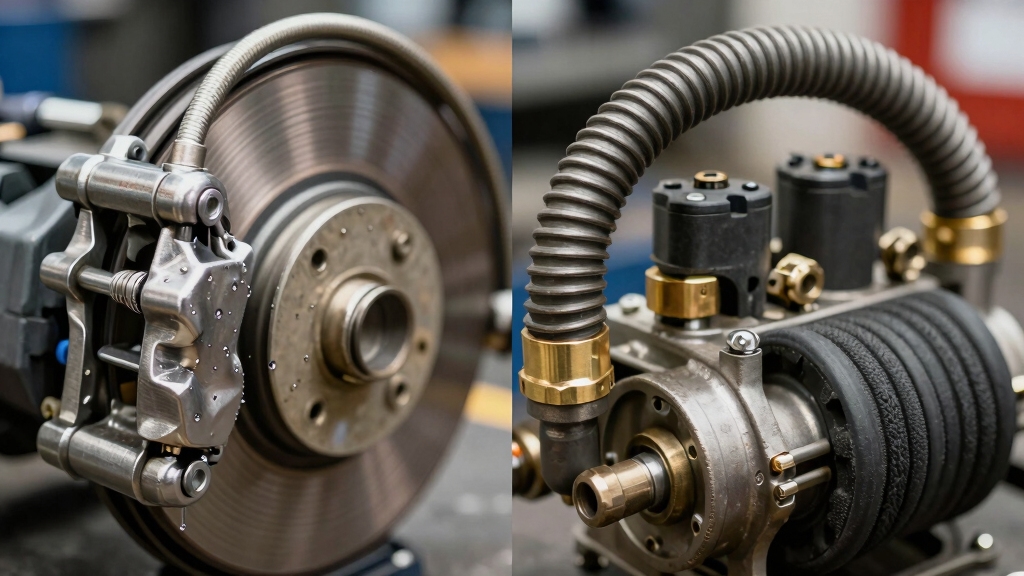
When deciding between hydraulic and air brakes for your vehicle, you need to take into account its weight and intended use carefully.
Choosing between hydraulic and air brakes depends on your vehicle’s weight and how you use it.
Hydraulic brakes, powered by incompressible fluid, offer precise control and are ideal for vehicles with a Gross Vehicle Weight Rating (GVWR) of 26,000 pounds or less.
These systems generate high pressure efficiently, suitable for lighter vehicles requiring shorter stopping distances without risk of overload.
Conversely, air brakes utilize compressed air at lower pressures, making them better suited for heavier vehicles exceeding 26,000 pounds GVWR, such as heavy-duty trucks.
Their fail-safe design and simpler maintenance support continuous operation under demanding loads.
Evaluating your vehicle’s GVWR and typical load scenarios is essential to selecting the braking system that balances performance, safety, and maintenance demands effectively.
Additionally, maintaining proper brake balance between braking components is crucial to ensure optimal braking performance and vehicle safety.
How Hydraulic Brakes Stop Your Vehicle?
Understanding how hydraulic brakes stop your vehicle clarifies why they deliver such precise control for lighter vehicles.
When you press the brake pedal, you increase pressure in an incompressible brake fluid within the master cylinder. This fluid transmits force uniformly through brake lines to pistons housed in calipers or wheel cylinders.
Those pistons then push brake pads or shoes against rotors or drums, creating friction that slows wheel rotation. Because the fluid is incompressible, force transfer is immediate and exact, enabling responsive braking.
The system’s sealed design prevents fluid loss, maintaining consistent pressure. This hydraulic mechanism scales well for vehicles up to 26,000 pounds GVWR, balancing efficient stopping power with manageable maintenance, unlike air brakes designed for heavier loads. Proper maintenance, including bleeding the brakes when necessary, helps ensure consistent brake performance and safety.
How Air Brakes Create Stopping Power?
Air brakes work by generating stopping power through a pretty neat process. First off, they compress air to a pressure of about 70 to 120 PSI. This compressed air is then stored in pressurized tanks. The cool part is that these tanks keep the brakes disengaged until you really need them. Proper maintenance and regular inspection are crucial for ensuring the durability and safety of air brake systems.
Air Pressure Generation
Air brakes build up stopping power by pressurizing air stored in tanks, which stays ready to engage the braking mechanism instantly.
You rely on an engine-driven compressor to generate compressed air, typically between 70 to 120 PSI, which fills multiple reservoirs.
This pressurized air is maintained under constant monitoring via gauges and pressure switches to guarantee system readiness.
When you apply the brake pedal, the stored air is directed into brake chambers, converting air pressure into mechanical force.
The system’s design includes safety valves to prevent over-pressurization and moisture traps to remove condensation, preserving air quality and system integrity.
Effective air brake systems require durable construction and proper maintenance to ensure reliable material strength for long-term performance.
Brake Engagement Mechanism
When you press the brake pedal, compressed air from the reservoirs flows into the brake chambers, where it pushes against a flexible diaphragm. This diaphragm moves a pushrod connected to the slack adjuster, which then rotates the S-cam.
The S-cam’s rotation forces the brake shoes outward against the drum’s interior surface, generating friction that slows the wheel. Air pressure typically ranges between 70 and 120 PSI, providing sufficient force to engage the brakes effectively.
When you release the pedal, air exhausts from the chambers, allowing return springs to retract the brake shoes and disengage the brakes. This fail-safe mechanism guarantees braking occurs automatically if air pressure drops, maintaining safety and reliability in heavy vehicles where hydraulic force alone would be insufficient.
For optimal brake performance, regular maintenance such as bleeding the brakes to remove air bubbles is essential to ensure proper brake function.
Operational Differences: Hydraulic vs Air Brakes
Although both hydraulic and air brakes serve the fundamental purpose of stopping vehicles, they operate through distinctly different mechanisms that affect performance and maintenance.
Hydraulic brakes use incompressible fluid to transmit force directly from the pedal to the brake pistons, providing precise and immediate response.
In contrast, air brakes rely on compressible air at pressures between 70-120 PSI, which introduces slight delays due to air compressibility.
You’ll find hydraulic systems require fluid maintenance and full flushing if lines are opened, whereas air systems allow easier repairs without complete system overhaul thanks to their segmented dual circuits.
Additionally, air brakes incorporate fail-safe designs that automatically engage brakes if pressure drops, enhancing safety.
Understanding these operational distinctions helps you evaluate braking responsiveness, upkeep demands, and system reliability effectively.
Hydraulic brakes often feature pre-bled systems filled with mineral oil, simplifying installation and maintenance compared to air brake systems.
Vehicle Applications: When To Use Hydraulic Or Air Brakes?
Deciding which braking system to opt for hinges largely on your vehicle’s Gross Vehicle Weight Rating (GVWR) and intended use.
If your vehicle weighs 26,000 pounds or less, hydraulic brakes offer precise control and quicker stopping power.
For vehicles exceeding this weight, air brakes provide reliable, fail-safe operation suitable for heavy-duty demands.
It’s also important to consider the type of brake fluid used in hydraulic systems, as DOT 3, DOT 4, and DOT 5 brake fluids offer different performance characteristics and compatibility.
| Vehicle Type | Recommended Brake System | Key Reason | Typical Use Case |
|---|---|---|---|
| Light trucks & SUVs | Hydraulic | Precise force transmission | Daily driving, light towing |
| Medium-duty trucks | Air | Fail-safe design, durability | Commercial logistics |
| Heavy-duty trucks | Air | Handles high GVWR efficiently | Long haul, heavy towing |
| Specialized machinery | Hydraulic | High torque braking | Cranes, elevators |
Choose based on GVWR and operational demands for peak braking performance.
Maintenance: Hydraulic Vs Air Brake Systems
Maintenance routines differ markedly between hydraulic and air brake systems, impacting both reliability and downtime.
With hydraulic brakes, you must regularly check fluid levels and replace brake fluid to prevent contamination and corrosion, especially after opening lines. You’ll also inspect seals and pistons for leaks or wear, as fluid leaks degrade performance and cause failure.
Conversely, air brake systems require you to monitor air pressure tanks, compressors, and valves for leaks or moisture buildup, which can freeze and impair operation. You’ll drain air tanks frequently to remove water and oil contaminants.
Repairs on air systems are generally simpler since you can fix leaks without a full system flush. Overall, hydraulic systems demand more fluid maintenance, while air brakes need vigilant air quality and pressure management to guarantee consistent functionality. Additionally, performing maintenance in a well-ventilated area enhances safety and helps prevent damage during servicing.
Safety Features Of Air Brakes vs Hydraulic Brakes
When you compare safety features, air brakes offer a distinct advantage through their fail-safe design: if air pressure drops, the brakes automatically engage, preventing uncontrolled movement.
This inherent safety mechanism guarantees that even in case of system failure, the vehicle stops, reducing accident risk.
Hydraulic brakes, relying on fluid pressure, lack this automatic fail-safe; a leak or system failure can lead to brake loss without immediate engagement.
However, hydraulic systems provide precise, immediate braking response due to incompressible fluid transmission, enhancing control during normal operation.
Air brakes incorporate dual air circuits per axle, adding redundancy to prevent total brake failure.
While hydraulic brakes deliver consistent force, air brakes prioritize fail-safe redundancy, making them more suitable for heavy-duty vehicles where safety margins are critical.
You must weigh these features based on vehicle application and required safety standards.
Cost Comparison: Hydraulic vs Air Brakes
Beyond safety, cost plays a significant role in choosing between hydraulic and air brake systems.
Hydraulic brakes generally have a lower initial purchase price and simpler installation, making them cost-effective for vehicles under 26,000 pounds GVWR.
However, their maintenance costs can rise due to fluid replacement and potential line flushing after repairs.
Air brakes, while about $2,500 more expensive upfront, offer long-term savings through durable components and easier repairs, such as fixing leaks without full system flushing.
Their fail-safe design reduces costly downtime.
Over time, air brakes’ resilience and lower upkeep requirements often offset the higher initial investment, especially for heavy-duty applications.
You’ll need to weigh upfront expenses against maintenance frequency and vehicle weight to determine the most economical system for your specific needs.
Using proper brake system securing methods can also influence overall maintenance costs and vehicle safety.
How To Choose The Right Brake System For You?
Although selecting the right brake system depends on multiple factors, you should prioritize your vehicle’s weight rating and typical usage conditions.
If your vehicle’s Gross Vehicle Weight Rating (GVWR) is 26,000 pounds or less, hydraulic brakes offer precise control and shorter stopping distances.
For heavier vehicles exceeding this threshold, air brakes provide superior reliability under load and a fail-safe mechanism critical for safety.
Consider maintenance demands: hydraulic systems require fluid checks and flushing, whereas air brakes feature easier repairs and durability.
Also, analyze your operational environment; air brakes excel in heavy towing and commercial applications, while hydraulic brakes suit lighter, frequent-stop scenarios.
Balancing upfront costs against long-term upkeep helps you decide which system best aligns with your vehicle’s specifications and operational demands.
Selecting drivetrain components like chain and sprocket kits with appropriate durability and maintenance profiles can similarly influence your vehicle’s overall performance and reliability.
Frequently Asked Questions
Can Hydraulic and Air Brakes Be Combined on the Same Vehicle?
You can combine hydraulic and air brakes on the same vehicle, but it’s uncommon and complex.
Typically, lighter axles use hydraulic brakes while heavier ones rely on air brakes.
This dual system demands careful integration to guarantee synchronized braking performance and safety.
You’ll need specialized control valves and maintenance routines to manage both fluid and air systems effectively.
This helps prevent failures caused by incompatible responses or delayed actuation times.
How Do Temperature Changes Affect Hydraulic vs Air Brake Performance?
You might notice your brakes feel different when the temperature shifts.
Hydraulic brakes rely on fluid, which can expand or contract slightly.
However, they maintain pressure well, so performance stays stable.
Air brakes, on the other hand, use compressible air.
Cold temperatures can cause moisture to freeze in lines, reducing efficiency or causing failures.
You’ll want to monitor air brake systems closely in cold climates.
Meanwhile, hydraulic brakes handle temperature changes with less impact.
What Are the Environmental Impacts of Hydraulic Brake Fluid Leaks?
You should know hydraulic brake fluid leaks can harm the environment markedly.
These fluids often contain toxic chemicals that contaminate soil and water, posing risks to aquatic life and ecosystems.
When leaks occur, they degrade local habitats and can persist due to slow biodegradability.
Proper containment and disposal are essential to prevent such damage.
You must handle brake fluid carefully to minimize environmental impact and comply with regulations.
Are Air Brakes Noisier Than Hydraulic Brakes During Operation?
You know what they say: where there’s smoke, there’s fire.
Air brakes tend to be noisier than hydraulic brakes during operation due to the release of compressed air and mechanical components like the S-cam engaging brake pads.
Hydraulic brakes use incompressible fluid, resulting in smoother, quieter function.
So, if noise reduction is critical for you, hydraulic systems offer a quieter solution.
Air brakes prioritize reliability and heavy-load capacity at the expense of increased sound.
How Do Brake Pad Materials Differ Between Hydraulic and Air Brake Systems?
You’ll find brake pad materials vary significantly between hydraulic and air brake systems.
Hydraulic brakes typically use semi-metallic or ceramic pads designed to handle precise, high-pressure friction from fluid force.
Air brakes require more robust, heat-resistant materials like composite or sintered metals to endure the higher thermal loads and mechanical stresses from compressed air actuation.
This material choice guarantees durability and consistent performance under heavy-duty, variable load conditions you face with air brakes.
Safety in Every Stop: Decide with Confidence
Now that you’ve seen the intricate differences between hydraulic and air brakes, the choice might seem straightforward. But don’t decide just yet.
Each system’s unique mechanics, maintenance demands, and safety features could dramatically impact your vehicle’s performance and reliability. Are you ready to match the braking system perfectly to your needs, or will you risk costly mistakes?
Dive deeper, analyze carefully, and make the informed decision that keeps you safely in control.