
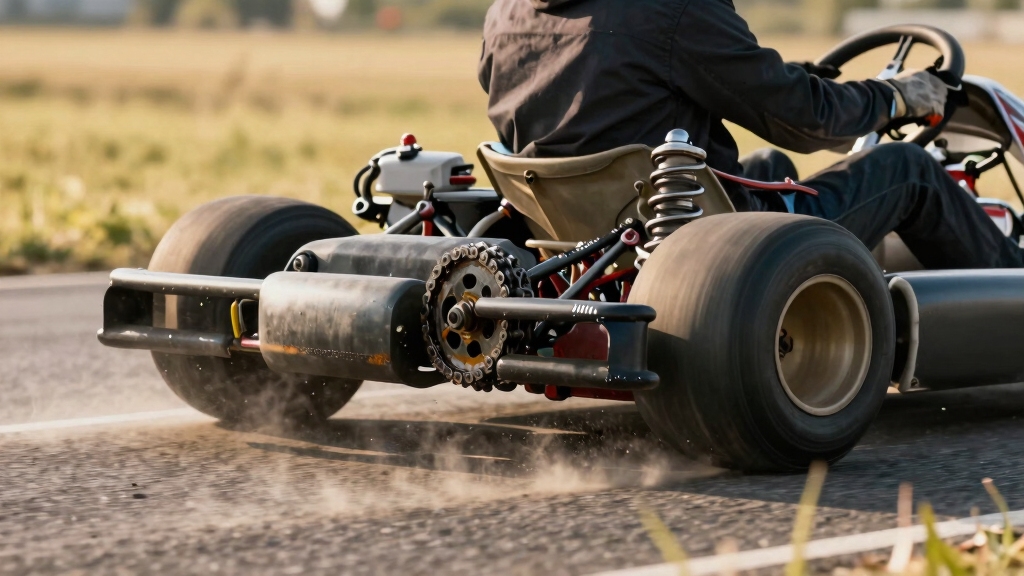
To make your go kart faster, focus on mastering the ideal racing line. Choose a late apex to shorten distance and maintain traction while minimizing steering corrections.
Apply smooth, precise throttle to balance power and prevent tire slip, especially exiting corners. Brake firmly in a straight line before turns and coordinate gradual trail braking to enhance front grip.
Adjust your weight distribution by seating position for better handling. Fine-tuning these techniques sharpens lap times and overall control; exploring these methods further reveals advanced speed optimization strategies.
Key Takeaways
- Optimize your racing line with a late apex to shorten distance and maintain higher corner exit speeds.
- Apply smooth throttle and gradual power delivery to prevent wheel spin and maximize acceleration out of turns.
- Brake firmly in a straight line before corners, then trail brake gently into the turn to maintain front tire grip.
- Execute clean, fluid steering inputs to preserve tire traction and avoid unnecessary speed loss from corrections.
- Adjust seat position and tire pressures to improve weight distribution and enhance kart handling and cornering response.
How Racing Lines Help Your Go Kart Go Faster?
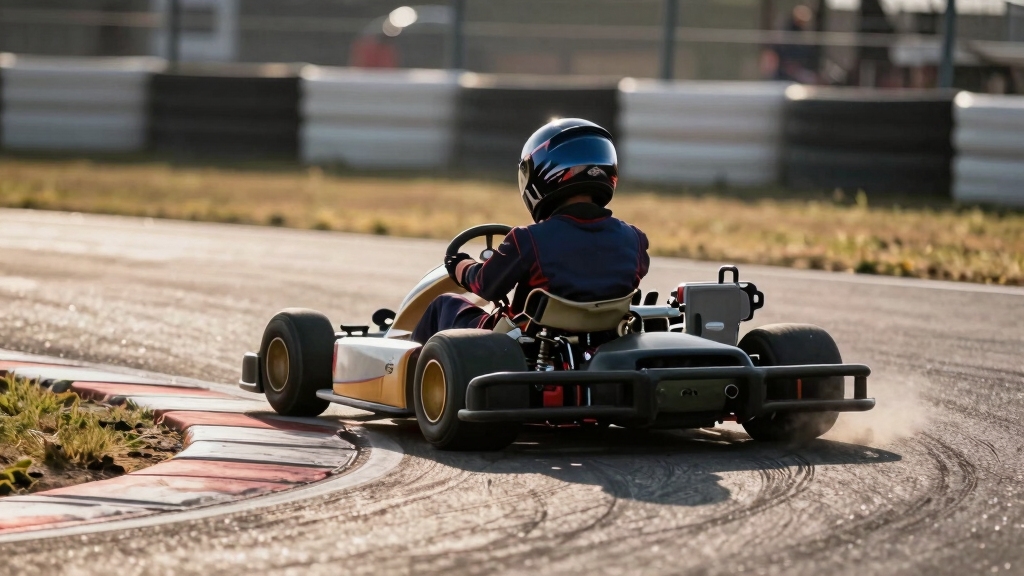
Although mastering your racing line takes practice, it directly reduces lap times by optimizing your kart’s path through corners.
Mastering your racing line sharpens cornering precision, directly cutting lap times through optimal kart paths.
You achieve this by selecting the appropriate apex: a late apex tightens your mid-corner trajectory, shortening track distance while maintaining speed.
An early apex lets you accelerate sooner out of tight corners but risks longer overall distance. Most turns benefit from a mid apex, balancing control and speed.
You can also save vital tenths of seconds by straight-lining corners, minimizing steering input and maintaining momentum.
For high-speed bends, rounding off the curve allows you to carry more speed through the turn.
Optimizing your racing line also helps manage aerodynamic drag, which becomes increasingly significant at speeds above 40 mph.
Why Smooth Throttle Control Boosts Your Go Kart Speed?
When you apply throttle smoothly, you prevent tire slip and maintain peak grip, which directly enhances acceleration and stability.
Gradual power delivery balances weight transfer, keeping rear tires planted and improving traction during acceleration.
As you modulate throttle input, you avoid sudden load shifts that compromise tire contact patches, allowing consistent force application to the track.
This precision is critical when exiting corners, where smooth acceleration as the steering wheel straightens maximizes exit speed.
Overly aggressive throttle causes wheel spin, reducing effective acceleration and increasing lap times.
In electric karts, instant torque demands even finer modulation to prevent loss of traction.
Additionally, maintaining consistent power output similar to a dual suspension system helps optimize traction and stability on varied surfaces.
How to Brake Your Go Kart for Faster Corners?
Mastering smooth throttle control sets the foundation for effective braking techniques that help you carry more speed through corners.
You should brake in a straight line before the turn to maximize front tire grip. Then release pressure gradually to maintain stability.
Trail braking lets you apply light brake pressure into the corner, increasing front tire load and improving turn-in responsiveness.
Avoid braking mid-corner to preserve your racing line and speed. Consider later braking to outpace opponents in heavy braking zones.
| Technique | Purpose | Effect on Cornering |
|---|---|---|
| Straight-line Braking | Maximize tire grip | Stable entry, precise control |
| Trail Braking | Weight transfer to front tires | Enhanced turn-in, grip |
| Late Braking | Gain time in heavy zones | Faster approach, overtaking |
Regular maintenance and pre-ride checks of your equipment play a crucial role in ensuring maximum safety and performance during high-speed maneuvers.
How Steering Smoothness Improves Go Kart Lap Times?
Consistently applying smooth steering inputs reduces tire slip and maintains peak traction through corners, directly improving your lap times.
When you use the push-pull steering method, you eliminate abrupt wheel movements that cause traction loss and slow you down.
By committing to clean, fluid turns, you allow the kart to rotate naturally, maximizing tire potential mid-corner.
Avoid jerky or hesitant inputs; these disrupt the contact patch and waste valuable grip.
Quick, precise steering rotation is essential in tight corners but must remain controlled to prevent oversteer or understeer.
Smooth steering also harmonizes with your braking and throttle inputs, preserving momentum and stability.
Mastering steering smoothness sharpens your control accuracy, enabling you to maintain ideal racing lines and reduce lap times efficiently.
Proper balance prevents drifting or wandering during rides, which helps maintain consistent traction and handling essential for faster lap times.
How to Adjust Your Weight and Setup for Better Control?
Smooth steering enhances your control, but optimizing weight distribution and kart setup further refines handling and cornering stability.
Start by adjusting your seat position: move it forward to increase front tire load, reducing understeer and improving turn-in response.
Adjust your seat forward to boost front tire grip, cutting understeer and sharpening turn-in response.
Conversely, sliding your seat backward shifts weight rearward, enhancing rear traction and mitigating oversteer.
Maintain a solid, stable body posture to maximize consistent weight transfer, vital for predictable handling.
For outdoor karts, a looser body aids dynamic weight shifts through corners, improving grip.
Fine-tune your setup by balancing front and rear pressures to match your driving style and track conditions.
These adjustments directly impact tire contact patches and load distribution, enabling sharper cornering and improved stability without sacrificing speed.
Precise weight management is essential for optimizing your kart’s responsiveness and overall control.
Additionally, maintaining correct tire pressure is crucial to maximize traction and efficiency during acceleration and cornering.
Why Straight-Lining Corners Saves Seconds in Go Kart Racing?
Straight-lining corners is a game changer in go-kart racing! You save those vital seconds because it cuts down the distance your kart has to travel. This means you can keep a higher speed when you exit the turn.
Plus, by taking this approach, you’re actually reducing the number of times you have to adjust your steering. This helps you keep your momentum going strong and maintains better tire grip. So, it’s not just about the corners; it’s about how you optimize your line throughout the whole track.
When you get it right, you’re ensuring consistent acceleration, which leads to better overall lap times. It’s all about those little adjustments that can make a huge difference on race day! Additionally, maintaining proper body positioning is key to preserving balance and control during high-speed maneuvers, which can prevent loss of control while cornering.
Minimizing Distance Traveled
When cutting corners in go kart racing, minimizing the distance traveled directly impacts lap times by reducing the path your kart must cover.
The shorter the line, the less time you spend steering and accelerating.
To achieve this, consider:
- Late Apexing: Enter wide, clip a tight apex, then exit wide, shortening the corner radius.
- Tight Mid-Corner Line: Focus on hitting the geometric apex precisely to reduce traveled distance.
- Late Braking: Brake as late as possible before the corner to maintain a straighter, shorter entry.
- Visualizing the Ideal Racing Line: Plan your path to avoid unnecessary deviations.
Using proper techniques to maintain stability during turns can also help maximize speed and control.
Maintaining Higher Exit Speeds
Although cornering demands control and precision, maintaining higher exit speeds hinges on your ability to straighten the kart’s trajectory as quickly as possible.
Straight-lining corners reduces lateral grip loss, allowing you to apply throttle earlier and more smoothly. This minimizes tire slip and maximizes acceleration out of the turn.
Your goal is to minimize steering angle post-apex, enabling rapid power transfer and weight stabilization.
| Aspect | Benefit | Impact on Exit Speed |
|---|---|---|
| Early Trajectory | Quicker wheel straightening | Faster throttle application |
| Reduced Slip | Maintains tire grip | Higher acceleration |
| Balanced Weight | Stability during throttle | Consistent speed increase |
| Smooth changeover | Less resistance | Maximizes kart momentum |
Optimizing weight distribution and minimizing resistance can significantly enhance acceleration and top speed in go kart racing.
Reducing Steering Adjustments
Since every steering input slightly disrupts tire grip and momentum, minimizing adjustments through straight-lining corners directly enhances lap times.
When you reduce unnecessary steering corrections, you maintain peak tire contact patch and preserve kinetic energy, resulting in smoother, faster laps.
To achieve this:
- Identify the ideal racing line focusing on a late apex for shorter distance with minimal steering.
- Commit fully to each turn, allowing the kart’s natural rotation to guide you.
- Use the push-pull steering method to avoid jerky inputs that break traction.
- Anticipate corner entry by visualizing your line, reducing mid-corner corrections.
These techniques keep your kart stable, maximize grip, and prevent speed loss caused by oversteering or understeering.
Ultimately, this approach can shave valuable tenths of a second per lap. Additionally, optimizing the kart’s tire size and tread can reduce rolling resistance, further improving speed and handling.
How to Use Power Sliding to Carry Speed Through Corners?
By mastering power sliding, you can maintain higher cornering speeds without sacrificing control. Power sliding involves deliberately inducing oversteer by applying throttle mid-corner, allowing your rear tires to slide while keeping the kart balanced. This technique lets you navigate tight turns faster by carrying momentum through the apex.
Precise throttle modulation and steering input are critical to avoid excessive slip and maintain peak grip. Regular maintenance of mechanical components ensures your kart performs reliably when executing advanced driving techniques.
| Aspect | Effect |
|---|---|
| Throttle Control | Controls slide angle & speed |
| Steering Input | Balances kart rotation |
| Weight Transfer | Enhances rear tire traction |
| Exit Speed | Maximizes acceleration out |
How to Cut Corners Safely for Faster Lap Times?
When you cut corners safely, you reduce lap times by minimizing the distance traveled without compromising traction or control.
Cutting corners safely trims lap times by shortening distance while keeping traction and control intact.
To optimize corner cutting, focus on precise racing line choices and smooth inputs that maintain grip and balance.
- Use the late apex technique: Approach wide, clip a tight mid-corner apex, and exit wide to shorten distance while maximizing traction.
- Brake in a straight line before the corner to preserve steering grip and prepare for a smooth turn-in.
- Apply throttle gradually as you unwind the steering to prevent tire slip and enhance exit speed.
- Commit to clean, smooth steering inputs to maintain kart rotation without unsettling balance or traction.
Mastering these steps guarantees you shave vital tenths off your lap time safely.
How Regenerative Braking Affects Electric Go Kart Performance?
Mastering braking techniques not only improves your cornering but also impacts your kart’s overall energy management, especially in electric models. Regenerative braking recovers kinetic energy during deceleration, converting it back to battery power. This extends your run time and adjusts weight transfer, enhancing stability under braking.
However, you must modulate braking to balance energy recovery with maintaining peak corner entry speed.
| Aspect | Benefit | Consideration |
|---|---|---|
| Energy Recovery | Increases battery efficiency | May reduce braking feel |
| Weight Transfer | Improves front tire grip | Alters traditional brake timing |
| Thermal Management | Lowers brake system wear | Requires precise control |
Tune regenerative braking to improve both performance and energy efficiency without compromising control.
Visualize Laps to Improve Your Go Kart Racing Flow
Through detailed mental rehearsal of each lap, you sharpen your ability to anticipate corners, braking points, and acceleration zones.
Visualization enhances your racing flow by creating a precise internal map of the track’s demands. This mental preparation optimizes your timing and decision-making under pressure.
To improve your lap visualization:
- Map braking zones precisely, noting where to initiate and release pressure for maximum grip.
- Identify apex types: early, mid, or late to plan optimal entry and exit speeds.
- Mentally simulate throttle modulation to maintain smooth acceleration and prevent tire slip.
- Visualize seamless shifts between corners to sustain momentum and rhythm.
Frequently Asked Questions
What Type of Tires Is Best for Go Kart Racing Speed?
You want slick tires for maximum speed on dry asphalt because they provide the largest contact patch, optimizing grip and minimizing rolling resistance.
For wet or damp conditions, switch to grooved rain tires to channel water and prevent hydroplaning, maintaining traction.
Tire compound hardness also matters; softer compounds enhance grip but wear faster, whereas harder compounds last longer but reduce cornering speed. Match tire choice precisely to track conditions for peak lap times.
How Does Engine Tuning Impact Go Kart Acceleration?
Engine tuning directly affects your go-kart’s acceleration by optimizing fuel-air mixture, ignition timing, and valve timing.
Precise tuning maximizes combustion efficiency, increasing torque delivery at lower RPMs for quicker off-the-line response. Adjusting carburetor jets or ECU maps refines throttle responsiveness, preventing power lag.
Properly tuned engines reduce throttle delay and enhance power curves, letting you accelerate smoothly and aggressively while maintaining traction and control throughout the acceleration phase.
What Fuel Type Optimizes Go Kart Performance?
You’ll want to use high-octane racing fuel or premium unleaded gasoline to optimize go-kart performance.
High-octane fuels resist knocking, allowing your engine to run at higher compression ratios and deliver more power efficiently.
For two-stroke engines, a precise mix of synthetic oil and high-quality fuel guarantees smooth combustion and longevity.
Avoid low-grade fuels, as they can cause inconsistent power delivery and reduce acceleration, ultimately limiting your kart’s speed potential.
How Do Aerodynamic Modifications Affect Go Kart Speed?
Imagine slicing through air like a sharp blade. Your go kart’s aerodynamic tweaks reduce drag, letting it cut resistance smoothly.
By streamlining bodywork and adding spoilers, you minimize turbulent airflow, increasing top speed and stability.
These modifications optimize airflow around your kart, reducing lift and enhancing grip in corners.
You’ll notice quicker acceleration on straights and improved handling, as less aerodynamic drag demands less power to maintain higher velocities.
What Maintenance Practices Keep a Go Kart Running Fast?
You’ll keep your go-kart fast by regularly checking tire pressure and ensuring even wear for optimal traction.
Clean and lubricate the chain to reduce friction and prevent slippage. Inspect brake pads and discs to maintain consistent stopping power.
Tune the engine or electric motor for peak performance, and verify all bolts and components are tight to avoid mechanical issues. Consistent maintenance sustains speed and reliability on track.
The Final Edge: Precision, Control, and Speed
Mastering racing lines alone can cut your lap times by up to 10%, highlighting how precision impacts speed. By combining smooth throttle control, strategic braking, and optimized weight distribution, you enhance traction and cornering efficiency markedly.
Each technical adjustment compounds, improving overall performance. Visualizing laps and refining steering inputs further amplifies your control.
These analytical techniques aren’t just theory; they translate into measurable gains, pushing your go kart to its maximum potential on every track.