
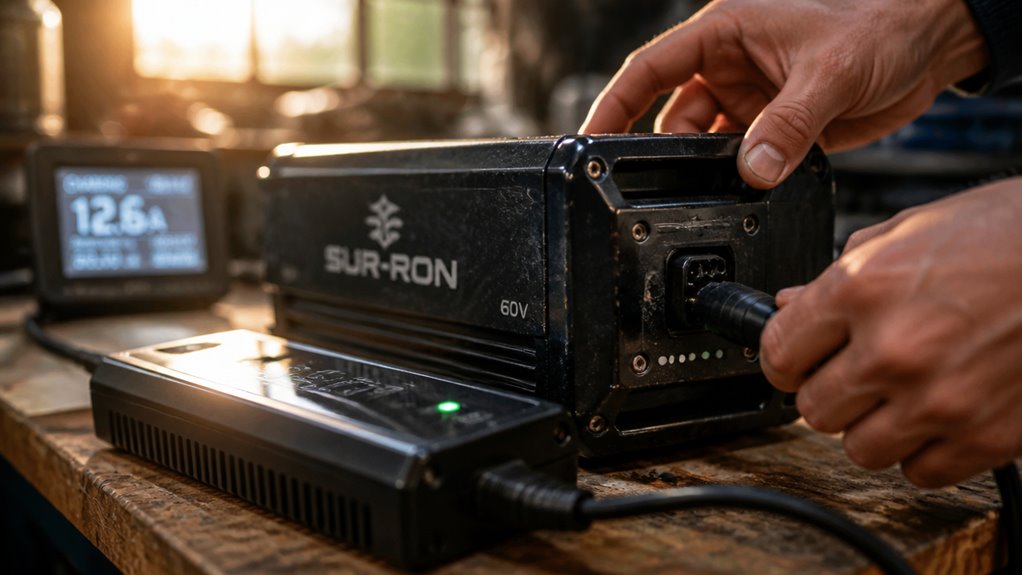
You can expect your Surron battery to take between 2.5 and 5 hours for a full charge, depending on the model and charger amperage.
For example, the Light Bee X with its 60V 40Ah pack usually charges in 3 to 4 hours using a 10A charger.
The larger Ultra Bee battery can take around 4.5 to 5 hours. Faster chargers reduce time, but battery size and condition also play key roles.
Keep exploring to understand what influences these timings further.
Key Takeaways
- Surron Light Bee X (60V 40Ah) battery typically takes 3 to 4 hours to fully charge with a 10A charger.
- Larger Surron Ultra Bee batteries require about 4.5 to 5 hours for a full charge using standard chargers.
- Partial charging from 20% to 80% usually takes around 2 to 2.5 hours, depending on battery size and charger amperage.
- Using higher amperage chargers (8A to 10A) can reduce charge time to 1.5 to 2 hours but may stress the battery.
- Charging time depends on battery capacity, charger amperage, state of charge, temperature, and battery age.
Surron Battery Charging Times: What to Expect
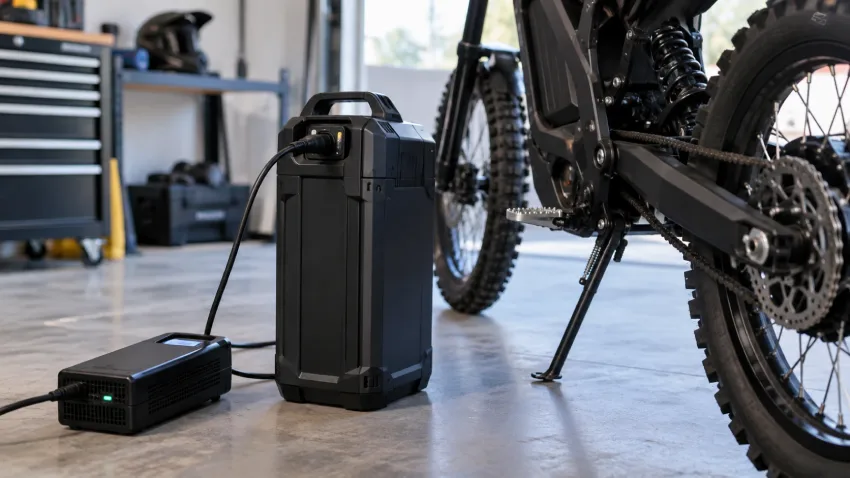
When charging a Surron battery, you can generally expect a full charge to take between 2.5 and 5 hours, depending on the model and charger amperage.
Charging a Surron battery typically takes 2.5 to 5 hours, varying by model and charger amperage.
For instance, the Light Bee X with its standard 60V 40Ah lithium-ion pack typically requires 3 to 4 hours using a 10A charger.
The Ultra Bee’s larger battery often extends charge times to around 4.5 to 5 hours.
You’ll find that faster charging mainly depends on the charger’s amperage, with 10A chargers reducing time compared to 5A options.
Partial charges, such as going from 20% to 80%, usually take about 2 to 2.5 hours.
To help prolong battery life, it is recommended to avoid full depletion and instead charge within the 20%–80% range.
Key Factors That Affect Surron Battery Charge Speed
Although many factors influence how fast your Surron battery charges, the primary ones include charger amperage, battery capacity, and the battery’s current state of charge.
Charger amperage determines the maximum current flow, while capacity dictates total energy storage. The battery’s state of charge affects how quickly it accepts power; lower charge levels generally allow for faster charging.
| Factor | Effect on Charge Speed | Notes |
|---|---|---|
| Charger Amperage | Higher amperage reduces time | Limited by charger and battery specs |
| Battery Capacity | Larger capacity increases time | Larger packs store more energy |
| State of Charge | Lower SOC speeds up charging | Charging slows near full capacity |
| Battery Temperature | Ideal temp improves efficiency | Extreme temps reduce charge rates |
| Battery Age | Older batteries charge slower | Capacity loss impacts charge acceptance |
Understanding these factors helps optimize your charging strategy. It is also important to perform charging and resetting procedures at room temperature to ensure accurate battery management system recalibration and safe operation.
How Charger Amperage Influences Charging Time?
Charger amperage directly impacts how quickly your Surron battery reaches full charge by controlling the maximum current delivered to the battery. Higher amperage chargers push more current, reducing charge time, while lower amperage chargers lengthen it.
Here’s how charger amperage influences charging time:
- A 5A charger typically takes about 3 to 4 hours for a full charge on standard 60V packs.
- A 7A charger often requires 5.5 to 6.5 hours for larger capacity batteries, due to battery chemistry limits.
- A 10A charger can reduce charging to roughly 4 to 4.5 hours for medium-capacity packs.
- Aftermarket chargers with 8A to 10A output can cut charge times to as little as 1.5 to 2 hours but may increase battery stress.
Choosing the right amperage balances speed with battery longevity. Charging above recommended rates can cause excess current damage and reduce the battery’s lifespan.
Impact of Battery Size and Voltage on Charge Duration
Because battery size and voltage directly determine the total energy capacity, they markedly influence your Surron’s charging duration.
Battery size and voltage directly impact your Surron’s total energy and charging time.
Larger batteries with higher ampere-hour (Ah) ratings store more energy, requiring longer charge times even at the same voltage.
For example, a 60V 40Ah pack holds 2.4 kWh, typically charging in 3 to 4 hours.
In contrast, bigger packs like 60V 84Ah or 72V systems demand considerably more time due to increased watt-hour capacity.
Voltage alone affects power delivery but has less impact on charge duration than total stored energy.
Consequently, if your Surron battery has a higher voltage or larger capacity, expect proportionally extended charging periods.
Understanding this relationship helps you plan charging intervals and manage downtime efficiently.
Proper charging using a smart charger designed for your battery type is essential to maximize battery life and ensure safe, efficient charging.
Comparing Charge Times: Light Bee X vs. Ultra Bee
Battery size and voltage influence charge duration, but comparing specific models like the Light Bee X and Ultra Bee reveals notable differences in charging times beyond capacity alone.
You’ll find:
- Light Bee X typically charges fully in 3 to 4 hours using a standard 10A charger.
- Ultra Bee often requires 4.5 to 5 hours for a full charge under similar conditions.
- Partial charges (20% to 80%) take about 2 hours on the Light Bee X and up to 2.5 hours on the Ultra Bee.
- Charger amperage and battery condition materially affect these times, with higher amps reducing charge duration but increasing thermal stress.
When choosing between these models, consider the trade-off between battery capacity and your charging infrastructure to optimize downtime and battery health. Proper charging habits, such as avoiding overcharging, are essential to maintain battery performance over time.
Frequently Asked Questions
Can I Use a Fast Charger Without Damaging My Surron Battery?
You can use a fast charger on your Surron battery, but you need to be cautious.
Fast charging reduces downtime but may generate extra heat and stress, potentially shortening battery lifespan if done aggressively or frequently.
Make sure your charger matches the battery’s voltage and amperage specs and avoid exceeding manufacturer recommendations.
Using a compatible, quality fast charger occasionally won’t damage your battery, but consistent high-rate charging can degrade its health over time.
How Does Ambient Temperature Affect Surron Battery Charging Efficiency?
You’ll find that ambient temperature directly impacts your Surron battery’s charging efficiency.
Charging in cold conditions slows chemical reactions inside the battery, extending charge time and reducing capacity temporarily.
In high heat, charging may speed up but risks overheating, which can degrade battery life.
Ideally, you should charge your battery between 10°C and 30°C to maximize efficiency and lifespan.
Avoiding extremes will help protect its performance.
Is It Safe to Charge the Battery Overnight Regularly?
Charging your Surron battery overnight is generally safe if you use the original charger and follow proper precautions.
Think of it like tending a delicate plant; it needs the right conditions.
Modern chargers have built-in protections against overcharging, but avoid cheap or damaged chargers.
Also, make certain the battery is in a cool, ventilated area to prevent heat buildup.
Regular overnight charging won’t harm the battery if these guidelines are strictly followed.
What Maintenance Tips Prolong Surron Battery Life During Charging?
To prolong your Surron battery life during charging, always use the recommended charger and avoid overcharging by unplugging once fully charged.
Charge in a cool, ventilated area to prevent overheating. Avoid frequent fast charging, as high amperage stresses the battery.
Keep battery contacts clean and dry, and don’t let the battery drain completely before charging.
Regularly inspect for damage and store your battery at about 50% charge if unused for long periods.
Can I Charge the Battery Partially Without Harming Its Lifespan?
Yes, you can charge your Surron battery partially without harming its lifespan.
Lithium-ion batteries used in Surron models handle partial charges well and don’t suffer from the memory effect common in older chemistries.
In fact, frequent partial charges can be better for battery longevity than deep discharges followed by full charges.
Just avoid letting the battery fully drain regularly and use a proper charger to maintain peak health.
Conclusion
When charging your Surron battery, expect wait times that can feel like an eternity if you overlook key factors. Charger amperage, battery size, and voltage all play essential roles in how quickly your battery powers up.
Knowing these variables helps you optimize charging, whether you ride a Light Bee X or an Ultra Bee. Stay informed, and you’ll never be caught off guard by unexpected downtime again.