
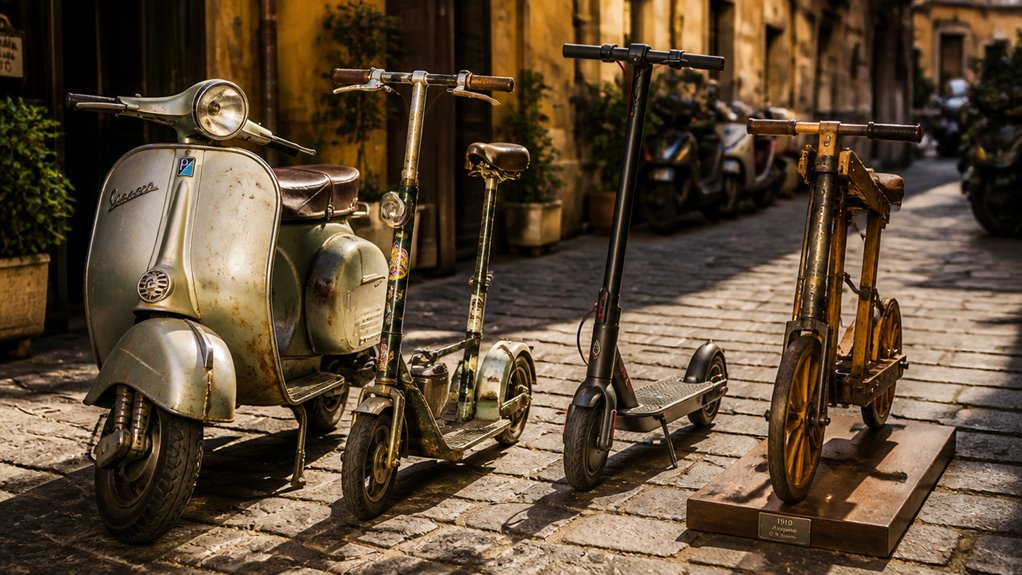
You can trace scootering back to Karl von Drais’s 1817 draisine and simple foot-powered devices. By 1915, motorized scooters like the Autoped transformed personal transport.
After World War II, scooters like Vespa shaped urban European culture, symbolizing freedom and style.
The 1999 kick-scooter revival sparked a global market boom. Freestyle scootering and electric models expanded its appeal.
Exploring further reveals how scooters evolved into versatile icons of mobility and recreation across generations.
Key Takeaways
- Scootering began with Karl von Drais’s 1817 draisine, a foot-powered two-wheeled precursor to modern scooters.
- The 1915 Autoped marked the first motorized scooter, featuring a compact engine and stand-up design.
- Postwar European scooters like Vespa revolutionized urban transport, symbolizing freedom and influencing youth culture.
- The 1999 launch of foldable aluminum kick-scooters by Micro Mobility Systems sparked a global market revival.
- Since the 2000s, freestyle scootering and electric shared scooters have expanded the sport and urban mobility options.
Early Scooter Designs and the First Motorized Models

Although scooters as we’re aware of them today weren’t formally designed until later, their origins trace back to early balance bikes and simple, foot-powered devices.
Modern scooters evolved from early balance bikes and simple, foot-powered devices long before formal designs emerged.
You’ll find that the earliest precursor was Karl von Drais’s 1817 draisine, a two-wheeled, rider-propelled machine considered a scooter ancestor.
Before formal scooter design emerged, homemade children’s scooters were common, often crafted from wooden planks, roller skate wheels, and makeshift handlebars.
These foot-powered devices were simple, inexpensive, and evolved from play equipment into practical short-distance transport.
By 1915, motorized scooters appeared, particularly the Autoped in New York City.
It featured a 155cc engine on a stand-up platform with a steering column, setting the standard for future motorized scooters as compact, engine-powered personal vehicles.
In cases where a kickstart mechanism is unavailable, the Rope or Cord Method can be used to start a scooter manually.
How Scooters Shaped Postwar Urban Culture in Europe?
When you look at postwar Europe, scooters played a crucial role in transforming urban mobility and culture.
Affordable and efficient, scooters like Vespa and Lambretta became essential for navigating crowded cities recovering from war.
You’d see them everywhere, offering practical transport for workers and students alike.
Beyond functionality, scooters shaped youth identity and style, symbolizing freedom and modernity.
Their sleek designs and distinctive sound contributed to a new urban aesthetic.
You’d also notice that scooters helped define a global image of two-wheel commuting, influencing city life and social interactions.
Ultimately, postwar scooters weren’t just vehicles; they became cultural icons that reflected economic recovery, technological innovation, and evolving social dynamics within European urban centers.
Modern scooters continue this legacy by incorporating dual suspension systems to enhance comfort and safety in urban environments.
The Kick-Scooter Revival and Market Explosion
Postwar scooters set the stage for a broader evolution in personal mobility.
Postwar scooters paved the way for transformative advancements in personal transportation and urban mobility.
The landscape shifted dramatically by the late 1990s with the reintroduction of the kick-scooter as a modern, foldable aluminum vehicle.
In 1999, Micro Mobility Systems launched this design, led by Wim Ouboter, marking a significant revival.
When Razor licensed and popularized the model in the United States, there was a global surge in demand.
Razor sold approximately five million units in 2000 alone, capturing about 65% of the market.
This boom transformed kick-scooters from niche products into mainstream youth mobility tools.
The lightweight, foldable design improved portability and usability, expanding urban short-distance travel options and recreational use.
This period laid the groundwork for the scooter’s widespread cultural and commercial success in the 21st century.
Modern scooters like the Razor A5 Lux, with its aircraft-grade aluminum frame, continue to build on this legacy by offering durable and lightweight designs ideal for diverse riders.
How Freestyle Scootering Grew From a Toy to a Sport?
Freestyle scootering took off quickly after the Razor kick-scooter boom, evolving from a casual toy into a recognized sport.
By the early 2000s, riders began pushing beyond simple scooting, developing tricks and techniques that demanded stronger, lighter scooters.
The sport grew through:
- The 2005 Montreux competition, the first official event, which formalized freestyle scootering as a competitive discipline.
- Advances in aluminum scooter designs, improving durability and trick performance, allowing for complex maneuvers.
- The rise of pro scooter brands and urban riding crews worldwide, building communities and promoting freestyle as a serious activity.
This rapid evolution marked the shift from scootering as a child’s plaything to a structured sport with dedicated athletes and events. Proper maintenance, such as applying silicone-based lubricant to moving parts, became essential for ensuring scooter performance and safety.
Electric Scooters and the Rise of Shared Urban Mobility
Although electric scooters have existed since the 1970s, their widespread adoption only became feasible with advances in lithium-ion battery technology during the 1990s.
These batteries provided the energy density and rechargeability needed for practical use. By 2017, you saw the rise of shared electric scooter services in urban areas, blending compact design with app-based access.
This model offered convenient, short-distance transport options complementing public transit. You can easily activate and ride scooters via smartphone apps, paying only for the minutes used.
Shared electric scooters reduced reliance on cars, easing traffic congestion and lowering emissions in cities. Their integration into urban mobility networks transformed how you navigate short trips, emphasizing flexibility and sustainability.
This phase marks a significant evolution in scooter history, linking technology with modern urban transport needs. Modern electric scooters often feature dual motor setups that provide powerful acceleration and hill-climbing capabilities for diverse urban terrains.
Why Scooters Continue to Appeal Across Generations?
Electric scooters have reshaped urban mobility, but scooters of all types continue to captivate people beyond just practical transportation.
You’ll find their appeal crosses generations due to several key factors:
- Versatility: Scooters serve multiple purposes, from childhood playthings to adult commuting tools. This makes them accessible and useful at any age.
- Affordability and Efficiency: Compared to many vehicles, scooters offer a cost-effective, energy-efficient way to cover short distances. This appeals to budget-conscious users.
- Cultural and Recreational Value: Scooters foster community through freestyle sports and social riding. They connect generations via shared interests and evolving styles.
Additionally, innovations such as foldable aluminum frames have enhanced portability, making scooters even more attractive for urban commuters.
These elements help guarantee scooters remain relevant, blending utility with enjoyment while adapting to technological and social changes across time.
Frequently Asked Questions
Who Invented the First Foldable Aluminum Kick Scooter?
You can credit Wim Ouboter with inventing the first foldable aluminum kick scooter.
He introduced this design in 1999 through Micro Mobility Systems.
This innovation sparked a global scooter revival, especially after Razor licensed and sold the design in the U.S.
This led to massive popularity.
What Materials Were Used in Early Homemade Children’s Scooters?
Picture a childhood workshop where wooden planks became wings, roller skate wheels spun like tiny planets, and handlebars were crafted from whatever scraps were handy.
That’s exactly what early homemade children’s scooters were made of: simple, foot-powered creations using wood, roller skate wheels, and improvised handlebars.
These materials were inexpensive and accessible, transforming playful imagination into practical vehicles you could ride around the neighborhood with ease and joy.
When and Where Was the First Scooter Competition Held?
The first scooter competition was held in 2005 in Montreux, Switzerland.
If you’re into freestyle scootering, this event marked a key moment when the activity shifted from casual riding to organized sport.
Lightweight aluminum scooters improved trick performance, making competitions more exciting.
Since then, pro brands and city riding crews have grown worldwide, turning scootering into a serious sport with a dedicated community you can join and enjoy.
How Did Lithium-Ion Batteries Impact Electric Scooter Development?
You’ll find lithium-ion batteries revolutionized electric scooters by vastly improving energy density and reducing weight. This made scooters more practical and efficient.
They allowed longer rides, faster speeds, and quicker recharging. This breakthrough enabled compact designs and reliable performance.
It fueled the rise of shared electric scooter programs starting around 2017. Without lithium-ion technology, modern electric scooters wouldn’t offer the convenience and widespread urban mobility solutions you see today.
Which Scooter Brand Dominated the U.S. Market in 2000?
You’ll find that Razor dominated the U.S. scooter market in 2000. They licensed and sold the foldable aluminum kick scooter design from Micro Mobility Systems, sparking a massive craze.
Razor sold around five million scooters that year, capturing about 65% of the market. If you were buying a scooter then, Razor was the go-to brand, turning scootering into a mainstream youth activity and mass-market phenomenon.
How Scooters Evolved From Toys to Urban Transportation
You might think of scooters like a timeless bridge, connecting generations with every push and glide.
Just as a 1910 motorized scooter sparked urban change, today’s electric models are reshaping city life again. Over 5 million shared e-scooter rides happen monthly worldwide.
Whether you’re cruising a park or steering through busy streets, scooters keep evolving. They’re more than toys; they’re tools of freedom, culture, and innovation that continue to roll forward with you.