
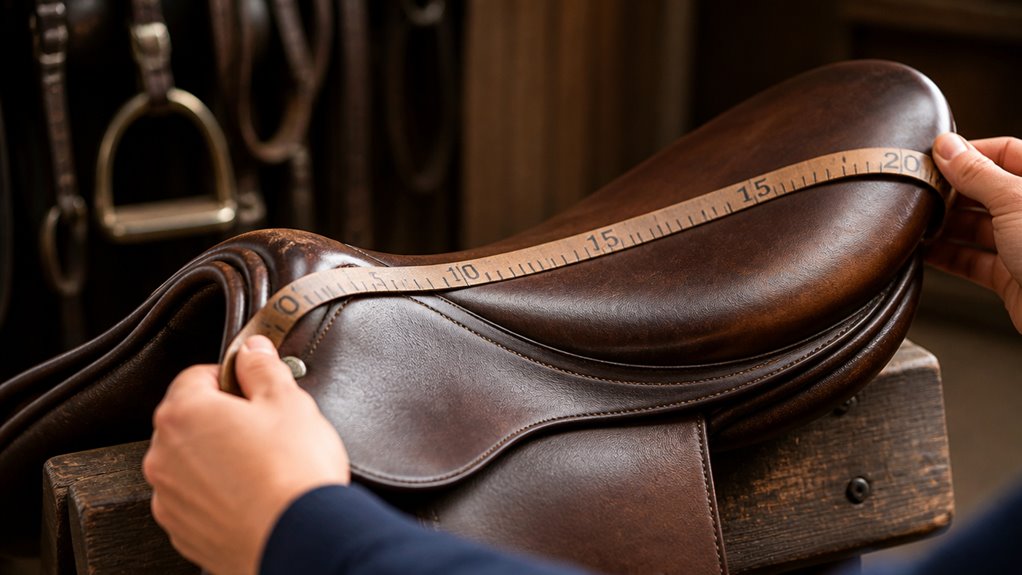
To measure your English saddle seat, locate the exact center of the pommel at the front and the cantle at the rear, both on the inner seat surface.
Use a tape measure diagonally between these two points, keeping it taut and aligned along the seat’s inner curve without sagging or stretching.
Record the measurement in half-inch increments to reflect the true rider space.
This diagonal method ensures accurate sizing essential for fit. Explore further to master precise saddle selection and fit considerations.
Key Takeaways
- Measure diagonally from the center of the pommel to the center of the cantle on the saddle’s inner seat surface.
- Identify and mark the exact center points of the pommel and cantle before placing the tape measure.
- Keep the tape measure taut and aligned flat along the seat’s inner diagonal line, avoiding edges and decorative trim.
- Record the measurement in inches, rounding to the nearest half-inch increment for accuracy.
- Use this diagonal measurement as a guideline to determine rider fit, cross-checking with the manufacturer’s sizing chart.
What English Saddle Seat Size Means for Rider Fit?

When you look into English saddle seat size, you’re basically gauging how much room you’ll have to sit comfortably and maintain control.
Understanding English saddle seat size helps ensure comfort and control while riding.
The seat size, measured diagonally from pommel center to cantle center, reflects the space available for your thigh length and hip width.
A seat too small restricts your upper leg, causing discomfort and limiting mobility.
Conversely, a seat too large reduces stability, making it harder to maintain a secure position.
Keep in mind, seat size addresses rider fit, not horse fit, and must be considered alongside saddle shape and your body proportions.
Typical adult sizes range from 16.5 to 18 inches, often in half-inch increments.
Selecting the correct size depends on your unique anatomy and riding style for ideal comfort and control.
Proper selection and maintenance of equipment, similar to the importance of using a calibrated tool in mechanical tasks, ensure optimal performance and safety.
How to Find the Pommel and Cantle on Your Saddle?
Understanding how the pommel and cantle define the boundaries of your saddle seat is key to measuring seat size accurately.
The pommel is the forward, raised part of the saddle’s seat, often marked by a metal button or nailhead at its center.
Locate this button carefully, as it serves as the starting point for measurement.
The cantle is the rear, elevated edge of the saddle, providing back support.
Identify the cantle’s midpoint along the inside curve, which acts as the endpoint for your measurement.
Both points lie on the inner seat surface, not the saddle’s outer edges or flaps.
Accurately finding these reference points makes certain your seat measurement reflects the true rider space, critical for proper fit assessment and saddle selection.
For optimal rider comfort and control, consider how ergonomics and suspension play a crucial role in overall riding experience beyond just seat size.
Step-by-Step Guide to Measuring English Saddle Seat Size
First, let’s find the exact center points of the pommel and cantle on your saddle. These will serve as your reference points.
Once you’ve got those marked, grab your tape measure and get ready to measure.
Now, align the tape measure diagonally across the inside of the seat. You want to measure from the center of the pommel to the center of the cantle.
Just make sure to follow the inner line of the seat rather than the outer edge—it’ll give you a more accurate measurement.
After you’ve got the tape in place, take a look at the number in inches. That’s your saddle’s official seat size! Easy, right?
Locate Pommel And Cantle
Locating the pommel and cantle accurately is essential for measuring an English saddle seat size correctly.
Begin by identifying the pommel’s center point, often marked by a pommel button or nailhead. This spot serves as the starting reference for your measurement.
Next, find the cantle’s center, located at the highest rear part of the saddle seat. These two points define the diagonal line along which you’ll measure the seat size.
Make certain you pinpoint these centers precisely because inaccuracies here directly affect the seat size reading.
Avoid estimating edges or decorative elements around the pommel or cantle; focus strictly on their central points.
This exact positioning guarantees a consistent and reliable measurement in inches, aligning with standard English saddle sizing methods.
For riders seeking comfort during long rides, choosing gear with adjustable sizing systems ensures a better fit and improved performance.
Align Tape Measure Properly
Place the tape measure carefully at the exact center of the pommel button or nailhead to guarantee accuracy.
Align the tape so it runs diagonally across the inside of the seat, following the natural contour between the pommel center and cantle center.
Avoid letting the tape stray along the saddle’s outer edges or trim details, as this will skew the measurement.
Keep the tape taut but not stretched, ensuring it lies flat against the seat’s inner surface without gaps or twists.
Proper alignment directly influences the precision of your measurement, which reflects the saddle seat size in inches.
By maintaining this exact tape positioning, you capture the true diagonal distance integral to correct English saddle sizing.
This differs from front-to-back methods used in other saddle types.
For accurate gear maintenance, always consider regular condition assessments to ensure safety and proper fit.
Read Measurement In Inches
Once you’ve aligned the tape measure correctly, you’ll want to carefully note the reading where it meets the center of the cantle.
This measurement, taken diagonally across the inside of the seat from the pommel’s center to the cantle’s center, represents the saddle’s seat size in inches.
Make sure to read the tape precisely, as English saddle sizes are commonly recorded in half-inch increments like 16.5, 17, or 17.5 inches.
Avoid measuring along the outer edges or decorative trims, since these can slightly distort the reading.
Remember, this measurement indicates rider space, not horse fit, so use it as a guide.
For accuracy, always cross-check with the saddle maker’s sizing chart for the specific model.
Why You Measure Diagonally Across the Saddle Seat?
Measuring diagonally across the saddle seat from the center of the pommel to the center of the cantle captures the true usable space available to the rider.
Measuring diagonally from pommel to cantle reveals the actual usable seat space for the rider.
This diagonal line reflects the actual contour and seating area inside the saddle, rather than a simple front-to-back length that could overlook the ergonomic shape.
When you measure this way, you account for the inward curve of the cantle and the natural position of the rider’s seat.
This method guarantees the measurement corresponds to the saddle’s functional seat size, expressed in inches.
By aligning the tape measure along the inner seat line, you get a more accurate figure that directly relates to rider comfort and fit.
This is essential in differentiating English saddles from Western styles that use different sizing approaches.
Proper maintenance, including regular cleaning and lubrication, ensures that saddle materials remain durable and resistant to weather damage.
Common English Saddle Seat Sizes and What They Mean?
Although English saddle seat sizes vary across models and manufacturers, you’ll typically find adult saddles ranging from about 16.5 to 18 inches.
The most common sizes are 17 and 17.5 inches, providing a balance for average adult riders.
Smaller saddles, around 15 to 16 inches, suit riders with shorter thighs or smaller frames.
Larger seats over 18 inches accommodate longer-legged riders.
Remember, the seat size reflects rider fit, not horse fit, indicating the rider’s thigh length and hip width accommodation.
A seat that’s too small restricts comfort; too large reduces rider security.
Since sizing can differ by maker, use these measurements as guidelines, not absolutes, to select a saddle that matches your body proportions and riding style.
Tips for Accurate English Saddle Seat Measurements
To make certain you get an accurate English saddle seat measurement, position the tape measure carefully from the center of the pommel button to the center of the cantle. Follow the seat’s inner diagonal line.
Keep the tape taut and aligned precisely along the seat’s inside surface, not the outer edges, to avoid skewed readings. Measure in inches, noting that seat sizes are usually recorded in half-inch increments.
Avoid measuring over trim or decorative features, which can add minor distortion. Confirm the tape’s placement at the exact center points of both pommel and cantle for consistency.
For saddles with varying riding positions, consider the wide/mid/narrow sizing to ensure a proper fit aligned with the rider’s posture.
Frequently Asked Questions
Can Saddle Seat Size Vary Between Different Manufacturers?
Yes, saddle seat size can vary between different manufacturers.
When you measure a saddle, keep in mind that each maker may interpret the pommel-to-cantle measurement slightly differently.
Their sizing charts mightn’t align perfectly. You shouldn’t rely solely on the labeled size; instead, refer to the specific maker’s sizing guide.
Test fit the saddle to make certain it matches your thigh length and riding position comfortably.
How Does English Saddle Sizing Compare to Western Saddle Sizing?
English saddle sizing differs markedly from western saddle sizing.
You measure an English saddle seat diagonally from the pommel center to the cantle center, usually in half-inch increments like 17 or 17.5 inches, reflecting rider fit.
Western saddles, however, measure seat size differently, often from the back of the horn to the top of the cantle, and use a different sizing scale.
Are Half-Inch Seat Sizes More Common Than Whole Inches?
Yes, half-inch seat sizes are more common than whole inches in English saddles.
You’ll often find sizes like 16.5, 17, and 17.5 inches because manufacturers use half-inch increments to offer a more precise fit for riders.
This finer gradation helps you select a seat that matches your thigh length and hip width better.
Improving comfort and stability compared to whole-inch sizing intervals.
What Tools Besides a Tape Measure Can Be Used for Measuring?
You might find a flexible ruler or a tailor’s measuring tape handy besides a standard tape measure when sizing an English saddle seat.
Both tools help you follow the saddle’s curved lines accurately, ensuring precise diagonal measurement from pommel center to cantle center.
A laser distance measurer could work, but it’s less practical for close, curved surfaces. Always pick tools that let you measure along the seat’s inner line without stretching or bending excessively.
How Often Should I Re-Measure My Saddle Seat Size?
You should re-measure your saddle seat size whenever you notice changes in your riding comfort or body proportions, such as weight fluctuations or muscle development.
Also, re-check after purchasing a used saddle or if the saddle undergoes repairs or modifications.
Routine re-measuring every 1-2 years helps guarantee peak fit, but adjustments depend on your individual riding frequency and physical changes.
Regular assessment maintains rider comfort and saddle performance.
Finding the Perfect English Saddle Seat Size
Now that you know how to measure an English saddle seat correctly, you’re well on your way to finding the perfect fit.
Remember, getting this measurement right is key to comfort and control. Don’t cut corners.
By measuring diagonally from pommel to cantle and understanding seat sizes, you’ll avoid the common pitfalls that throw riders off balance.
With these skills, you’ll be sitting pretty in no time, ready to ride with confidence and precision.