

A 1000W motor typically propels your e-bike or scooter between 28 and 35 mph under ideal conditions.
However, this isn’t guaranteed since factors like motor efficiency (70–90%), battery voltage, rider weight, and terrain greatly affect speed.
Efficiency losses and voltage drops reduce top speed, while heavier riders or hills can lower it further.
Understanding these variables clarifies why power alone doesn’t determine velocity.
Exploring component roles reveals how you might optimize your ride’s performance.
Key Takeaways
- A 1000W motor typically enables electric scooters or bikes to reach top speeds between 28 and 35 mph under ideal conditions.
- Motor efficiency (brushless vs. brushed) significantly influences achievable speed, with brushless motors reaching closer to 35 mph.
- Rider weight, terrain, and aerodynamics can reduce top speed by 2 to 6 mph or more from the theoretical maximum.
- Battery voltage and controller tuning affect real-world speed, with higher voltage and efficient controllers supporting faster performance.
- 1000W denotes power output, not a fixed speed; actual mph varies due to mechanical, environmental, and rider factors.
How Fast Can a 1000W Motor Make an E-Bike Go?
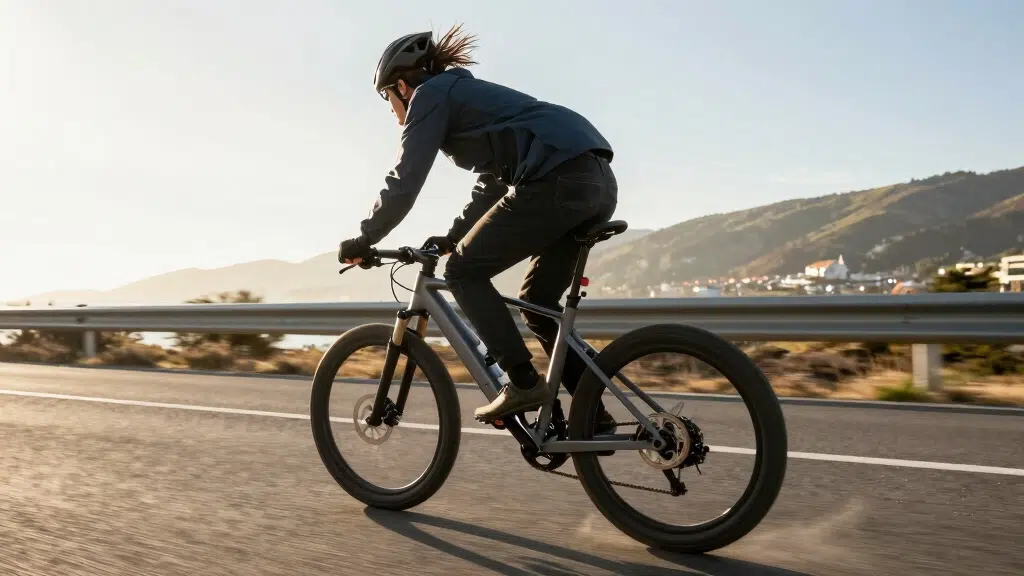
How fast can a 1000W motor propel an e-bike? Under ideal conditions, you can expect speeds between 28 and 35 mph (45 to 56 km/h).
A 1000W motor can propel an e-bike up to 28-35 mph under ideal conditions.
This range balances power output with mechanical efficiency, ensuring effective energy conversion without excessive loss. The type of motor, brushless or brushed DC, significantly affects this speed.
Brushless DC motors operate at 85-90% efficiency, enabling speeds closer to 35 mph. In contrast, brushed motors typically reach 28 mph due to 70-80% efficiency.
Keep in mind that rider weight and terrain will influence actual speed. Heavier riders or hilly terrain can reduce velocity.
The 1000W rating denotes power output, not speed directly. Consequently, factors like motor design and energy conversion efficiency critically determine your e-bike’s maximum speed.
For effective hill climbing and maintaining speed on inclines, a motor with at least 500W power is recommended.
How Does Battery Voltage Affect Your E-Bike’s Top Speed?
Because battery voltage directly influences the electrical power delivered to the motor, it materially affects your e-bike’s top speed.
Higher voltage increases the motor’s rotational speed by raising the electromotive force, enabling it to achieve higher RPMs and thereby greater velocity.
Conversely, a lower voltage reduces available power, restricting top speed output.
You’ll notice that voltage drop under load or as the battery discharges can diminish speed performance in real-time.
Additionally, the motor controller’s design dictates how efficiently it converts voltage into usable mechanical energy, but voltage remains a primary factor.
For a 1000W e-bike, maintaining peak battery voltage guarantees you reach the expected 28-35 mph range.
In contrast, undervoltage reduces speed, impairing performance and range simultaneously.
Performing a proper BMS reset can help recalibrate voltage sensors to maintain optimal speed and power output.
Why Does Motor Efficiency Matter for 1000W Speed?
Maintaining peak battery voltage sets the stage for your e-bike’s speed potential.
But motor efficiency determines how effectively that electrical power converts into mechanical output.
With a 1000W motor, efficiency directly impacts how much of that power propels your bike forward versus how much is lost as heat or friction.
Brushless DC motors, operating at 85-90% efficiency, maximize mechanical power conversion. This enables speeds up to 35 mph.
In contrast, brushed motors with 70-80% efficiency waste more energy, limiting speed to around 28 mph.
This difference means that even with identical battery voltage and power ratings, your e-bike’s top speed varies considerably based on motor design and efficiency.
Prioritizing high-efficiency motors guarantees you harness the full potential of your 1000W system for peak speed performance.
Additionally, battery capacity and riding conditions play crucial roles in sustaining those speeds over time without rapid depletion.
How Do Rider Weight and Terrain Affect 1000W E-Bike Speed?
Rider weight and terrain substantially influence the actual speed your 1000W e-bike can achieve. Both factors alter the energy demand on the motor. Heavier riders require more power to maintain speed, while rough or inclined terrain increases resistance, reducing velocity. Understanding these variables helps predict performance variations under real-world conditions. Additionally, features like high-quality suspension and tire type can impact stability and speed on diverse terrains.
| Rider Weight (lbs) | Approximate Speed Impact (mph) |
|---|---|
| 150 | +0 to -2 |
| 200 | -2 to -4 |
| 250+ | -4 to -6 |
| Terrain Type | Speed Reduction (mph) |
| Flat, smooth | Minimal (0-1 mph) |
| Hilly or uneven | Moderate (3-5 mph) |
| Off-road or steep | Significant (5+ mph) |
These factors combined can reduce top speed below the optimal 28-35 mph range.
What Limits the Maximum Speed of a 1000W E-Bike?
Several factors cap the maximum speed your 1000W e-bike can reach, despite its powerful motor rating.
Motor efficiency plays a pivotal role; brushless DC motors with 85-90% efficiency convert power more effectively than brushed motors, limiting speed to roughly 35 mph.
Battery voltage and capacity influence sustained power delivery, affecting peak velocity.
Aerodynamic drag rises exponentially with speed, requiring markedly more power to overcome at higher velocities.
Rider weight and terrain gradient increase load, reducing achievable speed.
Additionally, mechanical constraints such as drivetrain resistance and tire friction impose physical limits.
Electronic speed controllers often enforce speed caps to comply with legal regulations, further restricting top speed.
Ultimately, your 1000W motor’s theoretical output doesn’t translate directly to speed without considering these interconnected factors.
Upgrading your e-bike’s braking system with hydraulic brakes can improve safety and control at higher speeds.
How Can You Convert 1000W E-Bike Speed From Mph to Km/H?
How do you accurately convert the speed of a 1000W e-bike from miles per hour (mph) to kilometers per hour (km/h)?
You multiply the mph value by the precise conversion factor of 1.6093439, since 1 mph equals approximately 1.60934 km/h.
For example, if your 1000W e-bike reaches 30 mph, multiplying 30 by 1.60934 yields about 48.28 km/h.
This direct multiplication method is efficient and avoids intermediate conversions through meters per second, which can introduce rounding errors.
Keep in mind that the typical 1000W e-bike speed ranges from 28 to 35 mph, which translates to roughly 45 to 56 km/h when converted.
Using this straightforward approach guarantees precise speed conversions critical for performance assessment and compliance with regional regulations.
Note that a 1000W motor is considered high-performance motor power, often enabling speeds near 38 mph on electric scooters under ideal conditions.
How Can Modifications Push 1000W Speeds Beyond Factory Limits?
Releasing speeds beyond factory limits on a 1000W e-bike often involves targeted modifications to the motor, battery, and controller systems. To push past the typical 28-35 mph range, you must optimize energy delivery and mechanical efficiency.
Achieving speeds beyond factory settings on a 1000W e-bike requires precise motor, battery, and controller upgrades.
Focus on upgrading components that directly influence power output and conversion. Key modifications include:
Motor enhancement: Swap to a higher efficiency brushless DC motor to reduce energy losses and increase top speed.
Battery upgrade: Use a higher voltage battery pack to supply increased current, thereby boosting power potential.
Controller tuning: Adjust or replace the controller firmware or hardware to allow higher current flow and remove speed limiters.
These precise alterations improve power-to-speed conversion while balancing thermal management and system reliability. However, it is important to consider that battery durability can be significantly affected by increased power demands and improper maintenance.
Frequently Asked Questions
How Long Does a 1000W E-Bike Battery Typically Last per Charge?
A 1000W e-bike battery typically lasts between 20 to 50 miles per charge, depending on factors like battery capacity (measured in watt-hours), rider weight, terrain, and motor efficiency.
If you use a 48V 15Ah battery (720Wh), expect around 25-30 miles under mixed conditions.
You can extend range by riding at moderate speeds and minimizing stops.
Battery quality and riding style heavily impact overall endurance per charge.
Are 1000W E-Bikes Legal in All States or Countries?
Wondering if you can ride a 1000W e-bike anywhere? The answer is no.
Laws vary widely; some states and countries limit e-bike motors to 750W or less for legal road use.
You’ll need to check local regulations because exceeding those limits can classify your e-bike as a motor vehicle, requiring registration and licensing.
What Safety Gear Is Recommended When Riding a 1000W E-Bike?
You should always wear a certified helmet to protect your head from high-speed impacts typical with 1000W e-bikes.
Use gloves to maintain grip and reduce vibration, and wear reinforced jackets and pants with abrasion resistance.
Eye protection guards against debris at elevated speeds.
Consider high-visibility clothing and reflective gear for increased awareness.
Additionally, invest in sturdy footwear and knee and elbow pads to minimize injury risks during sudden stops or accidents.
How Does Weather Affect the Performance of a 1000W E-Bike?
Like a ship battling stormy seas, your 1000W e-bike’s performance shifts with weather.
Wind resistance can cut your speed by several mph.
Rain or wet surfaces reduce traction, affecting acceleration and braking.
Cold temperatures lower battery efficiency, decreasing power output and range.
Conversely, moderate temperatures optimize motor and battery function.
Understanding these factors helps you adjust your riding strategy for consistent performance regardless of conditions.
Can a 1000W E-Bike Be Used for Off-Road Trails?
Yes, you can use a 1000W e-bike for off-road trails, but you need to consider factors like terrain and rider weight. These elements impact performance.
The motor’s power offers strong torque, aiding in climbing steep or uneven surfaces.
However, efficiency varies by motor type and battery capacity, affecting range and speed.
Make sure the bike has appropriate suspension and tires designed for off-road conditions to maintain control and safety on rough trails.
Key Factors That Determine How Fast 1000W Really Goes
So, how fast can a 1000W motor actually make your e-bike go?
While factors like battery voltage, rider weight, and terrain play vital roles, you can generally expect speeds between 20 to 30 mph.
Motor efficiency and legal limits also cap your top speed.
Understanding these variables helps you optimize performance or safely modify your e-bike.
Ready to push your 1000W motor beyond factory limits with informed tweaks?