
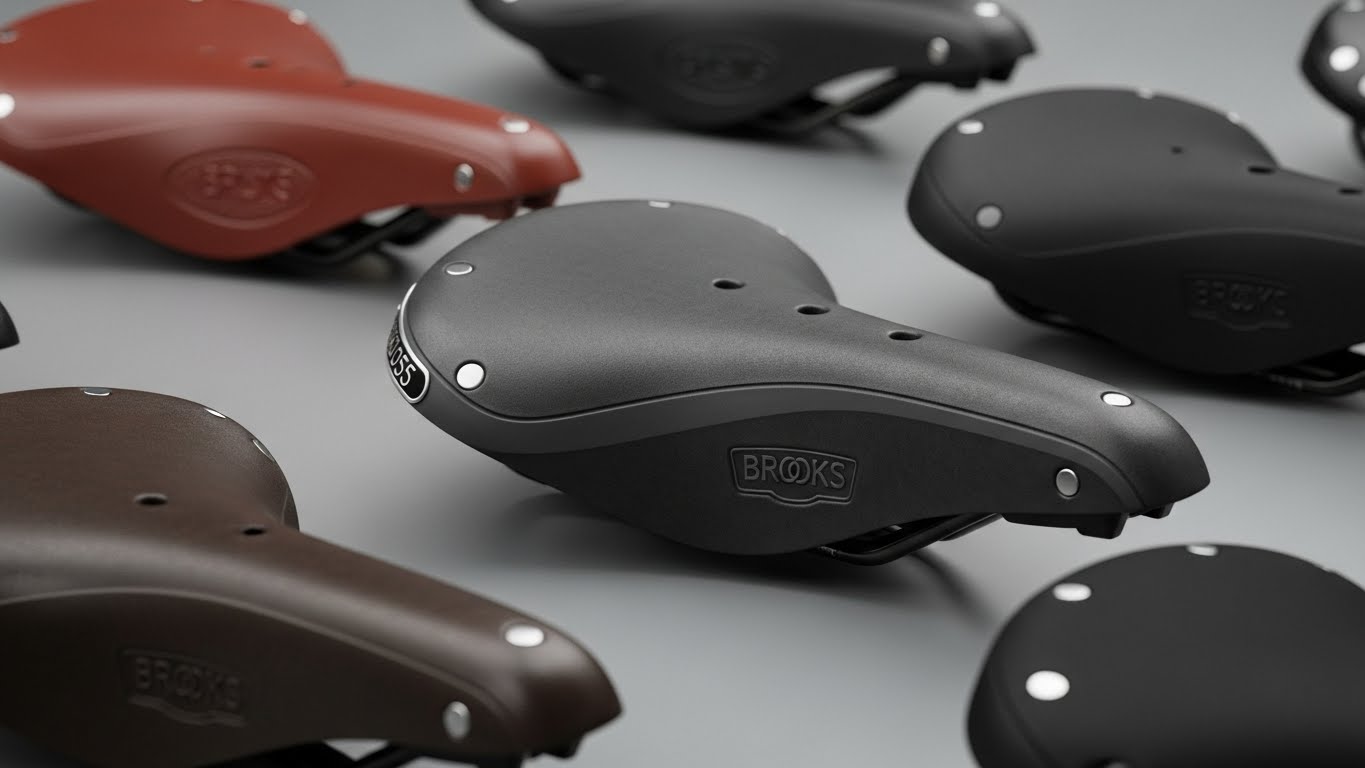
If you choose Brooks saddles, you’ll get timeless craftsmanship with models like the classic leather B17, favored for long rides.
The Cambium series offers weather-resistant comfort without break-in. Leather saddles mold to your shape for personalized fit but need regular care and a break-in period.
Exploring further reveals detailed fit, care tips, and performance insights tailored to your cycling needs.

- Rails: steel
- Shell: full-grain leather
- Seat Length: 275mm

Key Takeaways
- Brooks saddles are renowned for their high-quality leather that molds to riders’ bodies over time, providing personalized comfort after break-in.
- The Cambium series offers immediate cushioning with weather-resistant materials, requiring less maintenance than traditional leather models.
- Different models suit varied cycling styles, from the classic B17 for touring to lightweight Team Pro for racing and sprung saddles for upright riding.
- Proper maintenance, including regular application of Brooks Proofide and tensioning, is essential to preserve durability and prevent sagging or cracking.
Heritage and Brand Legacy of Brooks
Although Brooks began as a leather-goods maker in 1866, its shift to bicycle saddles in the early 1880s marked a defining moment in cycling history.
You’ll find that Brooks’ early innovation started when founder John Boultbee Brooks, dissatisfied with wooden bicycle seats, patented the first sprung saddle in 1882. This design introduced shock absorption systems to improve rider comfort over uneven terrain.
This move established Brooks as a pioneer in saddle manufacturing, distinguishing it from competitors who relied on simpler designs.
By the early 1900s, Brooks had scaled production considerably, becoming a major saddle producer with standardized models adopted by military forces.
The company’s consistent use of traditional materials like vegetable-tanned leather and steel rails sets it apart, maintaining manufacturing continuity in the West Midlands.
Brooks saddles are renowned for their ability to mold to the rider’s body after thousands of miles, enhancing comfort through long-term use (leather saddle advantage).
This heritage-backed craftsmanship continues to define Brooks’ enduring reputation for quality and durability.
Overview of Brooks Saddle Product Lines
When you explore Brooks’ saddle range, you’ll find distinct product lines designed to meet varied cycling needs.
From the durable Cambium series with its organic cotton and vulcanized rubber build to the classic B17 family favored by long-distance riders.
The Cambium offers suspended comfort with models like the C15 and wider C19, plus lightweight C13 variants with carbon rails.
The B17 family, available in steel or titanium frames, balances tradition and touring needs with multiple color and detail options.
Team Pro targets racers with lightweight titanium rails and hand-hammered rivets, while sprung models like the Flyer provide extra suspension for upright riders.
Narrower racing saddles such as the Swift and C15 All-Weather suit aggressive positions, featuring pressure relief cut-outs and synthetic materials for performance-focused cyclists.
Brooks saddles also complement well with ergonomic compression fit cycling apparel to enhance rider comfort and reduce fatigue on long rides.
Comfort and Fit Characteristics of Brooks Saddles
Understanding the fit and comfort of Brooks saddles complements their diverse product lines by addressing how each model adapts to different riding styles and body types.
Brooks offers wider saddles for upright riders, mid-width for touring, and narrow for aggressive positions, ensuring reduced thigh rubbing and peak pelvis support. Many models also come in an ‘S’ (short) version that shortens the nose by about an inch to better suit some riders’ preferences. Choosing the right saddle width and style can significantly improve comfort and performance during rides.
Leather models mold over time, delivering personalized comfort after break-in, while Cambium saddles provide immediate cushioning without break-in. Durability features of these materials also contribute to their long-lasting appeal and rider satisfaction.
Cut-out designs and coil springs enhance pressure relief and vertical compliance, benefiting sensitive riders. Incorporating safety and comfort accessories alongside the saddle can further enhance the overall cycling experience.
Nose length variations affect stability and clothing compatibility.
Material choice impacts comfort: vegetable-tanned leather breathes and molds but needs care, Cambium offers waterproof, consistent flex, and synthetic options prioritize short-term ease.
This fit and comfort diversity lets you match a Brooks saddle precisely to your riding needs.
Durability and Maintenance Requirements
Since Brooks saddles combine traditional craftsmanship with high-quality materials, their durability hinges on consistent maintenance tailored to leather care.
You’ll want to apply Proofide once or twice yearly to prevent drying, cracking, and fading while aiding break-in. Proofide application should focus mainly on the underside of the saddle, where it is most vulnerable to road spray. Regularly inspecting for signs of wear and treating affected areas enhances overall leather longevity.
For indoor storage, this frequency suffices; outdoor use demands rain covers and moisture protection on the saddle’s underside. Use multiple layers of plastic bags or fitted saddle covers to protect from rain and sun when parking outside for extended periods.
Regular cleaning with saddle soap and a Tampico brush removes grime without harming the leather, unlike abrasive bristles. Proper surface preparation and cleaning are essential for maintaining the saddle’s finish and preventing deterioration.
Maintaining proper tension is vital; tighten the tensioning nut gradually and avoid over-tightening, especially when the saddle is wet. It’s best to avoid frequent adjustments and let the saddle break in naturally to prevent damage.
Over-oiling risks softening the leather, leading to sagging, so limit hydration to weekly light treatments during riding season.
Performance Use Cases and Rider Suitability
Although Brooks saddles excel across various cycling disciplines, their design nuances cater to specific performance needs and rider preferences.
For road racers, models like the Professional, Swallow, and Swift offer low-profile, lightweight options with titanium rails under 430g. These are optimized for aggressive, forward-leaning positions. These race saddles generally have a smooth upper surface without the three top holes found on other models, enhancing aerodynamic performance.
Touring riders benefit from the B17 Standard’s 275mm length and 175mm width, providing molded comfort over long distances. It also absorbs road noise with its steel rails.
If you ride upright in the city, consider sprung models like the B72 or Flyer. These enhance bump absorption but reduce control in aggressive stances.
Brooks also tailors saddles by rider build. Smaller cyclists and women might prefer S versions or the B17 Short.
Width categories and saddle flexibility align with anatomical needs, ensuring a precise fit across riding styles.
Common Issues and Customer Feedback
When you first switch to a Brooks leather saddle, expect a break-in period that can last several hundred miles. During this time, initial discomfort such as localized pressure, chafing, and numbness is common. Many riders find padded shorts and standing on pedals help ease this phase, while regular leather conditioning accelerates shaping. However, if the saddle’s width or shape mismatches your anatomy, discomfort may persist, prompting returns or model changes. Choosing a saddle that accommodates your weight capacity can help reduce persistent discomfort.
Over time, leather can sag or stretch asymmetrically, especially under heavier riders, but periodic re-tensioning often restores fit. Some models, like the wider B72, tend to sag more noticeably due to their leather thickness and design. Exposure to rain or humidity without proper treatment risks hardening and cracking, so consistent use of Brooks Proofide and covered storage is essential.
Frequently Asked Questions
How Do Brooks Saddles Compare in Weight to Other Premium Brands?
You’ll find Brooks saddles generally heavier than many premium brands.
Their leather and Cambium models often weigh between 400–600 grams, while sprung versions can reach about 1,000 grams.
In contrast, top-tier carbon race saddles from other brands typically weigh under 250 grams, sometimes as light as 120 grams.
Brooks prioritizes durability and comfort with heavier materials, so if you want minimal weight, other brands might suit you better.
Are Brooks Saddles Suitable for Electric Bikes?
Yes, Brooks saddles suit e-bikes well. Over 80% of their eBike-specific models feature reinforced backplates supporting heavier loads.
Their standard leather saddles fit most e-bike seatposts, but you’ll want to check clamp compatibility. Leather models shape to your anatomy but need break-in and maintenance.
Alternatively, Cambium variants offer immediate comfort, waterproofing, and durability. They’re ideal for urban e-bike riders seeking low-maintenance, vibration-damping seats on upright or cargo e-bikes.
Can Brooks Saddles Be Customized With Personalized Embossing or Logos?
You can’t get official personalized embossing or custom logos directly from Brooks, as they don’t offer that standard service.
However, you can explore limited-edition collaborations or factory finishes for some uniqueness.
For true customization, independent leatherworkers can emboss or laser-engrave your saddle.
Swapping rivets or adding branded hardware offers a safer, less permanent option to personalize your Brooks saddle.
What Tools Are Needed for Brooks Saddle Tension Adjustments?
You’ll need the official Brooks chromed-steel tension spanner, weighing just 29g, designed specifically for precise adjustments.
While a 14mm open-ended wrench or a small adjustable wrench can work, they risk slipping or damaging the saddle.
Use soft leather conditioner and a cloth to prep the saddle, and make small quarter-turn adjustments to avoid over-tension.
Brooks recommends incremental turns of 90–180°, ensuring peak tension without frame stress or damage.
Do Brooks Saddles Come With Integrated Mounting for Bike Bags or Accessories?
Brooks saddles generally don’t come with integrated mounting systems like modern performance saddles.
Instead, many classic leather models feature saddle-loop eyelets or metal loops for attaching traditional leather straps or saddlebags.
Cambium and other modern Brooks saddles lack built-in accessory rails but often use standard 7mm rails, letting you attach common clamp-style bags.
For nonstandard rails, you’ll need specific adapters.
Choose Brooks Saddles for Everyday and Touring Rides
Choosing a Brooks saddle is like investing in a finely crafted timepiece. It is built to last and improve with age. You’ll appreciate the blend of heritage and modern comfort, though be ready for some break-in time and occasional maintenance.
If you value durability and timeless design over immediate plushness, Brooks delivers great value.

- Naturally Flexible Rubber: our Cambium saddles are made from flexible natural rubber, harvested from…
- All-surface absorption: designed to absorb shocks and smooth out the ride.
- Continuously comfortable: provides natural comfort for the duration of the ride in all conditions…
Last update on 2026-04-05 / Affiliate links / Images from Amazon Product Advertising API