
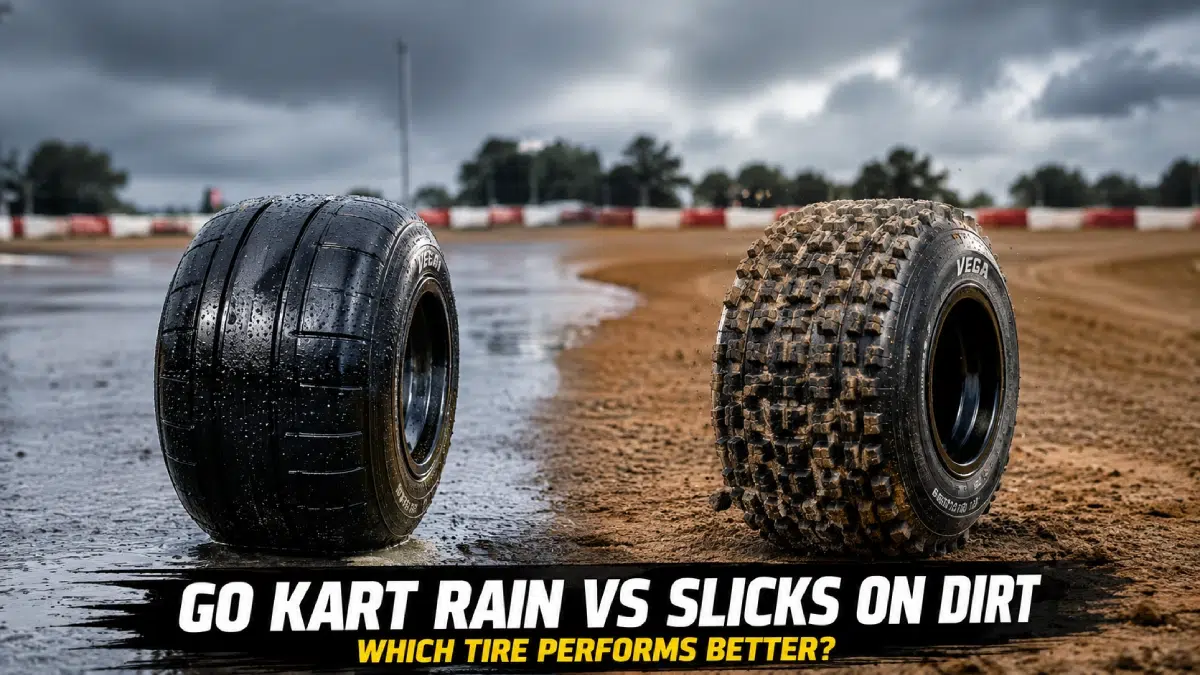
You should choose grooved tires for rainy dirt karting, as slicks lack grooves to channel water and mud. This causes hydroplaning and rapid traction loss.
Grooved tires displace wet debris, maintain contact, and offer 30–40% better cornering speeds with more control. Optimize PSI between 13–18 and pick softer compounds for grip, adjusting for wear as needed.
Proper tire setup and driving techniques further enhance performance. Keep exploring to improve your wet dirt karting strategy.

- 【Compatibility】2 Pack 145/70-6 Tires Compatible with c Baja Blitz Dirt Bug Doodle Bug DB…
- 【Optimum impact and vibration absorption】 Add comfort to your ride with these 145 70 6 tires…
- 【Puncture and abrasion resistance】 145 70-6 tubeless off-road tires offers enhanced skid and…

- Ideal for Tracks where Slick Tires are Fastest
- No More Grinding Tread Off Tires!
- Refined Tires Shape for Best Possible Performance

Key Takeaways
- Grooved tires outperform slicks in rain by efficiently channeling water and mud for better traction on wet dirt.
- Slick tires on wet dirt cause hydroplaning and rapid traction loss due to lack of grooves and poor water displacement.
- Grooved tires provide 30–40% higher cornering speeds and enable more aggressive driving on rainy dirt tracks.
- Maintaining PSI between 13–18 and using softer compounds enhances grip and tire compliance on wet dirt surfaces.
- Smooth throttle and steering inputs are crucial with slicks, while grooved tires allow heavier braking and earlier apexes.
Go Kart Rain or Slicks on Dirt: In-Depth Comparison
| Feature | Grooved Rain Tires | Slick Tires |
|---|---|---|
| Best Track Condition | Wet dirt and muddy tracks | Dry, hard-packed dirt |
| Tread Design | Deep grooves for water and mud evacuation | Smooth tread with no grooves |
| Wet Traction | Excellent | Poor |
| Hydroplaning Resistance | High | Low |
| Cornering Performance | 30–40% higher cornering speeds on wet dirt | Reduced cornering grip |
| Braking Performance | Allows heavier braking with better control | Requires earlier, gentler braking |
| Throttle Control | Supports earlier throttle application | Requires smooth, limited throttle inputs |
| Mud Shedding | Excellent | Mud builds up easily |
| Tire Pressure | 13–18 PSI recommended | Lower PSI may help but offers limited improvement |
| Tire Compound | Soft compounds for maximum grip | Softer compounds improve grip but wear faster |
| Wear Rate | More durable in wet conditions | Faster wear on wet dirt |
| Driver Confidence | High due to predictable grip | Lower due to inconsistent traction |
| Best Driving Style | More aggressive with controlled inputs | Smooth and conservative |
| Ideal Race Conditions | Rain, wet clay, slippery dirt | Dry, compacted tracks only |
| Main Advantage | Superior traction, stability, and control in rain | Maximum grip only on dry surfaces |
| Main Drawback | Less effective once the track becomes fully dry | Hydroplanes easily and loses traction on wet dirt |
Choosing the Right Tires for Rainy Dirt Karting
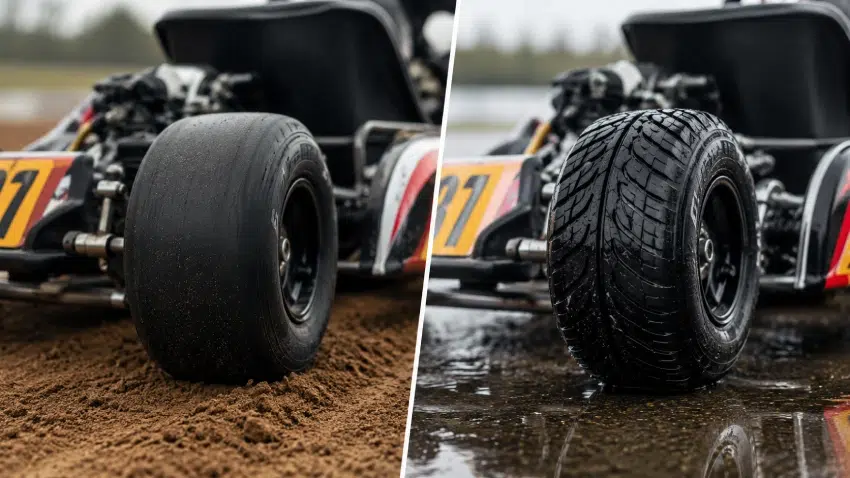
When karting on rainy dirt tracks, how do you guarantee ideal traction and control? You must select tires designed to handle moisture and loose surfaces efficiently.
Grooved tires excel by displacing mud and wet dirt, allowing the treads to bite into the underlying substrate. This tread pattern prevents dirt buildup on the tire surface, maintaining consistent grip throughout your run.
Using slick tires in these conditions compromises traction because they can’t channel water or debris, causing the kart to float and lose control. Moreover, grooved tires adapt better to variable moisture levels, providing 30–40% higher cornering speeds on wet dirt tracks.
To optimize your performance and safety, choose tires with aggressive tread designs tailored for rainy dirt conditions rather than relying on slicks. Tires with non-directional tread patterns are especially effective in preventing mud buildup and maintaining traction in such environments.
Why Slick Tires Struggle on Rainy Dirt Karting Tracks?
While grooved tires provide superior grip on wet dirt by effectively channeling water and displacing mud, slick tires face significant challenges under these conditions.
Slicks lose traction quickly because they lack grooves to evacuate water and mud, causing them to hydroplane over the surface.
This drastically reduces mechanical interlocking with the dirt, especially on clay-heavy tracks.
Additionally, slicks wear out faster due to abrasive wet soil and fail to maintain a consistent contact patch.
Key reasons slick tires struggle on rainy dirt include:
- Inability to channel water, leading to surface hydroplaning
- Reduced grip from floating over loose, wet soil
- Rapid tread wear caused by abrasive wet dirt
- Decreased mechanical interlocking on slippery clay-rich surfaces
Tire designs with self-cleaning tread blocks are essential for maintaining traction in such slippery conditions.
How Grooved Tires Improve Traction on Wet Dirt Karting Tracks?
Utilizing grooved tires on wet dirt karting tracks markedly enhances traction by actively channeling water and displacing mud from the contact patch.
The grooves prevent hydroplaning by evacuating water, allowing the tread to maintain direct contact with the soil. This design also reduces mud buildup that would otherwise diminish grip.
You’ll notice the tread patterns mechanically interlock with the uneven, slippery surface, increasing lateral and longitudinal grip compared to slicks.
Data confirms grooved tires improve cornering speeds by 30–40% on wet dirt, highlighting their superior stability under variable moisture conditions.
By maintaining consistent traction, grooved tires allow you to apply throttle and braking inputs more aggressively without losing control.
This optimizes performance on challenging wet dirt tracks where slick tires fail to provide sufficient grip.
Additionally, tires with directional tread blocks effectively channel water and debris away, further enhancing wet traction and control.
Setting PSI and Tire Compounds for Wet Dirt Karting
Optimize your wet dirt karting performance by carefully adjusting tire PSI and selecting the appropriate compound.
Lowering PSI to the 13–18 range increases the tire’s contact patch, enhancing grip on uneven, moist dirt surfaces.
Avoid pressures above 20 PSI as they reduce compliance and traction.
Use soft compounds to maximize adhesion to wet, abrasive soil.
However, consider harder compounds for longer races to balance wear resistance.
Key settings to optimize traction:
- Maintain PSI between 13–18 for ideal footprint
- Choose soft compounds for superior grip in wet conditions
- Monitor tire temperature to prevent pressure fluctuations
- Adjust compound hardness based on race duration and track abrasiveness
These precise adjustments guarantee consistent traction and durability on wet dirt tracks. Proper tire selection and pressure settings, combined with all-terrain tires, can significantly improve performance on varied surfaces.
Driving Tips for Rainy Dirt Karting With Slick and Grooved Tires
You’ll often need to adjust your driving style considerably when racing in rainy dirt conditions, especially depending on whether you’re running slick or grooved tires.
With slicks, reduce throttle input to minimize wheel spin since these tires lack grooves to displace water or mud. This causes flotation and reduced grip.
Smooth, gradual steering inputs prevent loss of traction on slippery surfaces.
Conversely, grooved tires allow heavier braking and earlier apexes due to superior water displacement and mechanical grip.
You can push harder through corners but still maintain control by avoiding abrupt maneuvers that disturb the dirt surface.
In both cases, adopt conservative starts and increase following distances to mitigate incident risks on wet, low-traction dirt.
This ensures stability and consistent lap times despite challenging conditions.
Proper tire balance is essential to maintain better traction and control in such slippery conditions.
Frequently Asked Questions
How Does Dirt Composition Affect Tire Wear on Rain-Soaked Tracks?
Dirt composition on rain-soaked tracks acts like a double-edged sword, sharply influencing tire wear.
Clay-heavy soils become slippery and abrasive when wet, accelerating tread degradation and demanding deep grooves for better grip.
Loose topsoil with moisture turns into a sticky paste that clogs tires, increasing friction and wear.
You’ll need softer compounds at lower PSI to manage heat buildup while maintaining adhesion, or risk rapid tire deterioration and compromised control.
What Are the Cost Differences Between Rain and Slick Tires for Dirt Karting?
You’ll find slick tires cost around $160–$180 per set, but they wear out quickly on dirt, often needing replacement after 3–4 races.
Rain or grooved tires, priced near $200, offer better durability and heat dissipation, reducing long-term expenses.
Although initially pricier, investing in treaded rain tires saves money by lasting longer.
This minimizes frequent purchases compared to slicks that degrade faster due to abrasive dirt conditions.
Can Slick Tires Be Used Safely on Dry, Compacted Dirt After Rain?
You can use slick tires on dry, compacted dirt after rain, but only if the surface is extremely smooth and moisture has evaporated thoroughly.
Studies show cornering speeds drop 30–40% on dirt with slicks versus grooved tires, indicating slicks lose grip easily on loose or damp dirt.
You’ll need lower PSI and softer compounds to maximize contact, but be wary. Slicks wear out 2–3 times faster and offer limited traction in variable conditions.
How Does Tire Temperature Management Differ Between Slick and Grooved Tires?
You’ll find slick tires heat up faster on dirt due to higher friction and smaller tread surface. This demands close pressure monitoring to avoid overheating and grip loss.
Grooved tires disperse heat better through tread channels, maintaining more stable temperatures during runs.
Managing PSI is vital: slicks need softer, lower pressures to increase contact.
Grooved tires tolerate slightly higher PSI without compromising heat dissipation, helping you sustain traction longer.
What Maintenance Is Required to Extend Tire Life on Wet Dirt Surfaces?
You know what they say: “An ounce of prevention is worth a pound of cure.” To extend tire life on wet dirt, regularly clean grooves to prevent mud buildup.
Maintain peak PSI (13–18) and monitor tire temperature closely. Rotate tires to ensure even wear and avoid aggressive throttle inputs that cause excessive spin.
Store tires in a cool, dry place to prevent compound degradation. Consistent maintenance minimizes wear and preserves traction.
- 【Compatibility】2 Pack 145/70-6 Tires Compatible with c Baja Blitz Dirt Bug Doodle Bug DB…
- 【Optimum impact and vibration absorption】 Add comfort to your ride with these 145 70 6 tires…
- 【Puncture and abrasion resistance】 145 70-6 tubeless off-road tires offers enhanced skid and…
- Ideal for Tracks where Slick Tires are Fastest
- No More Grinding Tread Off Tires!
- Refined Tires Shape for Best Possible Performance
Choose the Right Tire for Wet Dirt Racing Conditions
When you switch from slicks to grooved tires on wet dirt, it’s like swapping ice skates for cleats. You gain grip where you’d otherwise slip.
Studies show grooved tires reduce lap times by up to 15% in rain by channeling water and improving traction. Remember, just as footing changes in mud, your tire choice must adapt.
Mastering this nuance sharpens your edge, ensuring you don’t just race; you dominate in wet conditions.
Last update on 2026-10-07 / Affiliate links / Images from Amazon Product Advertising API