
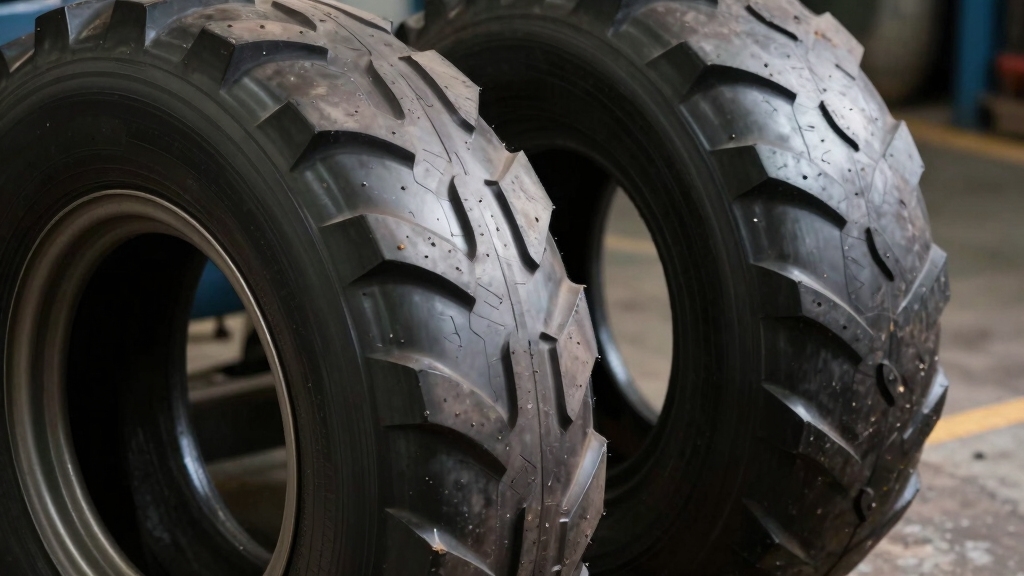
You’ll find pneumatic tires use air-filled cavities for superior ride comfort, lower rolling resistance, and better traction by flexing under load.
Solid tires, made from dense rubber, win on durability, resisting punctures and lasting about three times longer with minimal maintenance.
However, they add weight and increase energy consumption due to higher rolling resistance.
Your choice balances comfort and fuel efficiency against toughness and reduced downtime. Explore further to understand how these factors affect your operation’s cost and performance.
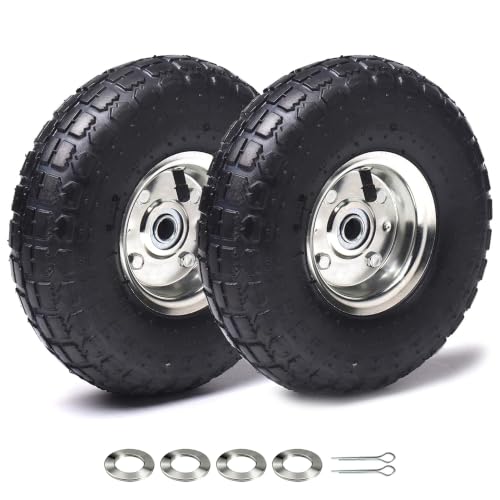
- UNIVERSAL 4.10/3.50-4 PNEUMATIC TIRE ASSEMBLY: 10″ pneumatic tire and wheel assembly…
- EASY REPLACEMENT FOR 5/8″ AXLE WHEELS: Pre-mounted pneumatic tire on durable steel rim, designed as…
- PREMIUM RUBBER & HEAVY-DUTY LOAD CAPACITY: Crafted from high-quality natural rubber with inner tube…
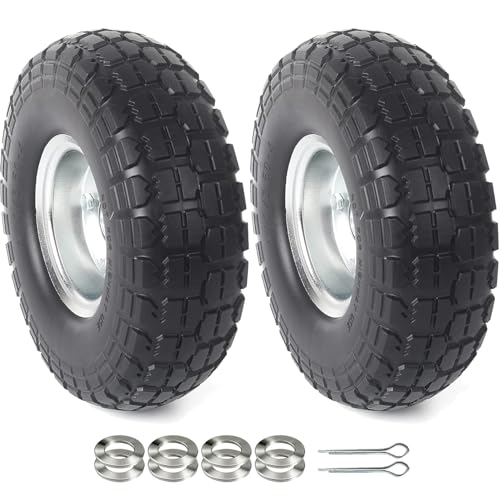
- HEAVY-DUTY 10″ FLAT FREE TIRE & WHEEL: Designed as a 4.10/3.50-4 solid replacement tire and wheel…
- FLAT FREE SOLID TIRE – NO AIR REQUIRED: Solid rubber compound construction eliminates flats…
- SUPPORTS UP TO 500 LBS DYNAMIC LOAD: Each tire supports dynamic loads up to 500 lbs, making it…
Key Takeaways
- Pneumatic tires offer better shock absorption, ride comfort, and traction by flexing and adjusting air pressure to terrain conditions.
- Solid tires provide superior durability, puncture resistance, and last approximately three times longer than pneumatic tires.
- Solid tires require minimal maintenance, eliminating flat repairs and air pressure checks, reducing downtime and operational costs.
- Pneumatic tires have lower rolling resistance, improving fuel efficiency, while solid tires increase rolling resistance and energy consumption.
- Solid tires deliver stable handling on hard surfaces and enhanced load stability, whereas pneumatic tires perform better on uneven terrain.
Pneumatic Tires or Solid Tires: Complete Side-by-Side Comparison
| Feature | Pneumatic Tires | Solid Tires |
|---|---|---|
| Construction | Air-filled rubber tire | Solid rubber construction |
| Ride Comfort | Excellent shock absorption | Firmer ride quality |
| Durability | Good | Excellent |
| Puncture Resistance | Vulnerable to flats | Flat-free and puncture-proof |
| Maintenance | Requires air pressure checks and repairs | Minimal maintenance |
| Lifespan | Shorter | Approximately 3× longer |
| Rolling Resistance | Lower | Higher |
| Fuel Efficiency | Better | Lower due to added resistance |
| Weight | Lighter | Heavier |
| Traction | Superior on uneven terrain | Better on smooth, hard surfaces |
| Terrain Adaptability | Excellent | Limited |
| Load Stability | Good | Excellent |
| Handling on Rough Ground | Better | Harsher ride |
| Downtime Risk | Higher due to punctures | Very low |
| Repairability | Can be patched or repaired | Usually requires replacement if damaged |
| Operating Cost | Higher maintenance costs | Lower long-term maintenance costs |
| Best For | Lawn equipment, carts, wheelbarrows, off-road use | Construction sites, warehouses, industrial equipment |
| Main Advantage | Comfort, traction, and fuel efficiency | Durability and zero flat tires |
| Main Drawback | Prone to punctures and maintenance needs | Heavier with a rougher ride |
Construction Differences Between Pneumatic and Solid Tires

While both pneumatic and solid tires serve similar purposes, their fundamental construction differs markedly, impacting their performance and application.
Pneumatic tires consist of an air-filled cavity enclosed by flexible rubber and reinforced sidewalls. This design allows them to compress and absorb shocks.
In contrast, solid tires are made from dense rubber compounds molded into a singular, solid structure. This eliminates any air space, granting solid tires superior resistance to punctures, cuts, and abrasions.
Their tear strength and sidewall durability markedly exceed those of pneumatic counterparts. However, pneumatic tires’ air cushioning offers adaptability in shape and pressure, enhancing traction and ride comfort.
Understanding these structural differences helps you select the appropriate tire type based on operational demands. This balances durability, maintenance, and terrain adaptability without conflating performance characteristics discussed elsewhere.
Additionally, polyurethane wheels provide shock absorption and vibration damping that can improve ride stability on uneven terrain compared to traditional solid tires.
Durability Comparison for Tough Jobsites
The distinct construction of pneumatic and solid tires directly influences their durability in demanding jobsite environments. Solid tires outlast pneumatic ones by roughly three times due to their specialized rubber compounds and reinforced sidewalls.
They resist punctures, cuts, and abrasions better, making them ideal for harsh conditions. Pneumatic tires, filled with air, are more vulnerable to flats and sidewall damage, which limits their lifespan on rough terrains.
| Feature | Solid Tires | Pneumatic Tires |
|---|---|---|
| Tear Strength | Over twice that of pneumatic | Moderate |
| Puncture Resistance | High, flat-free operation | Low, prone to flats |
| Load Handling | Excellent under heavy loads | Good but vulnerable to damage |
Using a heat shield can similarly protect tires and other components from damage caused by excessive heat exposure on tough jobsites.
With this, you can confidently choose tires that match your jobsite durability needs.
Maintenance Needs: Pneumatic vs Solid Tires
Because solid tires eliminate the need for air pressure checks and repair from flats, they markedly reduce maintenance demands compared to pneumatic tires.
Solid tires cut maintenance by removing air pressure checks and flat repairs.
You won’t have to monitor inflation levels regularly or address punctures, which materially lowers downtime and repair costs.
Solid tires also bypass the risk of deflation in debris-heavy environments, maintaining consistent performance without intervention.
In contrast, pneumatic tires require frequent pressure monitoring and patching to prevent operational disruptions.
Additionally, pneumatic tires often need sealants or slime to mitigate flats, adding complexity to upkeep.
If you prioritize minimal maintenance and reliability under harsh conditions, solid tires offer a clear advantage by eliminating inflation-related tasks and flat repairs.
This streamlines your maintenance schedule and reduces overall labor and material expenses.
However, pneumatic tires with folding bead construction offer enhanced ride comfort and performance benefits that solid tires cannot match.
Performance and Handling of Pneumatic and Solid Tires
Understand that solid and pneumatic tires deliver distinctly different performance characteristics that directly impact vehicle handling and operational efficiency.
When you choose between them, consider how each tire affects your vehicle’s dynamics and energy use.
Pneumatic tires offer lower rolling resistance, improving fuel efficiency and providing smoother rides on uneven surfaces.
Solid tires maintain their shape consistently, providing stable handling on hard, flat surfaces but increase rolling resistance and vehicle weight, slightly reducing agility.
Pneumatic tires flex under load, absorbing shocks and vibrations.
Solid tires resist deformation, enhancing load stability.
Increased weight of solid tires can affect acceleration and maneuverability.
Pneumatic tires reduce energy consumption due to lower rolling resistance.
Solid tires provide consistent handling without air pressure concerns.
Your choice depends on your operational priorities and terrain.
Additionally, fat tire electric scooters with dual suspension systems enhance ride comfort and stability, which can influence the performance differences between pneumatic and solid tires.
Traction Differences: Which Tire Grips Better?
When you evaluate traction performance, pneumatic tires generally outperform solid tires due to their ability to deform and increase contact area with the ground.
This deformation enables pneumatic tires to adapt to varying surfaces, enhancing grip, especially on rough or uneven terrain.
By adjusting air pressure, you can optimize traction for different conditions, such as soft soil or wet environments, where pneumatic turf and super-float tires excel.
In contrast, solid tires maintain a rigid profile, limiting their ability to conform to terrain irregularities, which reduces their grip effectiveness.
Consequently, while solid tires offer durability, they provide inferior traction, making them less suitable for off-road or challenging surfaces.
If traction is your priority, pneumatic tires deliver superior performance through adaptive contact and enhanced surface engagement.
For off-road vehicles like dirt bikes, choosing components such as lightweight aluminum sprockets can further improve handling and traction by reducing rotational mass and enhancing acceleration.
Cost, Lifespan, and Fuel Efficiency Compared
When it comes to choosing tires, you might notice that solid tires are cheaper upfront and can last about three times longer than pneumatic ones. This means you won’t have to replace them as often, which can really save you on maintenance costs.
On the flip side, pneumatic tires usually have lower rolling resistance. This can actually lead to better fuel efficiency, especially since solid tires tend to be heavier and create more resistance. Additionally, pneumatic tires often feature puncture-resistant technology that enhances durability while maintaining performance.
Initial Purchase Expense
Choosing between pneumatic and solid tires requires careful consideration of initial purchase expenses, including cost, lifespan, and fuel efficiency. You’ll find that:
Solid tires generally have a lower upfront cost but provide extended lifespan, reducing long-term expenses.
Pneumatic tires may cost more initially and are prone to punctures, increasing maintenance and replacement costs.
Solid tires’ heavier weight raises rolling resistance, slightly decreasing fuel efficiency.
Pneumatic tires offer lower rolling resistance, improving fuel economy but require frequent air pressure checks.
Over time, solid tires reduce total ownership cost through durability, offsetting their initial price advantage.
Similar to the maintenance demands of brake systems, tire type selection impacts ongoing upkeep and operational efficiency.
Tire Longevity Benefits
Beyond initial purchase expenses, examining tire longevity reveals significant differences in cost efficiency, lifespan, and fuel consumption between pneumatic and solid tires.
Solid tires last roughly three times longer due to durable rubber compounds and stronger sidewalls, reducing replacement frequency and maintenance costs.
Pneumatic tires, while lighter and offering lower rolling resistance, demand frequent pressure checks and repairs. This increases downtime and expenses.
| Aspect | Pneumatic Tires | Solid Tires |
|---|---|---|
| Lifespan | Moderate; prone to punctures | Approximately 3× longer |
| Maintenance Cost | Higher; repairs and pressure checks | Lower; no inflation or flats |
| Fuel Efficiency | Better due to lower rolling resistance | Increased due to heavier weight |
Choosing solid tires minimizes operational interruptions and total ownership costs despite slightly reduced fuel efficiency. Additionally, solid tires with durable rubber compounds provide enhanced wear resistance, making them ideal for rough terrains such as grassy or uneven surfaces.
Impact On Fuel
Evaluating the impact of tire type on fuel consumption, cost, and lifespan reveals critical trade-offs. When choosing between pneumatic and solid tires, you’ll notice differences affecting operational efficiency and expenses.
Pneumatic tires offer lower rolling resistance, improving fuel efficiency. Solid tires have higher rolling resistance, increasing energy consumption.
Solid tires last approximately three times longer, reducing replacement frequency. Pneumatic tires require regular maintenance and repair, raising total costs.
Solid tires’ durability lowers downtime and maintenance, cutting operational expenses. While pneumatic tires enhance fuel economy due to lighter weight and flexibility, solid tires provide cost benefits through longevity and reduced maintenance.
Additionally, pneumatic tires generally weigh more than solid tires because of their shock absorption benefits, which can also influence energy consumption.
Your choice depends on balancing fuel efficiency against durability and maintenance demands.
Frequently Asked Questions
Can Solid Tires Be Repaired if Damaged?
You generally can’t repair solid tires once they’re damaged because their dense rubber compounds and structure resist puncture repair methods.
Instead, you replace them when cuts or chunks occur since patching solid tires isn’t practical or reliable. Their design prioritizes durability and resistance over reparability.
You’ll avoid downtime from flats but plan for replacement after significant wear or damage.
This ensures consistent performance without complicated repairs.
Are Pneumatic Tires Better for High-Speed Applications?
You’ll find pneumatic tires better suited for high-speed applications because they offer lower rolling resistance, enhancing fuel efficiency and handling.
Their air cushioning absorbs shocks, providing smoother rides and reducing heat buildup at speed.
Solid tires, while durable, generate more friction and heat, compromising stability and increasing energy consumption.
How Do Temperature Extremes Affect Each Tire Type?
You might think temperature extremes would shred any tire, but solid tires laugh off the heat and cold like a champ. They resist cracking and hardening thanks to their robust rubber compounds.
Pneumatic tires, however, can be drama queens. Extreme cold stiffens their rubber and reduces air pressure, while heat risks overexpansion and blowouts.
Which Tire Type Is Quieter During Operation?
You’ll find solid tires are quieter during operation because their dense, solid rubber construction dampens vibrations and reduces noise from surface contact.
Pneumatic tires, filled with air, tend to produce more sound due to their flexible sidewalls flexing and air compressing with each rotation.
If noise reduction is critical in your environment, solid tires provide a more silent ride, especially on hard, smooth surfaces where noise transmission is otherwise amplified.
Do Solid Tires Impact Vehicle Suspension Requirements?
You’ll feel like you’re riding a brick wall without suspension upgrades when using solid tires!
Because they lack air cushioning, solid tires transmit more vibrations and shocks directly to the vehicle frame.
This means your suspension system has to work harder or be specially tuned to absorb harsher impacts.
Without adjustments, your ride will be rougher, and suspension components might wear faster, demanding more robust, shock-absorbing solutions.
- UNIVERSAL 4.10/3.50-4 PNEUMATIC TIRE ASSEMBLY: 10″ pneumatic tire and wheel assembly…
- EASY REPLACEMENT FOR 5/8″ AXLE WHEELS: Pre-mounted pneumatic tire on durable steel rim, designed as…
- PREMIUM RUBBER & HEAVY-DUTY LOAD CAPACITY: Crafted from high-quality natural rubber with inner tube…
- HEAVY-DUTY 10″ FLAT FREE TIRE & WHEEL: Designed as a 4.10/3.50-4 solid replacement tire and wheel…
- FLAT FREE SOLID TIRE – NO AIR REQUIRED: Solid rubber compound construction eliminates flats…
- SUPPORTS UP TO 500 LBS DYNAMIC LOAD: Each tire supports dynamic loads up to 500 lbs, making it…
Solid Tires vs. Pneumatic Tires: Pros, Cons, and Best Uses
So, if you enjoy the thrill of unexpected flats and the joy of constant maintenance, pneumatic tires are your best bet.
But if you prefer actually getting work done without tire drama, solid tires might just save your day and your sanity.
Either way, you’ll master the art of balancing cost, durability, and performance. After all, who said choosing the right tire wasn’t a high-stakes game of mechanical roulette?
Last update on 2026-10-27 / Affiliate links / Images from Amazon Product Advertising API