
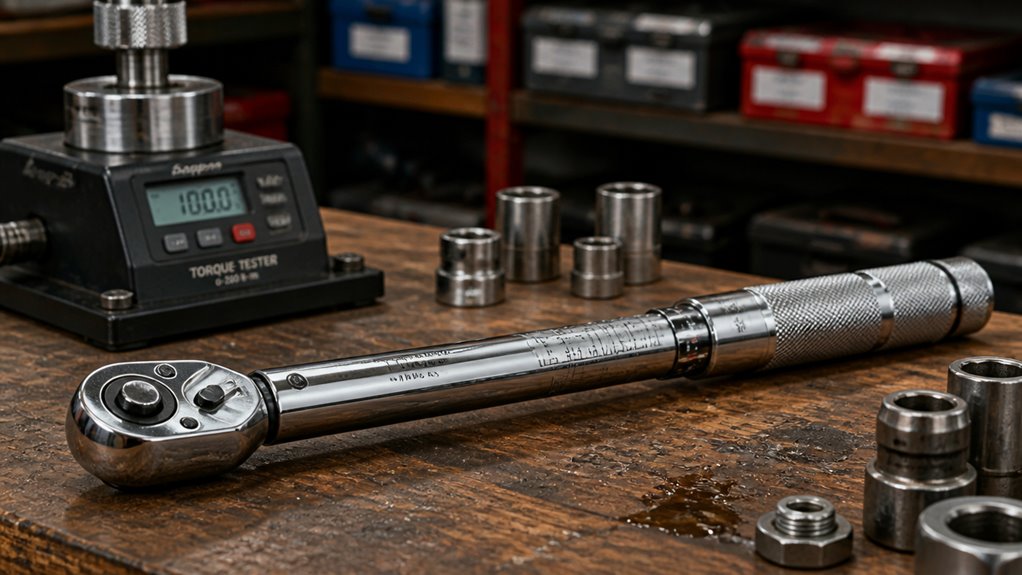
You should calibrate your torque wrench at least every 12 months or after 5,000 cycles, whichever comes first.
More frequent calibration is needed if your wrench experiences impacts, overloads exceeding 25% of max torque, extreme environmental exposure, or inconsistent torque readings.
Heavy use, harsh conditions, or industry-critical applications demand shorter intervals, sometimes as often as every six months.
Following these guidelines guarantees precision and compliance, but understanding how usage, environment, and manufacturer advice influence your schedule is essential for peak accuracy.
Key Takeaways
- Torque wrenches should be recalibrated at least every 12 months or after 5,000 usage cycles, whichever comes first.
- Immediate recalibration is essential after drops, impacts, overloads, or exposure to extreme environmental conditions.
- Heavy usage (over 3,000 cycles/year) requires recalibration every 3 to 6 months to maintain accuracy.
- Industry standards and manufacturer guidelines may mandate stricter intervals, sometimes requiring biannual calibration.
- Regular inspection for physical damage, inconsistent readings, or faded markings also triggers the need for recalibration.
When And Why To Calibrate Your Torque Wrench?

Regularly calibrating your torque wrench guarantees it delivers accurate torque readings critical for maintaining joint integrity and safety.
You need to calibrate whenever you notice performance inconsistencies or after any event that could affect accuracy, such as drops, impacts, or overloading beyond 25% of the maximum setting.
Environmental factors like extreme temperature, humidity, or exposure to moisture also justify immediate recalibration to prevent drift.
Additionally, if your wrench has a history of drifting out of tolerance, schedule more frequent checks.
Proper calibration timing depends on usage intensity, operating conditions, and risk level of your applications.
Aim to calibrate your torque wrench at least once a year or more frequently if used often or for critical tasks, following manufacturer guidelines for calibration intervals and procedures.
Standard Calibration Intervals: The 12-Month Or 5,000-Use Rule
After identifying when recalibration is necessary based on tool condition and usage factors, you should also adhere to established standard intervals to maintain accuracy.
Regularly assess tool condition and usage, then follow standard recalibration intervals to ensure ongoing accuracy.
The widely accepted benchmark, per ISO 6789 and BS EN ISO 6789:2017, prescribes recalibration every 12 months or 5,000 cycles, whichever occurs first.
This interval serves as a baseline rather than a rigid maximum, reflecting a balance between tool longevity and precision retention.
Manufacturers and calibration providers commonly endorse this timeframe, applying it equally to torque wrenches and torque screwdrivers.
By following this rule, you ensure your tool remains within tolerance under typical conditions.
However, keep in mind that this standard interval assumes normal usage and environment and doesn’t replace condition-based recalibration triggered by specific events or operational stressors.
How Frequent Use Affects Torque Wrench Calibration?
Frequent use directly accelerates torque wrench calibration drift by increasing mechanical wear and internal component stress.
When you use your torque wrench repeatedly, its internal springs and ratchets degrade faster, causing measurement inaccuracies.
The standard 12-month or 5,000-cycle calibration interval suits typical use.
However, heavy daily use demands shorter intervals to maintain precision.
| Usage Frequency | Calibration Interval | Impact on Accuracy |
|---|---|---|
| Occasional (<1000 cycles/year) | 12 months or 5,000 cycles | Minimal drift |
| Moderate (1000-3000 cycles/year) | 6-9 months | Noticeable drift possible |
| Heavy (>3000 cycles/year) | 3-6 months | Significant drift likely |
Regular routine maintenance and inspection of mechanical components can help identify issues early, preventing further damage and ensuring ongoing tool accuracy.
When Environment And Handling Affect Calibration?
Although torque wrenches are designed for durability, environmental conditions and handling practices markedly impact their calibration stability. Exposure to extreme temperatures, high humidity, moisture, or saltwater accelerates internal component wear and sensor drift, compromising accuracy.
Similarly, impacts from drops or collisions cause immediate mechanical deformation or misalignment, necessitating prompt recalibration. Improper storage, such as leaving the tool in corrosive or dusty environments, further degrades performance.
Handling overloads beyond 25% of the maximum torque stresses the internal spring mechanism, leading to calibration shifts. To maintain precision, you must factor in these variables when determining calibration intervals.
Tools subjected to harsh environments or rough handling require more frequent calibration checks than standard ISO 6789 guidelines suggest, ensuring reliable, consistent torque readings under operational conditions. Regular visual inspections of the tool’s components can help identify early signs of wear or damage that affect calibration accuracy.
Signs Your Torque Wrench Needs Calibration Now
If you notice any visible wear or damage on your torque wrench, it’s definitely time to calibrate it right away. Those signs can really mess with its accuracy, and you don’t want that.
Also, if you’re getting inconsistent torque readings, that’s another red flag. It probably means the calibration has drifted beyond what’s acceptable, and that can lead to big problems down the line.
Oh, and let’s not forget about any impact or overload events. If that happens, it’s crucial to get your tool recalibrated ASAP. You want to ensure it’s delivering reliable performance every time you use it.
Regular maintenance and periodic checks are essential to keep your torque wrench functioning accurately and extend its lifespan.
Visible Wear Or Damage
Regularly inspecting your torque wrench for visible wear or damage plays a vital role in maintaining its accuracy and reliability.
Look closely for cracks, dents, or corrosion on the handle, head, and scale markings. These physical defects can alter torque application.
Pay special attention to the ratchet mechanism and locking components. Signs of wear or deformation here often indicate compromised performance.
Surface damage from impacts or drops can cause internal misalignment, directly affecting calibration.
Additionally, faded or illegible scale markings reduce your ability to set precise torque values, increasing error risk.
When you detect such wear or damage, recalibration becomes necessary immediately to ensure the tool meets specified tolerance levels.
This preserves the integrity of your torque measurements and prevents potential failures in critical applications.
For maintaining tool accuracy, it is also important to follow recommended maintenance intervals to avoid degradation over time.
Inconsistent Torque Readings
When torque readings fluctuate unexpectedly during use, it signals that your torque wrench may have lost calibration accuracy. Such inconsistency compromises joint integrity and safety, demanding immediate recalibration.
You should monitor readings closely, especially during repetitive tasks, to detect any deviation from expected torque values.
| Symptom | Description |
|---|---|
| Fluctuating Torque Values | Readings vary for the same setting |
| Difficulty Achieving Set Torque | Torque wrench slips or overruns |
| Inconsistent Click Feedback | Click feels different or muted |
| Variable Output Under Same Load | Torque output changes under identical load |
These signs indicate internal wear or calibration drift. Addressing the issue promptly prevents assembly errors and maintains compliance with ISO 6789 calibration standards.
After Impact Or Overload
Inconsistent torque readings often hint at internal wear or calibration drift. However, sudden physical events like impacts or overloads demand immediate attention.
When your torque wrench experiences a drop, collision, or load beyond 25% of its maximum capacity, internal components can deform or shift, compromising accuracy.
You shouldn’t rely on routine calibration schedules alone. Instead, recalibrate immediately after such incidents to prevent erroneous torque application.
Overload stresses can cause permanent deviation from factory settings, rendering measurements unreliable. Ignoring these signs risks tool failure and compromised joint integrity.
Always inspect your wrench for physical damage after impact or overload and initiate calibration without delay. This proactive approach maintains precision, guarantees compliance with ISO 6789 standards, and safeguards critical operations dependent on exact torque values.
Industry Risks That Affect Calibration Timing
When it comes to calibration timing, it’s essential to consider the unique risks associated with your industry. In high-stakes fields like aerospace or energy, even a small error can lead to serious consequences.
Because of this, critical operations may need more frequent checks—sometimes as often as every six months—to ensure that torque accuracy remains consistent.
So, it’s not just about following a schedule; your organization’s calibration policies should really align with these risk factors and industry standards. This alignment is crucial for maintaining compliance and ensuring safety.
It’s all about creating a reliable framework that helps you manage risks effectively while keeping operations running smoothly. Additionally, monitoring equipment within safe operational limits can prevent degradation and ensure long-term accuracy.
High-Risk Industry Requirements
Although standard calibration intervals provide a baseline, industries like aerospace, automotive, aviation, and energy demand tighter control due to the critical nature of their operations.
You’ll need to calibrate torque wrenches more frequently, often every six months, to mitigate the high risk of failure from inaccurate torque application.
These sectors rely on precise torque values to guarantee safety, functionality, and regulatory compliance.
Overlooking calibration frequency can lead to costly errors or catastrophic failures.
You must factor in operational stresses, environmental exposure, and tool usage intensity when setting your calibration schedule.
Industry-specific standards or organizational policies often mandate stricter intervals than ISO 6789’s baseline.
Regular inspection before heavy towing or after modifications protects transmission components and ensures tool accuracy in critical applications.
Critical Operation Considerations
When critical operations demand unwavering accuracy, you must adjust calibration timing to reflect the heightened risks inherent in these environments.
In sectors like aerospace or energy, the cost of torque inaccuracies mandates more frequent recalibration, often biannually or after fewer cycles than standard intervals.
You should factor in operational stresses that accelerate tool drift or failure. Consider these critical risk factors when setting calibration schedules:
- Exposure to extreme temperatures, moisture, or corrosive environments
- Repeated high-frequency use or cycles exceeding manufacturer limits
- Mechanical impacts, drops, or overloads beyond 25% of max torque
- History of calibration drift or inconsistent torque delivery
- Consequences of torque failure, including safety and compliance risks
Tailoring calibration timing to these variables guarantees precision and reduces costly or hazardous errors. Additionally, employing proper tools and techniques during maintenance can help preserve torque wrench accuracy and extend calibration intervals.
Organizational Calibration Policies
Critical operational factors set the foundation for calibration frequency, but organizational policies ultimately codify how often torque wrenches must be calibrated. You need to tailor calibration intervals based on risk assessments relevant to your industry’s standards.
Aviation, automotive, and energy sectors often mandate tighter schedules, sometimes every six months. Your policies should reflect tool usage intensity, environmental exposure, and historical performance data.
High-frequency use, impacts, or overloads justify shorter intervals than the 12-month or 5,000-cycle ISO baseline. Documenting calibration schedules with traceable certificates guarantees compliance and accountability.
Following stricter manufacturer recommendations is essential when they exceed generic guidelines. By aligning your calibration policy with operational risks and tool history, you maintain accuracy, safety, and regulatory adherence.
This minimizes costly failures and guarantees consistent torque application. Additionally, industries with stringent safety requirements often integrate thermal management systems to ensure equipment operates within optimal temperature ranges, which can influence calibration needs.
Using Your Torque Wrench’s History To Set Calibration Schedules
Analyzing your torque wrench’s usage history provides essential data for establishing an effective calibration schedule.
You’ll want to review operational cycles, environmental exposure, and any incidents that could affect accuracy.
Tools with frequent use or recorded performance drift usually require shorter intervals.
Additionally, consider the wrench’s exposure to impacts, overloads, or harsh conditions, which necessitate immediate recalibration.
Key factors to track include:
- Total operation count since last calibration
- Recorded deviations or out-of-tolerance events
- Instances of physical shocks or drops
- Environmental conditions during use and storage
- Maintenance and storage quality
Regular maintenance and timely recalibration help prevent transient faults that could affect tool precision and safety.
Best Practices For Torque Wrench Calibration Routines
Although setting calibration frequency depends on your tool’s usage and history, adhering to well-defined routines guarantees consistent accuracy and reliability.
You should document calibration schedules clearly, basing intervals on operational cycles, environmental exposures, and past performance trends.
Implement immediate recalibration triggers after impacts, overloads, or environmental stresses to prevent unnoticed drift.
Regular calibration every 12 months or 5,000 cycles aligns with ISO 6789, but adjust intervals for heavy use or critical applications.
Maintain traceability with certificates and records to support compliance and audit requirements.
Incorporate periodic performance verification to detect early deviations.
By standardizing your calibration process with these practices, you minimize torque errors, enhance tool longevity, and safeguard safety.
Consistency and data-driven adjustments remain key to effective torque wrench management.
Following Manufacturer Recommendations Versus General Guidelines
Building on the importance of documented calibration schedules and immediate recalibration triggers, you must also weigh manufacturer recommendations against general guidelines like ISO 6789.
While ISO 6789 suggests calibration every 12 months or 5,000 cycles, manufacturers may prescribe stricter intervals based on tool design and materials.
You should prioritize manufacturer guidance when it’s more stringent to guarantee accuracy and warranty compliance.
Consider these factors:
- Manufacturer intervals often reflect specific tool tolerances and usage conditions.
- General guidelines serve as a baseline, not an absolute limit.
- Industry risk levels may demand more frequent calibration than either source.
- Documented tool history can justify adjustments to intervals.
- Stricter manufacturer recommendations help mitigate liability and maintain certification.
Balancing both guarantees peak calibration frequency tailored to your application’s precision and safety needs.
Frequently Asked Questions
Can I Calibrate a Torque Wrench Myself at Home?
You can attempt to calibrate a torque wrench at home, but it requires precise equipment and a controlled environment to guarantee accuracy.
Without proper calibration tools and traceable standards, your adjustments might be unreliable.
For critical applications or consistent accuracy, professional calibration services are recommended.
DIY calibration risks inaccurate torque settings, leading to potential equipment damage or safety issues.
If you proceed, document your process and verify results carefully.
What Tools Are Needed for Torque Wrench Calibration?
To tackle torque wrench tuning, you’ll need a torque tester or calibration device, a stable workbench, and precise measurement tools like dial indicators or strain gauges.
Calibration kits often include adapters and fixtures to secure the wrench. You’ll also want calibration certificates and software for data analysis.
Together, these tools let you test torque output accurately and adjust settings, ensuring your wrench performs perfectly within specified tolerances and maintains measurement integrity.
How Does Calibration Affect Torque Wrench Warranty?
Calibration directly impacts your torque wrench warranty by ensuring the tool performs within specified tolerances.
If you neglect recommended calibration intervals or fail to provide calibration records, manufacturers may void your warranty due to potential misuse or inaccuracy.
Regular calibration, especially following manufacturer guidelines, maintains warranty validity and safeguards you from liability related to inaccurate torque application.
Always document calibration to prove compliance and preserve your warranty rights.
Are Digital Torque Wrenches Calibrated Differently Than Mechanical Ones?
You know what they say: “The devil is in the details.”
Digital torque wrenches aren’t calibrated fundamentally differently from mechanical ones, but they require verifying both electronic sensors and software accuracy.
You’ll perform traditional mechanical calibration steps plus checks on digital readouts and signal processing.
This dual-layer approach guarantees precision.
How Long Does the Calibration Process Usually Take?
The calibration process typically takes between 15 to 30 minutes per torque wrench, depending on the tool’s complexity and calibration method.
You’ll need to allow time for warming up, zeroing the device, applying multiple torque settings, and verifying accuracy across the range.
If you’re calibrating multiple tools or more advanced digital models, it might take longer.
Always follow manufacturer protocols for precise and repeatable results.
Regular Torque Wrench Calibration Helps Prevent Costly Errors
You might think calibrating your torque wrench once a year is enough. What if your frequent use or rough environment demands more?
Ignoring subtle signs could lead to costly errors, compromising safety and precision.
By analyzing your wrench’s history and following best practices, you assure accuracy when it matters most.
Don’t wait for failure; stay proactive. Calibration isn’t just maintenance; it’s your guarantee of reliable, exact performance every single time.