
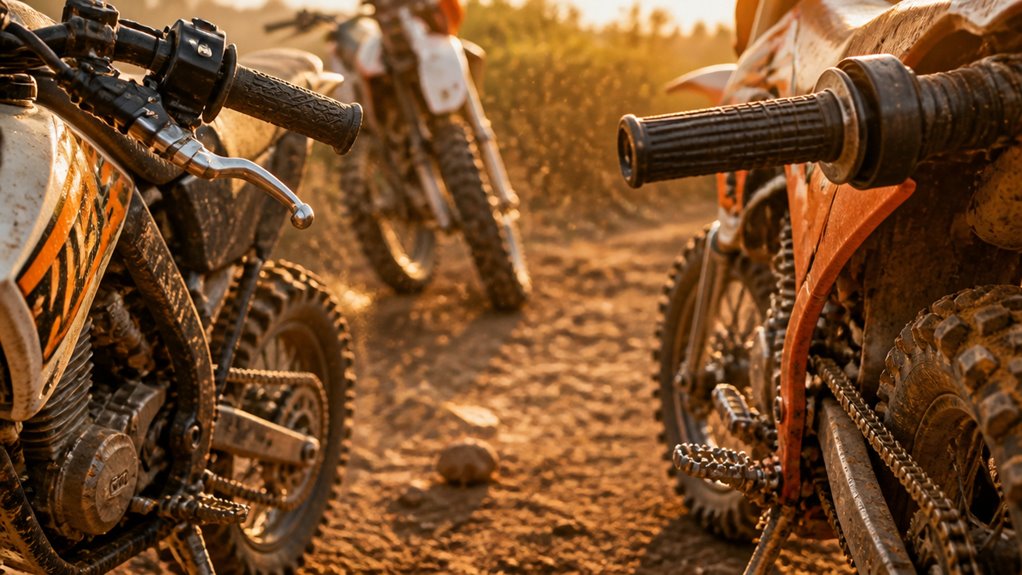
You don’t have to use a manual transmission on every dirt bike.
While many models feature manual gear shifting with clutch control for precise handling and performance, semi-automatic and fully automatic options exist.
Semi-automatics simplify gear changes by removing the clutch lever but retain foot shifting, easing rider effort.
Fully automatics, common in youth and electric bikes, use single-speed drivetrains for instant torque and minimal complexity.
Understanding these options helps you pick the ideal setup for your skill and riding style.
Key Takeaways
- Not all dirt bikes are manual; there are manual, semi-automatic, and fully automatic transmission types.
- Manual dirt bikes require clutch control and gear shifting, offering precise performance and advanced handling.
- Semi-automatic dirt bikes have automatic clutches but retain foot shifting, simplifying operation for beginners.
- Fully automatic dirt bikes use single-speed or automatic gearboxes, common in youth and electric models for ease.
- Electric and youth dirt bikes often feature automatic drivetrains to reduce complexity and improve safety.
Are All Dirt Bikes Manual? An Overview of Transmission Types

How do dirt bike transmissions differ, and are they all manual? Not exactly.
Dirt bikes come with three main transmission types: manual, semi-automatic, and fully automatic.
Manual transmissions require you to operate a clutch lever and shift gears using a foot shifter, offering precise control.
Manual transmissions offer precise control by requiring clutch operation and foot-shifted gear changes.
Semi-automatic bikes eliminate the clutch lever but still require foot shifting, engaging the clutch automatically.
Fully automatic dirt bikes remove both clutch and gear shifting responsibilities, typically featuring single-speed drivetrains.
This setup is common in youth models and electric dirt bikes, where instant torque simplifies power delivery.
Understanding these distinctions helps you choose a bike that matches your skill level and riding goals without assuming all dirt bikes demand clutch mastery and manual gear changes.
Many electric dirt bikes designed for teens feature multi-speed modes to support skill progression while maintaining ease of use.
How Manual Dirt Bikes Work and Who They’re For?
Mastering a manual dirt bike means you’ll be directly controlling the clutch lever and shifting gears with your foot. This gives you precise command over power delivery and engine response.
This setup demands coordination but rewards you with enhanced control, especially in varied terrain. Here’s how it works and who benefits most:
- You engage the clutch lever to disconnect the engine from the drivetrain, allowing smooth gear changes.
- You use the foot shifter to select gears, matching engine speed to terrain demands.
- You modulate throttle and clutch simultaneously for controlled acceleration and traction.
- This system suits riders seeking advanced handling, performance tuning, and full mechanical engagement.
Manual dirt bikes are ideal if you want to develop technical riding skills and demand maximum control on challenging trails. Many manual dirt bikes feature a 4-stroke engine that provides smoother power curves and better fuel efficiency, enhancing the riding experience.
How Semi-Automatic Dirt Bikes Make Riding Easier?
By removing the need to manually operate a clutch lever, semi-automatic dirt bikes simplify gear shifting while still giving you control over when to change gears.
Semi-automatic dirt bikes ease gear changes by eliminating clutch lever use while keeping rider control intact.
These bikes use an automatic clutch mechanism that engages and disengages the clutch based on engine speed and throttle input, eliminating manual clutch coordination.
You still shift gears with your foot, but without the complexity of clutch operation, which reduces rider workload and learning curve.
This design allows quicker, more precise gear changes, especially useful when traversing varied terrain or technical sections.
Semi-automatic transmissions offer a balance between full manual control and ease of use, making them ideal for riders progressing from automatic bikes or those wanting a less demanding setup without sacrificing gearbox interaction.
Many beginner-friendly dirt bikes, like the FRP FX40, feature easy starting systems and controlled speeds that complement semi-automatic transmissions for safer learning with predictable power delivery.
Benefits of Fully Automatic Dirt Bikes for Beginners
Many beginners find fully automatic dirt bikes ideal because they eliminate the need for manual clutch operation and gear shifting, streamlining the riding experience. This simplicity allows you to focus on balance, throttle control, and terrain navigation rather than complex mechanics.
Fully automatic dirt bikes typically use single-speed or automatic-gearbox drivetrains, which deliver instant torque without requiring gear changes.
Here are key benefits for you as a beginner:
- Reduced learning curve: No clutch or gear shifting means easier initial control.
- Consistent power delivery: Automatic systems provide smooth acceleration.
- Improved safety: Fewer distractions let you concentrate on handling.
- Lower maintenance: Simpler transmission reduces mechanical complexity and potential issues.
Choosing a fully automatic dirt bike lets you build confidence quickly while mastering fundamental riding skills. Additionally, models with powerful motors can provide the torque needed for challenging terrain, enhancing your riding experience.
Best Dirt Bikes for Kids and Youth Riders
When choosing the best dirt bike for kids and youth riders, you need to focus on ease of use, safety features, and appropriate power delivery.
Focus on ease of use, safety features, and suitable power when selecting a dirt bike for young riders.
Models like the Yamaha PW50 and Honda CRF50F excel because they offer fully automatic or automatic clutch systems, eliminating clutch operation complexity.
These bikes provide manageable power and predictable throttle response, which enhances safety and confidence.
Semi-automatic options such as the Kawasaki KLX110R and Honda CRF110F introduce gear shifting without a manual clutch, helping riders progress skillfully.
Frame size, weight, and seat height must also align with the rider’s physical stature to guarantee control and comfort.
Prioritize bikes with durable construction and reliable braking systems, as these factors contribute greatly to safe, enjoyable learning experiences for younger riders.
Adjustable features like handlebars and seats are important to accommodate teen growth and improve long-term control.
Electric Dirt Bikes and Their Automatic Transmissions
Although electric dirt bikes differ markedly from gas-powered models, they commonly utilize automatic transmissions to optimize performance and user experience.
These bikes typically feature single-speed drivetrains, eliminating the need for manual gear shifting due to the electric motor’s instant torque delivery.
When you ride electric dirt bikes, you benefit from:
- Simplified operation: no clutch lever or gear shifter to manage.
- Consistent power delivery: smooth acceleration without gear changes.
- Reduced mechanical complexity: fewer components need maintenance.
- Enhanced focus: letting you concentrate on balance and trail navigation.
This automatic setup suits beginners and riders seeking straightforward control. Additionally, many electric dirt bikes incorporate brushless motors to ensure quieter and more efficient operation.
Manual vs. Automatic Dirt Bikes: Pros and Cons
Sorting through the differences between manual and automatic dirt bikes helps you make an informed choice based on your skills and riding goals.
Manual bikes offer precise control through clutch and gear shifting, ideal for advanced riders seeking performance.
Automatic dirt bikes simplify operation by eliminating clutch use, benefiting beginners and youth by reducing learning complexity.
| Feature | Manual Dirt Bikes | Automatic Dirt Bikes |
|---|---|---|
| Gear Control | Full manual shifting | No shifting or auto gears |
| Learning Curve | Steeper, requires skill | Easier, beginner-friendly |
| Performance | High control, versatile | Limited by fixed gearing |
| Maintenance | Complex clutch system | Simpler drivetrain |
| Rider Focus | Clutch and gear management | Balance and throttle focus |
This comparison highlights key trade-offs you face choosing between control and simplicity. Many popular manual dirt bikes feature multi-speed transmissions, enhancing performance and rider engagement.
Choosing the Right Dirt Bike Transmission for You
Selecting the right dirt bike transmission hinges on your riding experience, physical size, and intended use. You’ll want to evaluate these key factors:
- Skill Level: Beginners benefit from automatic or semi-automatic transmissions. These options reduce complexity during initial learning phases.
- Control Needs: If you require precise power modulation and gear selection, a manual transmission offers superior control.
- Physical Size: Smaller riders often find semi-automatic or automatic setups easier to manage. Clutch coordination can be physically demanding.
- Riding Purpose: Performance-focused riding or competitive motocross usually demands manual transmissions for peak responsiveness.
Additionally, many beginner dirt bikes come equipped with throttle limiters to help manage power output and enhance safety during the learning process.
Where to Find Automatic and Semi-Automatic Dirt Bikes?
When browsing for automatic and semi-automatic dirt bikes, you’ll find that many manufacturers and retailers cater specifically to beginners and youth riders with these transmission options.
Brands like Yamaha, Honda, and Kawasaki offer models such as the Yamaha PW50 and Honda CRF110F, designed with fully automatic or semi-automatic clutches to simplify riding.
Retailers specializing in youth and beginner off-road vehicles, including TrailMaster, stock a variety of automatic and semi-automatic bikes alongside manuals.
Additionally, electric dirt bikes typically feature single-speed automatic drivetrains, enhancing accessibility.
To find these bikes, explore dealer websites, specialty off-road shops, and online marketplaces, filtering for transmission type.
This targeted approach guarantees you locate models that prioritize ease of use without compromising safety or performance for new riders.
Many beginner-friendly models also emphasize manageable power to ensure riders build skills safely and confidently.
Frequently Asked Questions
How Do Dirt Bike Transmissions Affect Maintenance Requirements?
Dirt bike transmissions impact maintenance markedly. Manual bikes demand regular clutch cable adjustments, clutch plate inspections, and gear oil changes.
Semi-automatic models reduce clutch maintenance but still require gearbox upkeep.
Fully automatic or electric bikes simplify maintenance by eliminating clutch components and complex shifting mechanisms.
These models focus mainly on chain and motor care. Understanding your bike’s transmission helps you schedule precise maintenance, preventing premature wear and ensuring smoother performance over time.
Can You Convert a Manual Dirt Bike to Automatic?
Converting a manual dirt bike to automatic is like swapping out a complex clock’s gears for a simple, single-speed motor. It’s possible but challenging.
You’d need to replace the transmission with an automatic or semi-automatic gearbox, remove the clutch lever, and modify the shifting mechanism.
This involves significant mechanical expertise and custom parts, making it often impractical. Instead, choosing a purpose-built automatic dirt bike is usually more efficient and reliable.
Do Automatic Dirt Bikes Have Lower Resale Value?
Automatic dirt bikes often have a lower resale value compared to manual models.
That’s because manuals appeal to more experienced riders seeking control and performance, driving demand and price.
Automatic bikes target beginners and youth, a smaller market with limited long-term interest.
However, well-maintained automatics still hold value if you sell within beginner circles.
Ultimately, resale depends on condition, brand, and market trends more than transmission alone.
How Does Transmission Type Impact Fuel Efficiency?
You might say transmission type nudges your dirt bike’s fuel efficiency.
Manual transmissions often let you optimize gear selection, squeezing more miles per gallon by matching engine speed to terrain.
Semi-automatics and automatics offer ease but may gently sacrifice peak efficiency due to less precise control.
Still, modern automatics, especially electric models, can be impressively efficient.
Thanks to instant torque and simplified drivetrains, they balance convenience with respectable fuel economy.
Are There Dirt Bikes With Both Automatic and Manual Modes?
Yes, some dirt bikes offer both automatic and manual modes, typically through advanced semi-automatic gearboxes.
These bikes let you ride fully automatic for ease or switch to manual mode for greater control by engaging the clutch and shifting gears yourself.
This dual-mode setup is rare but beneficial, allowing riders to shift smoothly between beginner-friendly automatic operation and more skilled manual handling as their experience grows.
Final Thoughts on Choosing the Right Dirt Bike Transmission
Choosing the correct dirt bike transmission can markedly simplify your riding experience.
Whether you prefer the precise control of a manual, the smoother shift of a semi-automatic, or the seamless simplicity of a fully automatic, understanding their distinct designs and benefits is essential.
By balancing your skill, style, and needs, you’ll confidently conquer courses with clarity and control.
So, select smartly and shift swiftly to sharpen your skills and satisfaction.