
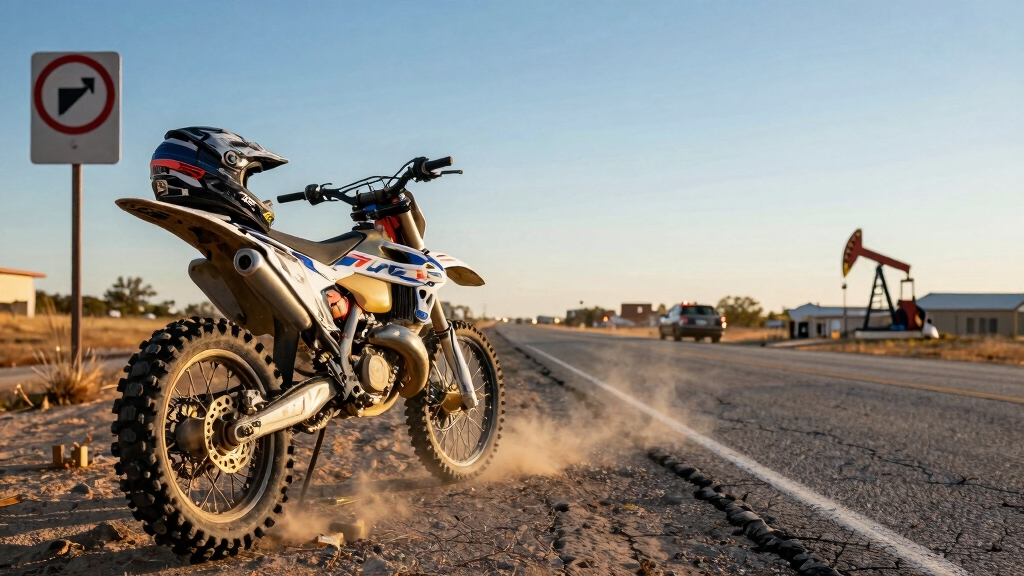
You can’t legally ride unmodified dirt bikes on Texas public roads. To be street-legal, your dirt bike must have equipment like headlights, turn signals, mirrors, and street-approved tires. It also needs to meet noise and safety standards.
You must have a valid title, registration, liability insurance, and a Class M motorcycle license if you’re 15 or older. Riding unregistered dirt bikes risks fines and impoundment. Understanding these rules helps you avoid penalties and operate properly on Texas roads.
Key Takeaways
- Unmodified dirt bikes are illegal to ride on Texas public roads without meeting specific equipment and registration requirements.
- Dirt bikes must have headlights, turn signals, mirrors, street tires, and a compliant exhaust system for lawful road use.
- Registration with the Texas DMV and passing a state safety inspection are mandatory before riding dirt bikes on public streets.
- Riders need a valid Class M motorcycle license, minimum age 15, and liability insurance to operate dirt bikes legally on Texas roads.
- Riding unregistered or unmodified dirt bikes on public roads can result in fines, vehicle impoundment, and legal penalties.
Can You Legally Ride Dirt Bikes on Texas Public Roads?
Although dirt bikes are popular for off-road recreation, you can’t legally ride unmodified dirt bikes on Texas public roads.
Texas law classifies these vehicles as Off-Highway Vehicles (OHVs), primarily intended for competition or off-road use only.
Most dirt bikes bear labels restricting their use to non-public surfaces.
Riding an untagged or unregistered dirt bike on public streets violates state regulations and may result in fines or penalties.
To operate legally on Texas roads, your dirt bike must meet specific statutory requirements, including equipment standards and formal registration.
Until you guarantee compliance with these legal mandates, riding your dirt bike on public roadways remains prohibited.
Understanding these restrictions is essential to avoid legal issues and promote public safety.
What Equipment Modifications Are Needed for Street Legal Dirt Bikes?
If you’re looking to make your dirt bike street legal in Texas, there are a few essential upgrades you’ll need to tackle. First off, you’ll want to install some specific lighting and signaling equipment. This means adding a headlight, turn signals, and mirrors. Don’t forget about the tail and brake lights—make sure they’re DOT-approved!
Next up, you’ll need to focus on safety and performance. For starters, street-approved tires are a must. You also can’t overlook having a functional speedometer; it’s important to know how fast you’re going, especially on public roads. And let’s not forget about the exhaust system—it has to be compliant with state regulations.
Additionally, ensuring that all safety devices are securely mounted and meet inspection standards is crucial for passing the DMV requirements.
These modifications aren’t just about following the law; they ensure your bike meets safety standards and is ready for the road. So, take the time to get these upgrades done, and you’ll be all set to ride legally!
Required Lighting And Signals
When preparing a dirt bike for street use in Texas, you must equip it with specific lighting and signaling devices to comply with state regulations.
Your bike needs a functioning headlight and a corresponding headlight indicator to guarantee visibility during various lighting conditions.
DOT-approved tail lights and brake lights are mandatory, enabling other drivers to recognize your bike’s position and stopping intentions clearly.
Additionally, you must install turn signals on both sides for safe lane changes and turns, alongside mirrors to enhance rear visibility.
A horn is required to alert pedestrians and other vehicles of your presence.
These modifications are essential for legal operation on public roads and must meet all Texas Department of Transportation standards to pass safety inspections.
Regular maintenance and inspections ensure these safety features remain functional and compliant with legal requirements.
Safety And Performance Equipment
Since dirt bikes are primarily designed for off-road use, you’ll need to make several safety and performance modifications to meet Texas street-legal requirements.
Equip your bike with a functioning headlight, headlight indicator, and DOT-approved tail and brake lights.
Install a horn, mirrors, and turn signals to guarantee compliance with road safety standards.
Replace off-road tires with street-approved ones, and fit a functional speedometer and odometer to monitor speed and distance accurately.
Additionally, your exhaust system must conform to state noise level regulations.
These modifications are essential not only for legality but also to enhance your safety and performance on public roads.
Without these upgrades, your dirt bike can’t be registered or operated legally on Texas streets.
For improved ride comfort and control, consider adding suspension systems similar to those used on street-legal scooters.
How Do You Register and License a Dirt Bike in Texas?
Sure! Here’s a more conversational version of your text:
—
So, you want to register and license your dirt bike in Texas? Great! First things first, you’ll need to show proof of ownership. This usually means having the title ready to go.
Next up, your bike has to pass a state safety inspection. You can get this done at an authorized facility—just make sure to find one nearby!
Once you’ve got that all squared away, you’ll head over to the Texas DMV to finish up the registration process. This is where you’ll get your license plate and ensure everything’s in line with the legal requirements. Easy peasy!
Keep in mind that Texas requires a standard driver’s license to legally operate many types of motor-driven cycles, including some dirt bikes on public roads.
Ownership Proof Requirements
Establishing clear ownership is essential before you can register and license a dirt bike in Texas. You must provide a valid title that proves you legally own the bike. Without this title, the Texas Department of Motor Vehicles (DMV) won’t process your registration.
If you purchased the dirt bike from a private party, make sure you receive a properly signed title and bill of sale. In cases where the dirt bike lacks a title, you may need to apply for a bonded title through the DMV to confirm ownership.
Additionally, the bike must meet all legal requirements for street use before registration. Accurately demonstrating ownership prevents legal complications and is a prerequisite for obtaining license plates and operating permits within the state.
For riders seeking versatile transportation options, considering the benefits of dual-rider designs can provide both comfort and stability for two people.
Safety Inspection Process
Completing a state safety inspection is a mandatory step before registering your dirt bike for street use in Texas. This inspection guarantees your bike meets all legal requirements for public road operation.
You must take your dirt bike to an authorized inspection station where certified technicians verify the presence and functionality of essential equipment.
Focus on these critical areas during inspection:
- Proper lighting system, including DOT-approved headlights, tail lights, and turn signals.
- Safety features such as mirrors, horn, and street-approved tires.
- Compliance with noise regulations and functional speedometer/odometer.
Failing to pass this inspection means you can’t legally register or ride your dirt bike on public roads. Prioritize these requirements to guarantee safety and legal compliance before moving forward with registration. It is also important to ensure that your tires meet the necessary performance and durability standards for street use.
Registration And Licensing Steps
Register your dirt bike with the Texas Department of Motor Vehicles (DMV) once it passes the state safety inspection and meets all equipment requirements.
You must provide a valid title proving ownership before submitting your registration application. After registration, you’ll receive a license plate that must be affixed to your dirt bike for lawful road use.
Additionally, Texas mandates that you hold a Class M motorcycle license to operate your dirt bike on public streets. Carrying current liability insurance is also compulsory while riding.
Make certain your dirt bike complies with all modifications for street legality, including lighting, mirrors, and exhaust standards.
Failure to adhere to these registration and licensing steps will render your dirt bike illegal for road use in Texas.
Understanding the regulatory and licensing requirements is essential to ensure compliance and safe riding on public roads.
What Age and Permits Do You Need to Ride Dirt Bikes on Texas Roads?
Although off-road dirt bike riding in Texas has no minimum age limit, you must be at least 15 years old to legally operate a dirt bike on public streets.
To guarantee compliance with Texas law, you also need specific permits and licenses.
Here are the essential requirements you must meet:
- Obtain a Class M motorcycle license, which authorizes you to ride on public roads.
- Secure an Off-Highway Vehicle (OHV) permit if you plan to ride on designated public lands. This permit costs $16 and supports recreational area maintenance.
- Carry valid liability insurance while operating the dirt bike on public streets to protect yourself and others.
Properly securing your dirt bike during transport with a suitable bike rack helps ensure safety and prevents damage.
Meeting these requirements guarantees your riding is lawful and safe on Texas roads.
Where Can You Legally Ride Dirt Bikes in Texas?
When riding dirt bikes in Texas, you must stick to designated areas to stay within the law. You can legally operate dirt bikes on private property with consent, approved off-road parks, and trails specifically designated for off-highway vehicle use.
Counties may also authorize certain roads for off-highway travel, but public streets require proper modification and registration.
It is important to wear proper safety gear such as helmets and reflective clothing to minimize risks while riding.
| Location Type | Legal Status |
|---|---|
| Private Property | Allowed with owner permission |
| Off-Road Parks/Trails | Authorized for dirt bike riding |
| County-Designated Roads | Permitted for off-highway vehicles |
Avoid riding on sidewalks, parks, or unauthorized public roads to comply with Texas regulations.
What Happens If You Ride an Untagged Dirt Bike on Texas Streets?
If you ride an untagged dirt bike on Texas streets, you risk facing legal penalties including fines and possible impoundment of the vehicle. Texas law classifies dirt bikes as Off-Highway Vehicles, prohibiting their operation on public roads unless properly modified and registered. Riding an untagged bike disregards these requirements, exposing you to serious consequences.
You may experience:
- Monetary fines that can strain your finances.
- Vehicle impoundment, resulting in additional storage fees and inconvenience.
- Potential legal charges that could affect your driving record and insurance rates.
To avoid these outcomes, make sure your dirt bike meets all equipment standards and is registered with the Texas DMV before riding on public streets. Additionally, understanding state and local regulations is crucial to ensure compliance and avoid penalties.
Why Are Electric Dirt Bikes Usually Not Allowed on Public Streets?
Since electric dirt bikes often lack the necessary features and certifications required for street legality, Texas generally prohibits their use on public roads.
These bikes typically don’t meet essential equipment standards such as functioning headlights, DOT-approved tail and brake lights, turn signals, horns, mirrors, and street-approved tires.
Additionally, they often fail to comply with noise and emission regulations, and they lack proper registration and titling, which are mandatory for public road use.
Without these modifications and certifications, electric dirt bikes remain classified as off-highway vehicles intended solely for off-road environments.
Consequently, you can’t legally operate electric dirt bikes on Texas streets, as doing so violates state laws designed to guarantee safety and regulatory compliance on public roadways.
How Do Dirt Bikes Differ From Electric Bikes on Texas Roads?
Understanding the key distinctions between dirt bikes and electric bikes is essential for steering Texas road regulations effectively.
Grasping the differences between dirt bikes and electric bikes is crucial for navigating Texas road laws.
While dirt bikes are classified as Off-Highway Vehicles and generally prohibited on public roads without extensive modifications, electric bikes face different criteria for legality.
Dirt bikes require full street-legal equipment and registration, whereas electric bikes must have operable pedals, limit motor power to 750 watts, and a maximum speed of 28 mph to qualify for road use.
Key differences include:
- Dirt bikes demand rigorous modifications and safety inspections; e-bikes have simpler requirements.
- Electric bikes must support pedaling, unlike dirt bikes which rely solely on engine power.
- Texas law permits certain e-bikes on roads, but nearly all electric dirt bikes remain banned.
These distinctions impact your compliance and safety on Texas roads.
Frequently Asked Questions
Can I Modify a Dirt Bike Myself to Meet Texas Street-Legal Requirements?
Yes, you can modify a dirt bike yourself to meet Texas street-legal requirements, but make sure you install all mandated equipment: headlights, DOT-approved tail and brake lights, horn, mirrors, turn signals, street tires, and a speedometer.
You must also meet exhaust noise standards. After modifications, pass a state safety inspection and register the bike with the Texas DMV.
Keep in mind, thorough knowledge and precision are essential to comply fully with legal standards.
Are There Specific Noise Limits for Dirt Bike Exhausts in Texas?
Imagine you’ve just upgraded your dirt bike exhaust, but a noise complaint follows. Yes, Texas enforces specific noise limits for dirt bike exhausts on public roads.
Your exhaust must comply with state noise level standards to pass inspection. This guarantees your bike doesn’t exceed permissible decibel levels, maintaining community peace and legal compliance.
How Much Does It Cost to Register a Dirt Bike for Street Use?
Registering a dirt bike for street use in Texas typically costs around $16 for the Off-Highway Vehicle (OHV) decal, which is mandatory.
Additional fees include the standard motorcycle registration fee, varying by county, generally between $30 and $50.
You’ll also pay for a safety inspection and title transfer, if applicable.
Make sure to budget for insurance and any required equipment modifications, as these are essential for legal street use.
Can Dirt Bike Riders Be Ticketed for Not Carrying Liability Insurance?
Yes, you can be ticketed for not carrying liability insurance while riding a dirt bike on public roads in Texas.
The state mandates current liability insurance for all street-legal motorcycles, including modified dirt bikes.
Riding without it violates the law, exposing you to fines and penalties.
Always make sure your insurance is valid and on hand to avoid legal trouble and protect yourself financially in case of accidents.
Are There Penalties for Riding Dirt Bikes on Sidewalks or Parks in Texas?
Yes, you face penalties for riding dirt bikes on sidewalks or parks in Texas. The law strictly prohibits dirt bike use in these areas, considering it illegal.
Violating these rules can result in fines, citations, or other legal consequences enforced by local authorities.
To avoid penalties, you must only operate dirt bikes in designated off-road parks, trails, or private property with permission, complying fully with state regulations.
Ride Your Dirt Bike Legally and Safely in Texas
If you’re thinking about riding a dirt bike on Texas roads, remember it’s not as simple as it seems.
Without proper modifications, registration, and permits, you could find yourself between a rock and a hard place with the law.
Stick to designated trails or make certain your dirt bike meets all legal requirements before hitting the street.
Knowing the rules keeps you safe and on the right side of Texas traffic laws.