

To check your rear end gear ratio, first securely raise the vehicle and identify if it’s an open or posi differential by spinning the wheels and observing their behavior.
Next, mark a tire sidewall and driveshaft for reference, then rotate the tire one full turn while counting driveshaft rotations. Double the count for open diffs to calculate the ratio.
Alternatively, inspect the ring gear tooth count and divide by the pinion’s teeth. Follow these steps carefully, and you’ll find precise gear ratio measurement techniques ahead.
Key Takeaways
- Raise the rear of the vehicle securely with jack stands and rotate one rear wheel to identify the differential type (open or posi).
- Mark the tire sidewall and driveshaft with visible marks aligned for accurate revolution counting during tests.
- Rotate the marked tire one full revolution and count driveshaft rotations; multiply by two for open differentials to find gear ratio.
- Remove the differential cover and count ring gear and pinion gear teeth, then divide ring gear teeth by pinion gear teeth for exact ratio.
- Use floor jacks, jack stands, and wheel chocks for safety, and verify results by repeating counts and cross-checking with gear ratio calculators.
Identify Your Rear End Differential Type for Gear Ratio Testing
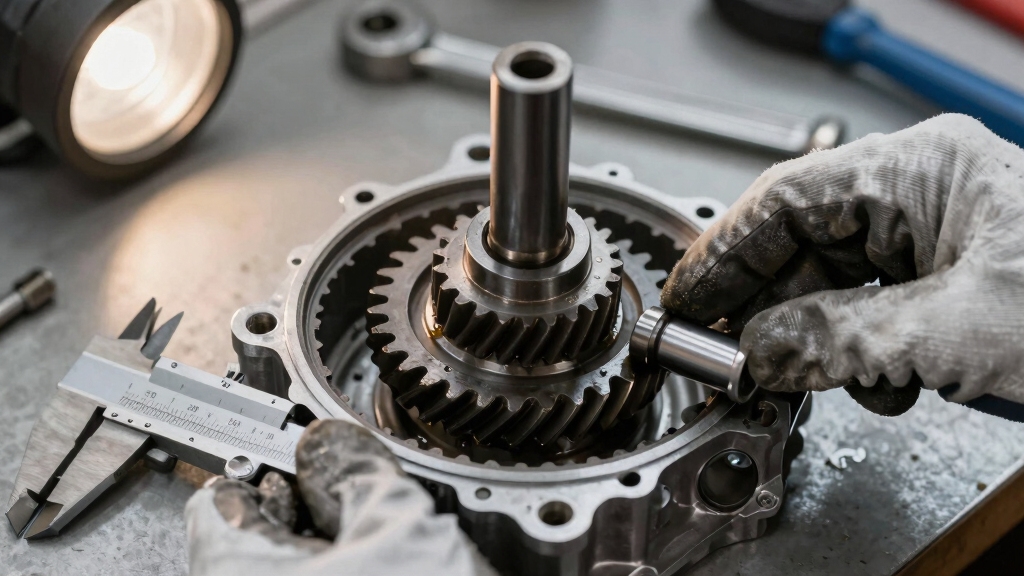
Before testing your rear end gear ratio, you need to identify whether your differential is a posi (limited-slip) or an open type, as this affects the testing procedure.
To determine the type, first raise the rear of your vehicle securely with jack stands. Ensure both rear tires are off the ground for a posi differential; one tire off may suffice for an open differential.
Rotate one rear wheel by hand and observe the opposite wheel’s movement. If both wheels rotate in unison, you have a posi differential. If only one wheel spins freely while the other remains stationary, it’s an open differential.
Confirming this distinction is critical because posi units require testing both tires simultaneously. Open differentials test only one wheel, impacting your gear ratio calculation method.
When raising the vehicle, use proper tools like jack stands or leveling blocks to stabilize the rear end safely during testing.
Mark Tires and Driveshaft for Gear Ratio Testing
When you’re getting ready to test the gear ratio, the first thing you want to do is grab a marking material that’s easy to see and really durable. You could use chalk, tape, or even a paint marker—whatever works best for you!
Now, make sure to place one mark on the tire sidewall and another on the driveshaft. It’s super important that these marks line up perfectly before you start rotating anything.
Why? Because you’ll need to accurately count how many times the driveshaft turns in relation to the tire revolutions during your test. Getting this placement right is key to getting reliable results!
For best accuracy, perform the test on a stable, level surface to ensure the motorcycle doesn’t move unexpectedly during measurement.
Choosing Marking Materials
When you mark the tires and driveshaft for gear ratio testing, choosing the right materials guarantees clear, lasting reference points during rotation.
Use tape for easy application and removal, chalk for temporary marks, or paint markers for durable, highly visible lines.
Select materials that resist smudging from dirt or moisture to maintain accuracy throughout the test.
| Material | Durability | Visibility |
|---|---|---|
| Tape | Moderate | High |
| Chalk | Low | Moderate |
| Paint Marker | High | Very High |
Choose based on test duration and surface conditions. For quick tests, chalk suffices; for extended or outdoor testing, paint markers offer reliability.
Avoid overly adhesive tapes that could damage components or leave residue. Your precise marking secures accurate gear ratio readings with minimal error.
Proper maintenance and regular inspection of the equipment help ensure consistent and reliable test results, reducing the risk of errors caused by wear and tear.
Placement of Reference Marks
Accurate placement of reference marks on the tire sidewall and driveshaft is essential for reliable gear ratio measurement.
Begin by selecting a visible spot on the tire sidewall, preferably near the tread’s outer edge, to guarantee clear observation during rotation.
Use chalk, tape, or a paint marker to make a distinct mark.
Next, locate the driveshaft section directly connected to the rear axle and apply a corresponding mark aligned with the tire mark.
This alignment helps you track relative rotations precisely.
Make certain marks are durable enough to withstand rotation without smearing.
Before testing, verify the vehicle is securely raised and stable.
Properly placed reference marks enable you to count driveshaft rotations accurately as you turn the tire, yielding precise gear ratio calculations without guesswork or error.
For enhanced stability during rotation, using a motorcycle chock can help secure the bike and minimize movement while performing gear ratio checks.
Perform the Driveshaft Turn Test to Find Gear Ratio
To determine the rear end gear ratio using the driveshaft turn test, you’ll first need to mark the tire sidewall and driveshaft with a visible reference such as chalk or tape.
Begin by marking the tire sidewall and driveshaft with chalk or tape for clear visibility.
Next, safely raise the rear tires off the ground and secure the vehicle. Rotate the marked tire one full revolution while counting how many times the driveshaft rotates.
For open differentials, spin one tire and multiply the driveshaft turns by two to get an accurate ratio. For posi units, both tires spin together, so count driveshaft rotations directly.
Key steps to follow:
- Mark tire sidewall and driveshaft clearly for visibility
- Rotate tire fully, count driveshaft turns precisely
- Adjust counting based on differential type (open vs. posi)
This method yields the gear ratio as driveshaft revolutions per tire revolution. Properly maintaining drivetrain components like the timing chain tensioner helps ensure accurate mechanical operation and prevents engine issues.
Inspect Ring Gear Stamping to Determine Gear Ratio
You can check the gear ratio by inspecting the ring gear stamping. This involves removing the differential cover to access the ring gear teeth.
Once exposed, rotate the ring gear slowly to locate the stamped numbers indicating the tooth count. Note the ring gear teeth number and the corresponding pinion gear teeth number stamped nearby or refer to vehicle specs.
Divide the ring gear teeth by the pinion teeth to determine the exact gear ratio without guesswork or rotation tests.
| Step | Action |
|---|---|
| Remove differential cover | Access ring gear teeth |
| Rotate ring gear | Locate stamped tooth count |
| Record numbers | Note ring gear and pinion teeth |
| Calculate ratio | Divide ring teeth by pinion teeth |
This method guarantees precise gear ratio identification.
Calculate Gear Ratios From Teeth Counts and Formulas
After identifying the ring and pinion tooth counts from the stamping, calculating the gear ratio becomes a straightforward process.
Once you know the ring and pinion teeth, determining the gear ratio is quick and easy.
Simply divide the number of ring gear teeth by the number of pinion gear teeth. For example, if you count 37 teeth on the ring gear and 12 on the pinion, the gear ratio is 37 ÷ 12 = 3.08. This method yields an exact ratio without guesswork.
Keep these key points in mind:
- Gear ratio = Ring gear teeth ÷ Pinion gear teeth
- Driveshaft revolutions per tire revolution also indicate the ratio
- Use this ratio to calculate torque multiplication and verify performance
For drivetrain efficiency, choosing compatible sprockets and chains made from quality materials like SAE 1023 carbon steel can help maintain durability and performance.
Use Tools and Tips for Accurate Gear Ratio Checks
Although calculating gear ratios by teeth count is straightforward, employing the right tools guarantees accuracy and efficiency during checks.
Start by using a chalk or paint marker to make clear reference marks on the tire sidewall and driveshaft. This secures precise counting of rotations.
Employ a reliable floor jack and sturdy jack stands to safely raise and secure the vehicle, preventing movement during testing.
For measurements, use digital calipers or measuring tapes to verify tire diameter if needed.
Consider using online gear ratio calculators or spreadsheets to cross-verify your data quickly.
When performing the driveshaft turn test, rotate the tire slowly and count driveshaft revolutions carefully, using your marked points as guides.
These tools and tips minimize errors, securing your gear ratio readings are both accurate and repeatable.
For added safety and stability during testing, consider using motorcycle wheel chocks to prevent any unwanted movement.
Frequently Asked Questions
Can Incorrect Gear Ratios Cause Vehicle Transmission Damage?
Yes, incorrect gear ratios can cause transmission damage.
When gear ratios don’t match your vehicle’s specifications, the engine and transmission experience undue stress.
This mismatch forces the transmission to work harder, leading to overheating, accelerated wear, and potential failure of components like clutches and gears.
You should always verify gear ratios precisely to guarantee compatibility, preventing mechanical issues and extending transmission life through proper torque and RPM management under varying loads.
How Often Should Rear End Gear Ratios Be Checked?
You should check rear end gear ratios whenever you suspect drivetrain issues or after replacing differential components.
Routine checks aren’t typically required unless you modify tires or gears, as gear ratios remain constant unless altered.
Verifying ratios post-installation guarantees correct torque and speed output.
Regular inspections during major service intervals or before heavy towing prevent unnoticed mismatches that could stress transmission components.
This practice helps protect your vehicle’s performance and longevity.
Do Gear Ratios Affect Fuel Efficiency Significantly?
Yes, gear ratios markedly impact fuel efficiency. Lower numerical ratios (like 3.23) reduce engine RPM at cruising speeds, improving fuel economy.
Higher ratios (like 4.10) increase torque but raise engine RPM, consuming more fuel. You’ll notice changes especially under load or highway driving.
Selecting the correct gear ratio balances performance and efficiency, so understanding your vehicle’s ratio helps optimize fuel consumption for your specific driving conditions.
Can I Change Gear Ratios Without Replacing the Differential?
You can’t change gear ratios without replacing internal components of the differential, so simply swapping gears externally won’t work.
The gear ratio depends on the ring and pinion gears inside the differential housing. To alter it, you must remove the differential cover, replace those gears, and properly set gear backlash and preload.
This requires precision tools and expertise; partial changes or external modifications won’t adjust the ratio effectively.
What Symptoms Indicate a Worn or Damaged Gear Ratio?
When your rear end gear ratio wears or damages, it’s like a clock losing its rhythm. Your vehicle’s drive feels off.
You’ll notice whining or grinding noises, especially during acceleration or deceleration. Shifting may become rough, and fuel efficiency drops.
Uneven tire wear or vibration through the drivetrain signals internal gear issues. These symptoms demand precise inspection to prevent further damage and guarantee your drivetrain’s synchronization stays intact.
From Measurement to Maximum Performance
By following these steps, you’ll have the gear ratio on your rear end nailed down without breaking a sweat. Whether you’re marking tires, turning the driveshaft, or counting teeth, precision is key to getting accurate results.
Remember, knowing your gear ratio is the backbone of optimizing your vehicle’s performance. So, don’t cut corners; take your time and measure carefully to make certain everything runs like clockwork.