
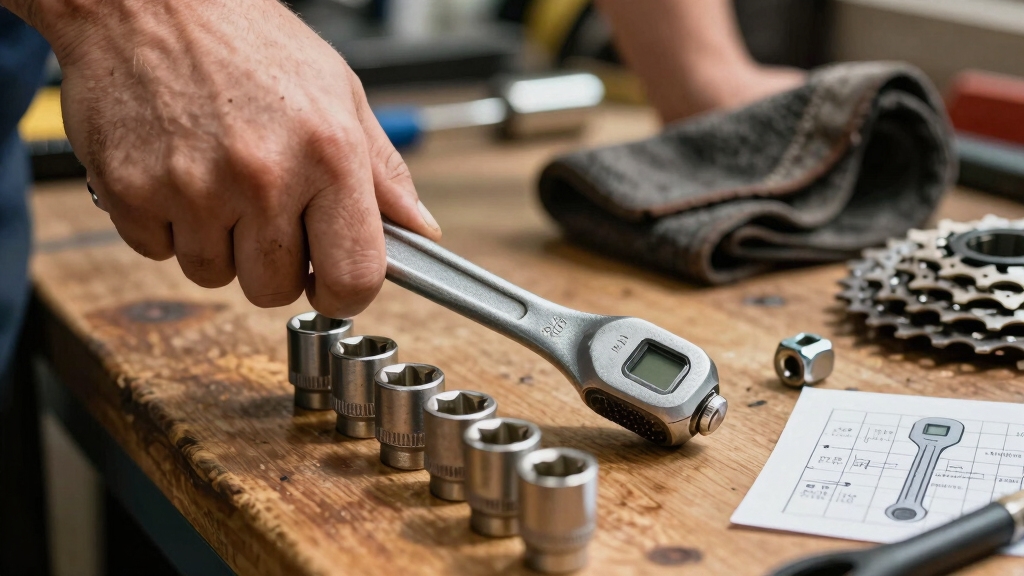
You’ll want to choose a torque wrench drive size based on your bolts’ size and required torque.
For small, delicate fasteners, a 1/4-inch drive offers precision and access in tight spaces up to about 21 ft-lbs.
A 3/8-inch drive suits medium torque tasks, 15 to 75 ft-lbs, common in engine and suspension work.
For heavy-duty automotive bolts needing 30 to 250 ft-lbs, a 1/2-inch drive is ideal.
Understanding these basics guarantees proper tool selection; more details help refine your choice.
Key Takeaways
- Choose a drive size based on bolt size and torque requirements; 1/4-inch for small fasteners, 3/8-inch for medium, and 1/2-inch or larger for heavy-duty jobs.
- Match the torque wrench range to the fastener’s torque specs, aiming to use the wrench near the middle of its capacity for best accuracy.
- Use a 1/4-inch drive for precision tasks with low torque (4–21 ft-lbs) and tight spaces like bicycles or spark plugs.
- Select a 3/8-inch drive for versatile automotive work requiring 15–75 ft-lbs torque, such as engine components and suspension parts.
- For high torque needs (30+ ft-lbs), pick a 1/2-inch or 3/4-inch drive wrench suitable for lug nuts, heavy equipment, or industrial applications.
Why Torque Wrench Drive Size Matters?

When selecting a torque wrench, understanding why drive size matters is crucial. It directly affects the tool’s compatibility, torque range, and maneuverability.
You’ll find smaller drives like 1/4-inch ideal for precision tasks involving small nuts and bolts. They’ve torque ranges suited to delicate components.
Medium drives, such as 3/8-inch, offer versatility for most automotive applications. They balance torque capacity and accessibility.
Larger drives like 1/2-inch are designed for heavy-duty tasks requiring higher torque, such as lug nuts and engine mounts. However, they tend to be bulkier.
The 3/4-inch drive caters to industrial needs with very high torque. It sacrifices maneuverability in tight spaces.
Selecting the right drive size guarantees you apply accurate torque efficiently. This prevents damaging fasteners or struggling with tool handling.
For tasks requiring stable support and safety, using tools compatible with durable steel components ensures reliability and longevity.
How to Match Torque Wrench Drive Size to Your Project?
When it comes to choosing a torque wrench drive size for your project, it’s really important to make sure it matches the torque range you need.
For instance, if you’re working on low-torque, precision tasks, a smaller drive like 1/4-inch is a great option. On the other hand, if you’re tackling high-torque applications—think lug nuts or suspension bolts—you’ll want to go with something larger, like a 1/2-inch drive.
By matching the wrench’s capacity to the size of your fasteners, you not only ensure accuracy but also help prevent any damage to your tools or hardware.
Drive Size Selection
Select the appropriate torque wrench drive size by closely matching it to your project’s torque requirements and bolt specifications.
For small, delicate tasks like bicycle maintenance or spark plug tightening, a 1/4-inch drive suits torque ranges between 4 and 21 ft-lbs. This allows precision in tight spaces.
The versatile 3/8-inch drive covers a broad spectrum, typically 15 to 75 ft-lbs. It’s ideal for engine work and suspension on light vehicles.
When working with larger fasteners, such as lug nuts or engine mounts, the 1/2-inch drive handles 30 to 250 ft-lbs. This balances power and control.
Reserve the 3/4-inch drive for heavy industrial applications requiring over 100 ft-lbs, but note its bulk limits maneuverability.
Choose a drive size that fits torque demands, bolt size, and workspace accessibility to ensure accurate, efficient tightening.
Additionally, using a torque wrench helps to apply consistent torque, which is critical for tasks like re-tightening rear axle bolts during motorcycle maintenance.
Torque Range Matching
Although matching the torque wrench drive size to your project may seem straightforward, accurately aligning the torque range with your specific fastener requirements guarantees both safety and performance.
Start by identifying the torque specifications for your fasteners. This guides your wrench selection. For delicate components like spark plugs or small bolts, a 1/4-inch drive with a 4-21 ft-lb range fits well.
Most vehicle tasks call for a 3/8-inch drive covering 15-75 ft-lb, suitable for engine parts and suspension.
Heavy-duty applications like lug nuts require a 1/2-inch drive with ranges from 30 to 250 ft-lb.
Avoid using a wrench with a range too broad or too narrow, as accuracy peaks mid-range. Matching torque range assures consistent tightening, preventing damage or failure.
Proper torque application also contributes to preventing premature tire wear by ensuring components are securely fastened without being over-tightened.
Choosing a 1/4-Inch Drive Torque Wrench for Precision Work
Why choose a 1/4-inch drive torque wrench for precision work?
Because it offers the exact control you need when working with small fasteners where over-tightening risks damage.
Provides precise control for small fasteners, preventing damage from over-tightening.
This size fits tight spaces and delicate components, making it ideal for tasks requiring finesse.
Consider the following when selecting a 1/4-inch drive wrench:
- Torque range typically between 4–21 foot-pounds, perfect for light applications.
- Compatibility with small sockets for nuts and bolts on bicycles and motorcycles.
- Ability to accurately torque spark plugs and valve covers without risk.
- Compact size enhances maneuverability in confined engine compartments.
- Provides high precision for low-torque requirements, ensuring consistent results.
Using this wrench guarantees accurate tightening in precision-critical scenarios, protecting threads and components from excessive force.
When working on motorcycle maintenance, using the correct torque wrench helps prevent issues like engine performance problems caused by improper fastener tension.
When to Use a 3/8-Inch Drive Torque Wrench?
When you’re working on most vehicle nuts and bolts, a 3/8-inch drive torque wrench is often your best friend.
It strikes that perfect balance between versatility and control, making it a go-to tool for many automotive tasks.
Typically, its torque range of 15 to 75 foot-pounds is just right for common jobs like engine maintenance and suspension work.
And here’s the great part: it fits a wide variety of sockets!
This makes it especially handy for small cars and light trucks.
Regular maintenance, such as bleeding motorcycle dual front brakes, ensures optimal performance and safety.
Versatile Vehicle Applications
Frequently, the 3/8-inch drive torque wrench serves as the go-to tool for most vehicle maintenance tasks due to its balance of versatility and torque capacity.
You’ll find it ideal for handling a wide range of nuts and bolts without over- or under-torquing. This drive size suits both small automobiles and light trucks, making it a practical choice for everyday use.
Use a 3/8-inch drive torque wrench when working on:
- Engine components like spark plugs and cylinder heads
- Suspension parts requiring moderate torque
- Brake assemblies and caliper bolts
- Transmission and drivetrain fasteners
- General repairs involving 10-100 ft-lb torque range
This tool combines accessibility with precise torque control, giving you efficiency and confidence across diverse vehicle applications. For tasks such as motorcycle maintenance, ensuring the bike is stabilized and lifted safely is crucial before applying torque with your wrench, highlighting the importance of safe lifting techniques.
Typical Torque Range
You’ll find the 3/8-inch drive torque wrench excels within a torque range of 15 to 75 foot-pounds (19 to 110 Nm), making it suitable for most medium-torque tasks on vehicles.
This range covers common fasteners like spark plugs, engine components, and suspension parts on small cars and light trucks.
When your bolts require torque beyond 15 foot-pounds but stay under 75, this wrench provides accuracy and control.
It balances maneuverability and strength, allowing you to work efficiently in engine bays and tight spaces without sacrificing precision.
Using a 3/8-inch drive within this range guarantees you apply the correct clamping force, preventing damage and maintaining safety.
It’s the ideal choice when you need versatility for typical automotive maintenance and repairs.
Common Socket Compatibility
Although the 3/8-inch drive torque wrench is praised for its versatility, it truly shines when paired with sockets sized for medium-duty fasteners common in automotive work.
You’ll find this drive size ideal for a broad range of tasks where precision and moderate torque are required. It fits sockets that handle nuts and bolts too large for a 1/4-inch drive but not heavy-duty enough for a 1/2-inch drive.
Use a 3/8-inch drive wrench when working with:
- Spark plugs and ignition components
- Suspension parts on light trucks
- Engine components requiring 15-75 ft-lbs torque
- Medium-sized fasteners on motorcycles
- General automotive repairs needing 10-135 Nm torque range
This size balances accessibility and torque capacity effectively for most vehicle maintenance. Proper use of a torque wrench also involves checking torque specifications to ensure components like clutch adjustments are tightened correctly.
Benefits of a 1/2-Inch Drive Torque Wrench for Automotive Tasks
Choose a 1/2-inch drive torque wrench when you need reliable power and accuracy for larger automotive fasteners. This size covers torque ranges from 30 to 250 foot-pounds, ideal for lug nuts, suspension bolts, and engine mounts.
It provides ±4% accuracy, ensuring consistent torque application critical for safety and performance. The 1/2-inch drive fits most standard sockets, balancing strength and maneuverability.
| Feature | Torque Range (ft-lb) | Typical Applications |
|---|---|---|
| Power & Precision | 30 – 250 | Lug nuts, engine mounts |
| Socket Compatibility | Standard 1/2-inch | Most automotive sockets |
| Accuracy | ±4% | Consistent torque delivery |
Using this wrench optimizes your automotive maintenance by combining durability and precision in one tool. Proper torque application is essential to avoid common risks such as component damage and ensure reliable vehicle safety.
When to Use a 3/4-Inch Drive Torque Wrench for High-Torque Jobs?
When handling heavy industrial machinery or large vehicle components, a 3/4-inch drive torque wrench delivers the high torque range you need, typically between 100 and 600+ foot-pounds.
A 3/4-inch drive torque wrench provides essential high torque, typically from 100 to over 600 foot-pounds.
You’ll want this size when standard wrenches can’t provide enough force or when precision at high torque levels is critical. Use it for:
- Tightening large fasteners on heavy equipment
- Securing wheel lugs on commercial trucks
- Assembling structural steel components
- Maintenance on agricultural machinery
- Tasks requiring torque beyond 250 foot-pounds
Keep in mind, the larger size reduces maneuverability in tight spaces. Reserve this wrench for jobs where clearance isn’t restricted.
Its robust design guarantees accuracy and durability for demanding, high-torque applications requiring consistent, reliable fastening. For tasks involving motorcycle maintenance, choosing the right holding device like a wheel vise can improve stability and safety during use.
Comparing Torque Wrench Ranges: Finding the Right Fit for Your Bolts
High-torque applications demand the 3/4-inch drive wrench, but most tasks call for tools with more moderate ranges.
When selecting your torque wrench, match its range to the bolts’ specifications. For small bolts, a 1/4-inch drive with 4-21 ft-lb suits precise, delicate jobs like spark plugs or bicycle components.
The 3/8-inch drive covers a versatile 15-75 ft-lb range, ideal for engine work and suspension on light vehicles.
For larger fasteners such as lug nuts, a 1/2-inch drive wrench operating between 30-250 ft-lb offers sufficient torque and accuracy.
Avoid oversizing wrenches, as using one with a much higher range reduces precision.
Always consider bolt size, required torque, and workspace constraints to make certain you pick a wrench that delivers consistent, accurate tightening without risking damage.
Regular maintenance and calibration of tools and components helps ensure reliable performance and prevents damage during use.
Torque Units Explained: Foot-Pounds vs. Newton Meters
Although torque measurements can be expressed in various units, foot-pounds (ft-lb) and newton meters (Nm) are the two most commonly used in automotive and mechanical work. Understanding their differences helps you select the right torque wrench and interpret specifications correctly.
Ft-lb measures torque as force applied over one foot of lever arm. Nm uses the metric system, force over one meter of lever arm.
1 ft-lb equals approximately 1.356 Nm; conversion is essential. Torque wrenches often list both units for versatility.
Regional preferences vary: ft-lb dominates in the US, Nm elsewhere. You should pick a wrench calibrated in the unit matching your vehicle or tool specifications to guarantee accuracy and prevent damage.
Flex-Head vs. Standard Torque Wrenches: Which Works Best in Tight Spaces?
Selecting the right torque wrench involves not only matching units like foot-pounds or newton meters but also considering the wrench’s head design for accessibility.
Flex-head torque wrenches offer adjustable pivoting heads, allowing you to reach tight, angled spaces without compromising torque accuracy. This makes them ideal for confined engine bays or suspension components where clearance is limited.
In contrast, standard fixed-head wrenches provide greater rigidity and often higher accuracy but require more room to maneuver. If your workspace is cramped or features awkward bolt orientations, a flex-head wrench enhances versatility and ease of use.
However, for straightforward applications with ample space, a standard wrench delivers stable torque application. Ultimately, choose a flex-head for complex or tight areas and standard heads when accessibility isn’t an issue.
Tips to Maintain Accuracy and Extend Your Torque Wrench’s Life
Regularly calibrating your torque wrench guarantees it maintains accuracy over time, preventing under- or over-tightening that could damage components.
To extend its life and reliability, follow these practical tips. First, always store your wrench at its lowest torque setting to relieve spring tension.
Avoid using it as a breaker bar or for loosening fasteners, which can damage the internal mechanism. Clean the wrench after use, keeping dirt and grease from impairing function.
Periodically check and recalibrate the wrench according to manufacturer recommendations or after heavy use. Finally, handle your tool carefully, avoiding drops or impacts that can skew calibration.
- Store at minimum torque setting
- Use only for tightening, not loosening
- Clean after each use
- Calibrate regularly
- Avoid physical shocks and drops
Frequently Asked Questions
Can I Use a Torque Wrench on Plastic Fasteners?
You can use a torque wrench on plastic fasteners, but you need to be very careful.
Plastic fasteners have much lower torque limits than metal ones, so use a wrench with a low torque range, like a 1/4-inch drive with 4-21 foot-pounds.
Always set the torque wrench precisely to avoid over-tightening, which can crack or strip the plastic.
Use gradual, controlled force and consider torque specs specific to the plastic fastener.
How Often Should I Calibrate My Torque Wrench?
Think of your torque wrench as a finely tuned instrument; you should calibrate it at least once a year to keep it playing true.
If you use it frequently or for critical tasks, consider calibrating every 5,000 cycles or sooner.
Regular calibration guarantees accuracy, maintaining your tool’s reliability and preventing damage from overtightening or undertightening bolts.
Always follow manufacturer guidelines for best results.
What Is the Best Storage Method for a Torque Wrench?
The best way to store your torque wrench is in its protective case to prevent dust, dirt, and damage.
Always set the wrench to its lowest torque setting before storage to relieve spring tension, ensuring accuracy.
Keep it in a dry, temperature-stable environment, away from moisture and extreme heat.
Avoid tossing it in a toolbox; secure storage preserves calibration and extends the tool’s life.
Regularly inspect before use for any signs of wear.
Are Digital Torque Wrenches More Accurate Than Analog Ones?
Picture a digital torque wrench’s crisp LCD screen displaying exact values, eliminating guesswork.
Yes, digital torque wrenches generally offer higher accuracy than analog ones because they provide precise electronic readings and alerts.
You’ll find them especially useful when working within tight torque tolerances. However, they rely on batteries and can be sensitive to impact.
Analog wrenches, while less precise, are durable and don’t require power, making them practical in many scenarios.
Can I Use a Torque Wrench to Loosen Bolts?
You generally shouldn’t use a torque wrench to loosen bolts.
Torque wrenches are designed to apply precise torque when tightening, not for breaking loose fasteners.
Using one to loosen bolts can damage the internal calibration and affect accuracy.
Instead, use a regular ratchet or breaker bar for loosening.
Reserve your torque wrench solely for tightening bolts to the specified torque to guarantee precision and tool longevity.
Accuracy Starts with the Right Drive Size
Choosing the right torque wrench drive size is essential. Did you know that using an improperly sized wrench can reduce accuracy by up to 20%?
To maintain precision, match your wrench to your project’s torque range and bolt size. For delicate tasks, a 1/4-inch drive offers control, while a 1/2-inch drive handles heavy automotive work.
Regular calibration and proper care will keep your wrench reliable, ensuring every fastener meets exact specifications.