
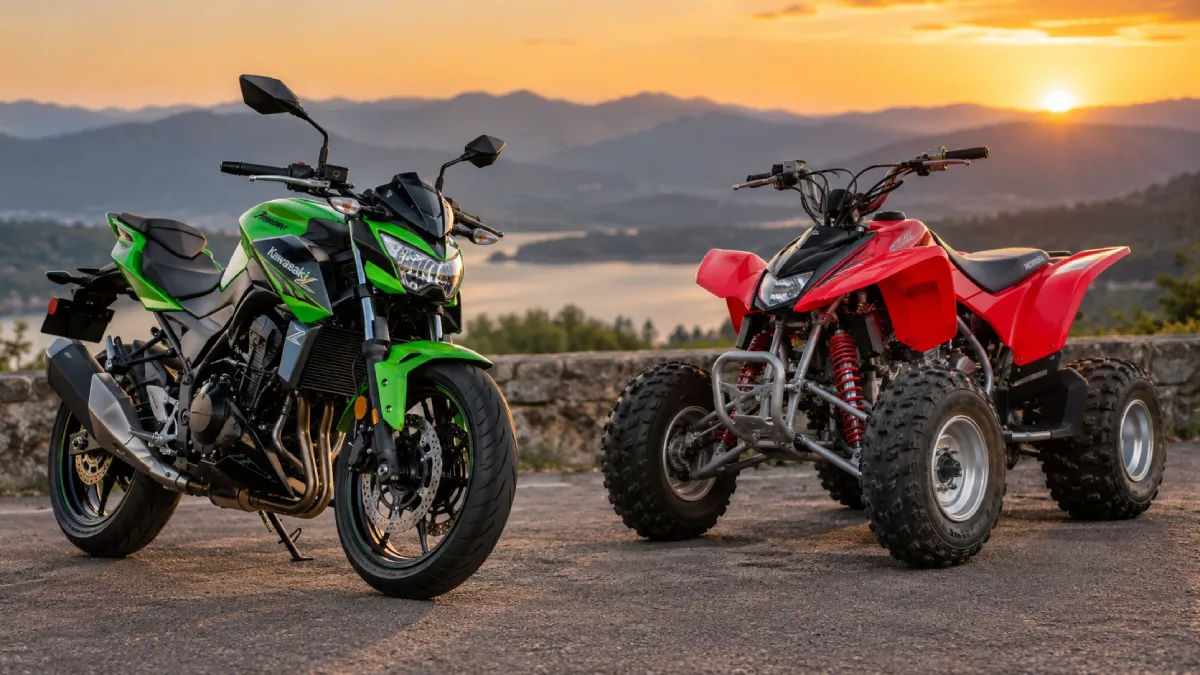
If you’re choosing between the Kawasaki Z400 and Honda 400EX, note the Z400’s 398cc liquid-cooled parallel-twin delivers 44–45 hp with high-RPM focus for sharp street acceleration and agile cornering. This is thanks to its sportbike-tuned suspension and narrow chassis.
The 400EX’s 397cc air-cooled single-cylinder puts out 28 hp, optimized for low-end torque and off-road traction. It features a wider frame and long-travel suspension.
Understanding these key contrasts in power delivery and handling helps clarify which machine suits your terrain needs best.
Key Takeaways
- Kawasaki Z400 delivers about 44–45.4 hp with a liquid-cooled parallel-twin engine optimized for street performance and high RPM power.
- Honda 400EX produces roughly 28 hp from an air-cooled single-cylinder engine tuned for low-end torque and off-road control.
- Z400 weighs around 364–370 lb with a narrow profile and sportbike suspension for agile pavement handling and lean-angle control.
- 400EX weighs 375–386 lb, features wider quad dimensions, and offers longer suspension travel for stability and traction on rough terrain.
- Z400 excels in nimble street riding, while 400EX is designed for off-road trail utility and stability across uneven surfaces.
Kawasaki Z400 vs Honda 400EX: Specs & Performance Compared
| Feature | Kawasaki Z400 | Honda 400EX |
|---|---|---|
| Vehicle Type | Street motorcycle | Sport ATV |
| Primary Use | Pavement and street riding | Off-road trails and dirt riding |
| Engine Type | Liquid-cooled parallel-twin | Air-cooled single-cylinder |
| Displacement | 398 cc | 397 cc |
| Peak Power | 44.3–45.4 hp | ~28 hp |
| Power Delivery | High-RPM, street-focused | Low-end torque, trail-focused |
| Cooling System | Liquid cooling | Air cooling |
| Wet Weight | Around 364–370 lbs | Around 375–386 lbs |
| Chassis/Profile | Narrow, compact motorcycle | Wider ATV chassis |
| Width | Narrow profile | 45.3 inches |
| Length | Compact footprint | 72.2 inches |
| Seat Height | Lower | 31.9 inches |
| Handling | Nimble and agile | Stable and steady |
| Suspension Focus | Precise pavement handling | Rough-terrain absorption |
| Front Suspension Travel | More limited | 8.2 inches |
| Rear Suspension Travel | More limited | 9.1 inches |
| Cornering | Sharp, lean-angle focused | Designed for off-road stability |
| Terrain Strength | Asphalt and urban roads | Uneven trails, dirt, and rough terrain |
| Maintenance | Oil, chain, and valve maintenance; liquid-cooled complexity | Simpler air-cooled mechanics, plus ATV tire/suspension servicing |
| Beginner Character | Sharper throttle and quicker responses | More forgiving low-end torque and wider stability |
| Insurance | Generally higher | Often lower |
| Best Overall Strength | Street acceleration and agile handling | Off-road traction and stability |
Kawasaki Z400 vs Honda 400EX: Street Bike vs ATV Explained

While the Kawasaki Z400 and Honda 400EX share a similar engine displacement around 400 cc, they serve fundamentally different purposes. The Z400 is a nimble street motorcycle designed for pavement performance, whereas the 400EX is a sport ATV built for off-road traction and stability.
You’ll notice the Z400’s 398 cc liquid-cooled parallel-twin engine delivers about 44 hp, revving high for rapid acceleration and top-end speed. In contrast, the 400EX’s 397 cc air-cooled single-cylinder produces roughly 28 hp, tuned for low-end torque ideal for trail riding.
The Z400’s lighter wet weight, around 365 lb, and street-oriented suspension facilitate agile handling on asphalt. Meanwhile, the 400EX weighs about 375–386 lb with longer suspension travel designed to absorb rough terrain and maintain quad stability across uneven surfaces.
For off-road tires, options like the WIG Racing 80/100-19 Rear Tire offer aggressive tread and durable construction to enhance traction and durability on varied terrain.
Key Differences at a Glance: Z400 and 400EX Compared
Because the Kawasaki Z400 and Honda 400EX cater to distinct riding environments, their core differences become clear when you compare engine design, power output, weight, and suspension setups, each optimized for street or off-road use.
Kawasaki Z400 and Honda 400EX showcase distinct engineering tailored for street agility versus off-road stability.
The Z400 sports a liquid-cooled 398 cc parallel-twin engine, emphasizing high-rev performance and a lighter wet weight around 364–370 lbs. This makes it ideal for agile pavement handling.
In contrast, the 400EX pairs a 397 cc air-cooled single-cylinder engine with a heavier 375–386 lb frame and wider ATV stance, built for off-road stability.
Suspension travel also diverges. The 400EX offers 8.2 inches front and 9.1 inches rear, prioritizing rough terrain absorption, while the Z400’s setup favors precise cornering.
These fundamental contrasts reflect their tailored engineering for street versus trail use.
For riders seeking a balanced off-road experience, features like suspension & frame quality greatly influence handling and comfort across rugged terrain.
Engine and Power Comparison: Z400 vs 400EX Performance
When comparing the engine and power characteristics of the Kawasaki Z400 and Honda 400EX, you’ll notice distinct engineering choices tailored to their different roles. The Z400’s 398 cc liquid-cooled parallel-twin delivers around 44.3–45.4 hp with high-revving performance, ideal for street acceleration.
In contrast, the 400EX uses a 397 cc air-cooled single-cylinder engine producing about 28 hp, emphasizing low-end torque for off-road control.
| Feature | Kawasaki Z400 | Honda 400EX |
|---|---|---|
| Engine Type | Liquid-cooled parallel-twin | Air-cooled single-cylinder |
| Displacement | 398 cc | 397 cc |
| Peak Power | 44.3–45.4 hp | ~28 hp |
| Power Delivery | High RPM, street-focused | Low-end torque, trail utility |
| Cooling System | Liquid cooling | Air cooling |
This contrast highlights their purpose: street speed vs. off-road torque. Proper adjustment of the clutch biting point is essential to maximize power delivery and smooth gear transitions on both motorcycles.
Weight, Size, and Handling: Kawasaki Z400 vs Honda 400EX
Explore how weight, size, and handling define the distinct riding experiences of the Kawasaki Z400 street bike and the Honda 400EX sport ATV.
The Z400 tips the scales slightly lighter, around 364–370 lbs wet, while the 400EX sits near 375–386 lbs, reflecting its wider, quad chassis.
You’ll notice the Z400’s compact footprint favors nimble pavement cornering with a narrow profile and lower seat height, enhancing lean-angle control.
In contrast, the 400EX’s broader 45.3-inch width and 72.2-inch length provide stability over rough terrain, with a higher 31.9-inch seat to accommodate suspension travel.
Handling differences stem from design: the Z400’s geometry optimizes street agility, while the 400EX’s wider stance and weight distribution prioritize off-road traction and steadiness.
This makes each suited for their intended environments.
For rough terrain performance, factors like tire design and size and suspension systems are critical to maintaining stability and rider comfort.
Suspension and Ride Quality: Which Suits Your Terrain?
The distinct weight and geometry differences between the Kawasaki Z400 and Honda 400EX directly influence their suspension design and ride quality, tailored to their respective terrains.
The Z400’s suspension focuses on precise pavement handling, featuring sportbike-tuned forks and a rear shock optimized for lean angles and responsive feedback.
This setup is ideal for smooth, high-speed cornering.
In contrast, the 400EX offers considerably longer suspension travel: 8.2 inches front and 9.1 inches rear.
This allows it to absorb rough off-road impacts and provides stability over uneven terrain.
The 400EX’s setup prioritizes traction and shock absorption for trail and dirt riding, while the Z400 sacrifices some compliance for sharper road feeler
Ultimately, your terrain choice dictates which suspension suits you.
The Z400 excels on asphalt, whereas the 400EX dominates off-road trails with its rugged ATV suspension geometry.
For riders seeking adjustable and tunable suspension options in beginner enduro bikes, models like the TRIFOX with 140mm travel air fork offer versatile performance on varied terrain.
Frequently Asked Questions
Can the Kawasaki Z400 Be Used for Light Off-Roading?
You can use the Kawasaki Z400 for light off-roading, but it’s not designed specifically for that. Its street-bike suspension and tires favor pavement, so rough trails might challenge its handling and comfort.
You’ll notice limited suspension travel and less traction compared to dedicated off-road vehicles. For occasional dirt paths or gravel roads, it’s manageable, but for serious off-road riding, a purpose-built ATV or dirt bike suits you better.
What Are the Typical Maintenance Costs for Each Vehicle?
You can expect the Kawasaki Z400’s maintenance costs to be moderate, with regular oil changes, chain upkeep, and valve adjustments due every 8,000–12,000 miles.
Parts tend to be affordable but may require specialized labor for the liquid-cooled twin engine. The Honda 400EX usually has lower maintenance complexity, with simpler air-cooled mechanics and carb tuning.
However, expect expenses for ATV-specific tires and suspension servicing. Both need routine brake and fluid checks to stay reliable.
Are There Aftermarket Upgrade Options for the Honda 400EX?
Yes, you’ll find a solid range of aftermarket upgrades for the Honda 400EX. You can enhance performance with high-flow air filters, bigger carburetors, and exhaust systems.
Suspension kits and heavier-duty shocks improve off-road handling, while tires designed for various terrains boost traction. Braking components and protective gear like skid plates are also popular.
Compared to street bikes, 400EX parts focus more on durability and off-road utility.
How Do Insurance Costs Compare Between the Z400 and 400EX?
You’ll generally find insurance for the Z400 higher than the 400EX due to its classification as a street motorcycle. This carries more risk factors like traffic exposure and theft.
The Z400’s higher horsepower and speed potential also raise premiums. The 400EX, as an ATV, often has lower insurance costs.
However, off-road use and specialized coverage can add expenses.
Your exact cost depends on location, usage, and insurer policies.
Which Vehicle Is Better for Beginner Riders or Drivers?
If you’re easing into riding, the 400EX gently introduces you to off-road control with its manageable low-end torque and wider stability. This makes it a friendly companion on trails.
The Z400 demands a bit more respect with its sharper throttle and higher revs. It’s better suited if you’re ready for street dynamics and quicker responses.
Both offer learning curves, but the 400EX’s forgiving nature often makes it the kinder classroom for beginners.
Kawasaki Z400 or Honda 400EX: Which Fits Your Riding Style?
When you rev the Kawasaki Z400, you feel the sleek precision of a street bike carving through urban corners. Its lightweight frame and agile suspension hug asphalt like a second skin.
In contrast, the Honda 400EX’s rugged build and robust suspension soak up rough trails, powering through mud and uneven terrain with steadfast confidence.
Choosing between them means deciding if you crave nimble street agility or the raw, earthy grit of off-road adventure.