

Tuning your motorcycle typically costs between $250 and $800, depending on its make, model, and service complexity. Basic tune-ups, including oil changes and adjustments, often start around $250.
However, specialized bikes like Ducati can exceed $800 due to advanced engine work. Labor rates vary by location, ranging $50 to $150 per hour, and adding parts or dyno tuning increases costs.
Performance upgrades and ECU flashes add further expenses. Let’s explore how these factors shape your tune-up investment.
Key Takeaways
- Basic motorcycle tune-ups typically cost between $250 and $300, including oil changes and minor adjustments.
- Labor rates vary regionally, ranging from $50–$150 per hour, affecting total tune-up costs.
- Harley-Davidson tune-ups usually range from $200 to $500, while Ducati tune-ups can exceed $800 due to complexity.
- Performance upgrades range from $500 for Stage 1 to over $7,000 for advanced Stage 3 modifications.
- Custom dyno tuning and ECU flashes add $250 to $2,500, depending on the motorcycle and service complexity.
Factors Influencing Motorcycle Tune-Up Costs

When considering motorcycle tune-up costs, you should recognize that several key factors directly affect the final price. First, the motorcycle’s make and model greatly influence costs due to varying mechanical complexity. For example, Harley-Davidson models usually cost less to tune than Ducati bikes, which require more intricate adjustments.
Labor rates also vary regionally, with urban areas charging $75–150 per hour. Custom or race tuning can reach $250 per hour. The scope of service matters too; basic services like carb syncing start around $100. In contrast, all-encompassing upgrades demand higher fees.
Parts replacement, such as spark plugs or air filters, adds to the total, ranging from $50 to several hundred dollars. Finally, specialized tuning methods like ECU flashes or dyno tuning introduce additional expenses. Proper maintenance, including regular checks on the motorcycle’s brake systems, can also influence overall tune-up costs by preventing more extensive repairs.
Typical Prices for Basic Motorcycle Tune-Ups
When you’re looking to get a basic motorcycle tune-up, you can generally expect to pay somewhere between $250 and $300.
This usually covers essentials like an oil change, filter replacement, and some minor adjustments.
Now, it’s worth noting that labor rates can really vary by region, typically falling between $75 and $150 per hour.
This can definitely impact the final price you pay.
And just a heads up, if you’re in an urban area, the costs might be on the higher side.
To keep your bike in good condition during maintenance, it’s important to lift the motorcycle safely to avoid damage.
Basic Tune-Up Costs
Basic motorcycle tune-ups typically cost between $250 and $300, covering essential tasks such as oil changes, filter replacements, and minor adjustments.
These basic services make certain your engine runs smoothly and efficiently. If you need carburetor syncing, expect an additional $100 to $150, as this requires precise balancing of fuel-air mixtures.
For Harley-Davidson models, tune-ups range from $200 to $500 due to their simpler mechanical layout. Keep in mind, parts like spark plugs and air filters generally add $50 to several hundred dollars, depending on quality and brand.
When budgeting, factor in that basic tune-ups focus on maintenance rather than performance upgrades. This pricing reflects standard labor and parts without involving complex diagnostics or electronic tuning tools.
Regular maintenance also helps prevent issues like low compression that can affect engine performance and longevity.
Regional Labor Variations
Since labor costs vary considerably by location, your motorcycle tune-up price can fluctuate accordingly.
In urban areas, expect labor rates between $75 and $150 per hour, which directly impacts your total cost. Basic tune-ups that include oil changes, filter replacements, and minor adjustments generally run from $250 to $300, but localized labor rates can push this higher or lower.
Specialty services, such as carburetor syncing, typically start around $100 to $150, with labor time and expertise influencing final pricing. For custom or performance tuning, hourly rates can spike to $250, especially when dealing with complex systems or dyno tuning, which often requires a minimum service duration.
Understanding regional labor variations helps you budget accurately and choose service providers offering fair pricing for your motorcycle’s tune-up. Proper adjustments, like setting the clutch biting point, are essential for smooth gear changes and preventing stalling during your tune-up.
How Labor Rates and Location Affect Tune-Up Pricing?
When considering motorcycle tune-up costs, labor rates and geographic location materially influence the final price.
Urban areas typically charge $75 to $150 per hour, while custom or race tuning can reach $250 per hour with minimum hours required. Your location affects access to specialized services and parts availability, impacting overall expenses.
| Location Type | Labor Rate (per hour) | Typical Tune-Up Cost Range |
|---|---|---|
| Urban Areas | $75 – $150 | $250 – $500 |
| Custom/Race Shops | $250 (3-hour min) | $750+ |
| Rural/Suburban | $50 – $100 | $200 – $400 |
Using proper equipment such as motorcycle wheel chocks can enhance safety during maintenance and tune-up procedures.
Comparing Harley-Davidson and Ducati Tune-Up Costs
If you’re weighing tune-up costs between Harley-Davidson and Ducati motorcycles, you’ll notice significant differences driven by their mechanical complexity and tuning requirements.
Harley-Davidson’s simpler V-twin engines generally demand less labor, with basic tune-ups ranging from $200 to $500. Their tuning often involves standard adjustments, spark plug replacements, and sometimes ECU flashes costing around $250 to $300.
In contrast, Ducati’s high-performance, multi-cylinder engines require specialized expertise and longer labor times, pushing tune-ups beyond $800 for complex models. Additionally, Ducati parts, like air filters or spark plugs, often cost more, increasing total expenses.
While Harley-Davidson tuning may occasionally include Power Commander installations and dyno labor at $500 to $650, Ducati’s tuning leans heavily on custom dyno work and advanced ECU recalibrations, elevating your overall maintenance investment.
Proper maintenance such as balancing motorcycle tires also plays a crucial role in ensuring smooth performance and longevity of the bike’s components.
What to Expect From Performance Stage Upgrades
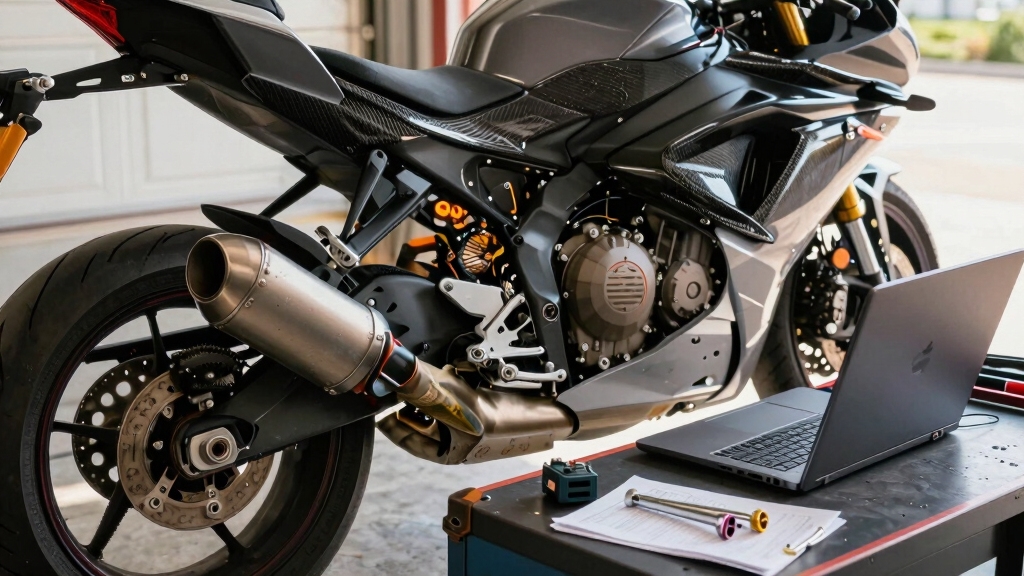
When you’re thinking about performance stage upgrades, it’s important to keep in mind that costs can really vary. You’re looking at anywhere from $500 all the way up to over $10,000, depending on how extensive the modifications are.
So, what kind of upgrades are we talking about? Well, typical enhancements usually include things like air intake systems, exhaust upgrades, ECU tuning, and even advanced engine components. These modifications can really make a difference, delivering noticeable gains in horsepower and torque.
But here’s the thing: it’s crucial to plan carefully. You want to make sure that whatever upgrades you choose are a good match for your bike’s specifications. That way, you can get the most out of your investment! Upgrading to a high-quality chain and sprocket kit is also a key factor in improving drivetrain performance and durability.
Stage Upgrade Cost Range
Expect performance stage upgrades on motorcycles to vary widely in cost depending on the extent of modifications and tuning involved.
For example, a Stage 1 upgrade, focusing on basic enhancements like air intake and exhaust with ECU tuning, typically ranges from $500 to $1,500.
Moving to Stage 2, expect costs between $1,500 and $3,500 due to more extensive component replacements and calibration.
Stage 3 upgrades escalate to $3,000 to $7,000, incorporating advanced parts such as throttle bodies.
Stage 4 can reach $3,000 to $10,000, reflecting significant engine modifications and labor intensity.
These prices generally include professional dyno tuning and installation.
Keep in mind, custom setups or specialized bikes may push costs higher.
Budget accordingly to match your performance goals and mechanical complexity.
Regular maintenance and fluid management, including periodic bleeding, help ensure reliable performance after upgrades.
Typical Modifications Included
Although performance stage upgrades vary by level, you’ll typically encounter a series of progressive modifications targeting airflow, fuel delivery, and engine management. These modifications optimize combustion efficiency and power output while maintaining reliability.
Early stages often focus on bolt-on parts, while advanced stages integrate internal engine components.
Typical modifications include:
- Upgraded air intake systems to increase airflow and reduce restriction
- High-performance exhaust systems designed for peak scavenging and reduced backpressure
- ECU remapping or flashing to recalibrate fuel injection and ignition timing
- Enhanced throttle bodies or fuel injectors for improved fuel delivery precision
These changes work together to guarantee your motorcycle’s engine breathes better and runs more efficiently. This sets the foundation for further performance enhancements in subsequent stages. Proper maintenance, including cleaning the 2 stroke exhaust, is essential to sustain engine performance and longevity after tuning.
Performance Gains Overview
Since performance stage upgrades target key engine systems, you’ll notice measurable improvements in horsepower, torque, and throttle response. Each upgrade stage builds on the last, enhancing airflow, fuel delivery, and ignition timing.
Expect smoother acceleration and increased overall power as you advance.
| Upgrade Stage | Typical Gains |
|---|---|
| Stage 1 | +10-15% horsepower, improved throttle response |
| Stage 2 | +20-30% horsepower, enhanced torque |
| Stage 3 | +35-50% horsepower, optimized fuel mapping |
| Stage 4 | +50%+ horsepower, upgraded engine components |
| Custom Dyno | Tailored gains, balanced power and efficiency |
These performance gains depend on your bike model and tuning precision. Each step appreciably boosts your motorcycle’s capabilities. Proper maintenance, including timing chain tensioner adjustment, ensures these gains translate into reliable engine performance.
Dyno and Custom Motorcycle Tuning Costs Explained
When you opt for dyno and custom tuning, you’ll pay for specialized labor and tailored adjustments that optimize your motorcycle’s performance beyond standard settings.
This process involves precise calibration of fuel maps, ignition timing, and throttle response, often requiring multiple runs on a dynamometer to fine-tune parameters.
Costs reflect the expertise and equipment needed, with prices varying by bike complexity and modification level.
Yamaha MT-09 Stage 3 custom dyno tune costs around $2,498.
Harley-Davidson Direct Link or Maximus dyno labor typically runs $650.
Stage 2 custom dyno tune bundles for Yamaha MT-07 start near $1,995.
Ducati Monster 659 Stage 3 custom tune prices reach $1,615.
Expect thorough tuning sessions to demand a few hours, balancing cost with significant performance gains.
Should You Choose ECU Flash or Power Commander?
Deciding between ECU flash and Power Commander hinges on your bike’s compatibility and your tuning goals.
ECU flash offers a cost-effective solution, typically costing $250-300 when done by a shop, but it’s limited to certain models and requires compatible software.
It modifies the existing engine control unit’s parameters directly, providing refined fuel and ignition maps without extra hardware.
Power Commander modules cost around $350-400 and come with base maps, allowing physical control over fuel injection and ignition timing.
They’re more versatile across various bikes and ideal if you want to add aftermarket parts or frequently adjust settings.
Installation labor for Power Commander can run higher, around $500-650 on a dyno.
Choose ECU flash if you want a clean, integrated tune; opt for Power Commander if you need flexibility and hardware-level control.
Additional Parts and Installation Costs for Tune-Ups
Although tuning labor forms a significant part of the total cost, you’ll also need to factor in additional parts and their installation fees. These components directly impact both performance and overall expense. Expect to pay extra for essential replacements and upgrades during your tune-up.
Key additional costs include:
Spark plugs and air filters, which typically add $50 to several hundred dollars. ECU flash updates costing around $250-300, sometimes requiring specialized software. Performance parts like Power Commander modules priced between $350-400. Installation fees, which can vary based on labor rates, often between $75-150 per hour.
Frequently Asked Questions
How Often Should I Schedule a Motorcycle Tune-Up?
You should schedule a motorcycle tune-up every 5,000 to 10,000 miles, depending on your bike’s make, model, and riding conditions.
Frequent riding in harsh environments or performance tuning demands more regular checks. Always follow the manufacturer’s maintenance intervals and adjust based on your usage.
Regular tune-ups guarantee peak fuel efficiency, engine health, and safety. They keep your motorcycle running smoothly and prevent costly repairs down the line.
Can I Tune My Motorcycle Myself Safely?
“Measure twice, cut once” applies well here.
Yes, you can tune your motorcycle yourself safely if you have the right tools, technical knowledge, and patience.
Basic tasks like changing spark plugs or syncing carbs are manageable.
However, advanced ECU flashes, dyno tuning, or stage upgrades require precision and specialized software.
Mistakes can cause damage or poor performance, so only attempt DIY tuning if you fully understand your bike’s systems.
What Signs Indicate My Bike Needs a Tune-Up?
You’ll know your bike needs a tune-up if it shows rough idling, difficulty starting, or decreased fuel efficiency.
Hesitation or stalling during acceleration also points to tuning issues.
Listen for unusual engine noises and check for excessive exhaust smoke.
If your motorcycle’s throttle response feels sluggish or you notice a drop in power, these are clear signs.
Regularly inspect spark plugs and air filters, as worn parts often signal it’s time for maintenance.
Does Tuning Improve Fuel Efficiency?
Oh sure, tuning your bike will instantly turn it into a fuel-sipping eco-warrior, just like magic!
But seriously, yes, tuning optimizes air-fuel mixture and ignition timing, improving combustion efficiency.
This means you can expect better fuel economy, especially if your engine was running rich or poorly synced.
Precise carb syncing or ECU flashing adjusts parameters to reduce wasted fuel.
This makes your ride smoother and more economical without sacrificing performance.
Are Tune-Up Warranties Common for Motorcycles?
Tune-up warranties for motorcycles aren’t very common, especially on basic services.
Most shops offer limited warranties on parts they install, like spark plugs or filters, but labor warranties usually last only 30 to 90 days.
If you opt for factory or dealer tune-ups, you might get better coverage tied to your bike’s overall warranty.
Always ask explicitly about warranty details before committing, so you know what protection you’re getting.
Plan Your Motorcycle Tune-Up to Boost Efficiency and Longevity
When tuning your motorcycle, you’ll want to take into account factors like labor rates, location, and whether you opt for basic services or advanced upgrades such as ECU flashes or dyno tuning.
Costs vary widely between brands like Harley-Davidson and Ducati, so budgeting accordingly is key.
Just as a clockmaker of old meticulously adjusted gears, you must precisely weigh parts and installation expenses to get the best performance without overspending.