

If you switch from a 525 to a 520 chain, you’ll shave nearly 1 kilogram off your drivetrain and gain about 1.5 horsepower due to reduced rotational mass and lower mechanical resistance.
While 520 chains have slightly less tensile strength and may wear sprockets faster, they suit most motorcycles up to 50 horsepower well. You’ll also find cost savings and improved throttle response.
Keep going to explore detailed trade-offs and suitability for your bike.
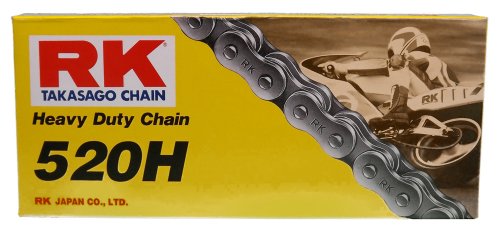
- RKM series chains are made in Malaysia with Japanese steel, meeting all Japanese specs with…
- Pre-stressed and pre-stretched for better performance with fewer adjustments, they outperform most…
- Maximum tensile in pounds/feet: 7700 pounds/feet; weight in pounds per 100 links: 3.65 pounds; max…


- Upgraded from the DID 525 VX2 chain, the DID 525 VX3 X-Ring chain fits a wider range of street, ATV…
- New “Direct Energy Transfer” gives you amazing throttle response due to D. I. D. State-of-the-art…
- Features greatly improved seal performance due to increased X-ring retention and durability
Key Takeaways
- 520 chains are lighter, saving about 1 pound over 525 chains, reducing rotational mass and improving acceleration and throttle response.
- 525 chains have higher tensile strength (~10,400 lbs) compared to 520 (~9,400 lbs), making them more suitable for bikes above 50 hp.
- 520 chains and sprockets may wear faster, especially aluminum sprockets, but wear difference is minimal for typical riding conditions.
- Switching to 520 requires replacing both sprockets, as 525 sprockets do not fit 520 chains properly.
- 520 chains and sprockets are generally more affordable and offer a good balance of performance and cost for mid-range motorcycles.
520 Chain or 525 Chain: Quick Comparison
| Feature / Factor | 520 Chain | 525 Chain |
|---|---|---|
| Weight | ~6 lbs (≈1 lb lighter) | ~7 lbs (heavier) |
| Rotational Mass | Lower → reduces inertia | Higher → more inertia |
| Performance Gain | ~+1.5 HP, quicker acceleration | No added performance gain |
| Throttle Response | Faster, smoother | Slightly slower |
| Tensile Strength | ~9,400 lbs | ~10,400 lbs |
| Durability | Slightly lower, but sufficient for most bikes | Higher, better for heavy-duty use |
| Wear Rate | Slightly faster (especially with aluminum sprockets) | Slower, especially with steel sprockets |
| Sprocket Compatibility | Requires 520 sprockets (full conversion needed) | Uses 525 sprockets |
| Sprocket Weight | Lighter (bi-metal, cutouts) | Heavier (mostly steel) |
| Cost | More affordable (~$140 range) | More expensive (~$240 range) |
| Fuel Efficiency | Slightly improved due to reduced drag | Standard efficiency |
| Best For | Bikes ≤ 50 HP, performance riders | Bikes > 50 HP, durability-focused riders |
| Maintenance Sensitivity | Requires more attention (lubrication, tension) | More forgiving |
What Are the Key Differences Between 520 and 525 Chains?
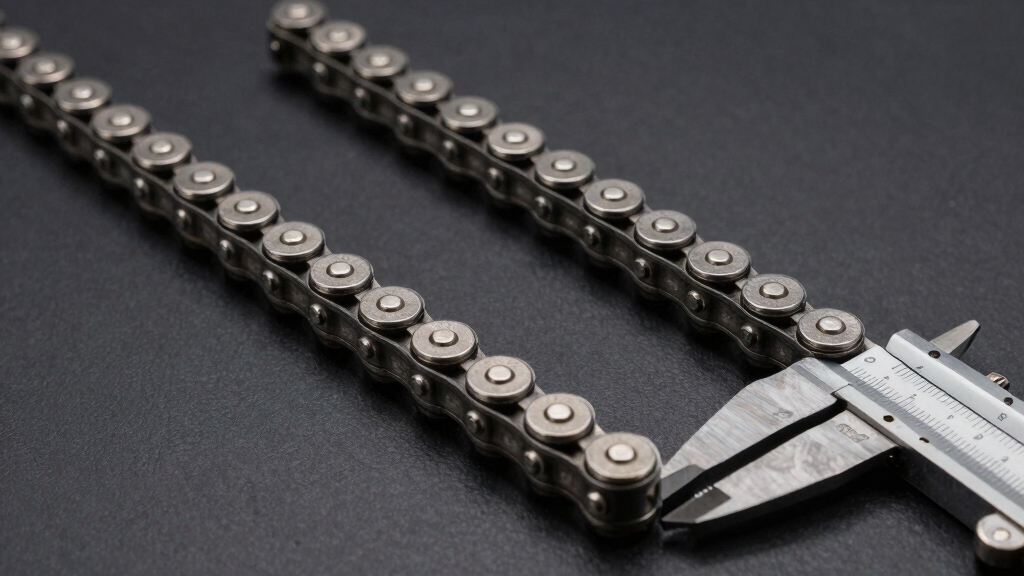
When comparing 520 and 525 chains, one of the most noticeable differences lies in their weight and size. The 520 chain weighs about 6 pounds, saving you roughly 1 pound compared to the 7-pound 525 chain.
This reduction stems from a smaller pitch size and lighter sprockets. Bi-metal 520 sprockets weigh approximately 800 grams less than all-steel 530 counterparts. The 520’s reduced mass lowers parasitic losses, improving efficiency.
However, the 520 chain’s tensile strength, around 9,400 lbs (EK520), is slightly less than the 525’s 10,400 lbs (DID 530).
You need to swap both sprockets when converting to 520, as 525 sprockets don’t fit properly.
Additionally, 520 sprockets often feature material cutouts, further decreasing weight without compromising fitment.
Many high-performance kits, such as the Vortex Racing Kits, emphasize lightweight 520 chains and sprockets to enhance acceleration and handling characteristics.
How Do Weight Savings Improve Motorcycle Performance?
When you switch to a lighter 520 chain, you’re actually reducing the rotational mass of your motorcycle. This is a big deal because it helps lower those pesky parasitic losses that can drain your engine power.
So, what does that mean for you? Well, it means better acceleration response. Your bike can rev up quicker and deliver power more smoothly.
In the end, all of this adds up to a noticeable boost in horsepower. And who doesn’t want that? Whether you’re hitting the track or just cruising on the street, lighter weight means faster and more efficient performance. It’s a win-win situation! Additionally, reducing rotational mass supports maintaining high RPMs within the narrow power band, optimizing peak engine output.
Reduced Rotational Mass
Although reducing weight anywhere on a motorcycle benefits overall performance, cutting down rotational mass, such as with a 520 chain conversion, directly decreases the effort required to spin drivetrain components.
The 520 chain weighs about 1 pound less than a 525 chain over equal lengths, while 520 sprockets are notably lighter due to smaller pitch and bi-metal construction, saving up to 800 grams compared to all-steel 530 sprockets.
This reduction in rotating mass lowers the inertia your engine must overcome, allowing quicker acceleration and smoother throttle response.
You’ll notice less drivetrain snatch and improved power delivery, with dyno gains around 1.5 horsepower.
Additionally, reducing rotational mass can contribute to improved fuel economy by decreasing engine drag and maintaining optimal engine performance.
Lower Parasitic Losses
Lowering the weight of drivetrain components consistently reduces parasitic losses by decreasing the energy your engine expends to overcome friction and inertia.
When you switch from a 525 to a lighter 520 chain and sprockets, your engine works less to turn the drivetrain, improving efficiency.
This reduction in parasitic drag translates to measurable power gains and smoother power delivery.
Key factors include:
- Chain weight: The 520 chain weighs about 1 pound less than the 525, cutting rotational and frictional losses.
- Sprocket mass: Smaller pitch size and bi-metal construction reduce sprocket weight by up to 800 grams, lowering mechanical resistance.
- Material friction: High-quality 520 components exhibit less internal friction, further minimizing energy wastage.
These weight savings reduce drivetrain drag, allowing your engine to deliver power more effectively. Choosing lightweight aluminum sprockets can further enhance acceleration by reducing rotational mass and improving handling, although they may wear faster than steel under extreme conditions, so material trade-offs should be considered.
Enhanced Acceleration Response
Since reducing drivetrain weight cuts rotational inertia, you’ll notice quicker throttle response and faster acceleration with a 520 chain conversion.
The 520 chain and sprockets weigh about 1 kilogram less than the 525 setup, markedly lowering rotational mass.
This reduction decreases parasitic losses, enabling the engine to transfer power more efficiently to the rear wheel.
As a result, you gain roughly 1.5 horsepower on the dyno, translating to improved throttle snatch control and sharper acceleration.
The lighter 520 sprockets, especially bi-metal variants, further enhance response by reducing unsprung weight.
This combination lets your motorcycle rev quicker, accelerate faster, and feel more responsive overall.
Proper clutch adjustment, including finding the correct clutch biting point, is essential to fully capitalize on the enhanced acceleration response from drivetrain upgrades.
What Performance Gains Can You Expect From a 520 Chain?
When you switch to a 520 chain, you gain approximately 1.5 horsepower on the dyno by reducing rotational mass and decreasing parasitic losses in the drivetrain.
This weight reduction allows your bike to accelerate quicker and maintain higher speeds with less effort. The lighter chain and sprockets cut down on drivetrain snatch, delivering smoother power transfer and improved throttle response.
Consider these performance factors with a 520 chain:
Nearly 1 pound saved in chain weight, plus lighter sprockets reduce overall rotating mass.
Reduced parasitic losses translate to measurable horsepower gains and better fuel efficiency.
Enhanced drivetrain smoothness lowers mechanical drag, improving acceleration consistency.
Switching to a 520 chain offers tangible performance improvements, especially on lightweight motorcycles aiming for optimized power delivery.
Regular maintenance such as preventive maintenance is essential to keep the drivetrain performing at its best and prolong the life of your chain and sprockets.
Is a 520 Chain Strong Enough and Durable for Your Bike?
The EK520 chain has a tensile strength of around 9,400 lbs. Now, that’s a bit less than the 10,400 lbs of a DID 530 chain, but it still surpasses most stock OEM chains out there.
You might notice that the wear rates on 520 chains can be slightly higher, especially if you’re racking up the miles. But honestly, the difference is pretty minimal for typical track days or daily rides. For bikes used in challenging conditions like sandy beaches, choosing components with high torque and durable frames can help maintain performance and longevity.
Tensile Strength Comparison
Although the 520 chain offers a tensile strength of approximately 9,400 lbs compared to the 10,400 lbs of a 530 chain, it still exceeds the typical OEM stock chain rating of around 6,500 lbs.
This means you can rely on a high-quality 520 chain for most motorcycles up to about 50 horsepower without compromising safety or performance. While the 530 chain provides a higher absolute strength, the 520’s tensile rating is sufficient for street and light sport applications.
The 520 chain’s tensile strength covers the majority of mid-range bikes, ensuring durability under typical loads. For high-power or heavy-duty use, the 530 chain’s additional strength offers a safety margin.
Tensile strength alone doesn’t dictate overall chain performance; installation and maintenance also play key roles. Proper installation and regular maintenance are essential for ensuring durability and serviceability over time.
Wear And Longevity
Strength alone doesn’t guarantee a chain’s lifespan under real-world conditions, so examining wear and longevity becomes necessary.
While 520 chains have slightly lower tensile strength than 525, high-quality 520 chains outperform many OEM stock chains in durability.
You’ll notice marginally faster wear on 520 chains and sprockets, especially aluminum sprockets, compared to 525 steel counterparts.
However, after extensive riding, such as track days, 4700 km touring, or daily commuting, the difference in wear is negligible for most users.
If you plan high-mileage touring, expect the smaller 520 chain to show wear sooner.
Proper maintenance and using quality 520 components will extend service life.
Regularly checking and adjusting the timing chain tensioner helps prevent premature chain wear and engine damage.
How Do 520 and 525 Chains Affect Sprocket Wear?
When you switch from a 525 to a 520 chain, the smaller pitch size and lighter weight influence sprocket wear patterns. The 520 chain’s reduced pitch means sprocket teeth engage differently, potentially accelerating wear on aluminum sprockets.
Lighter chains reduce stress on sprockets but may increase localized pressure due to narrower contact surfaces. You’ll find that 520 sprockets often use lighter materials and cutouts, which also impact durability.
520 chains cause faster wear on aluminum sprockets compared to steel 525 sprockets. The smaller pitch results in more frequent tooth engagement cycles per distance traveled. Thinner 520 sprockets can deform or wear unevenly under high loads, especially without proper chain tension.
Understanding these factors helps you optimize sprocket life when choosing between 520 and 525 chains. Choosing the right chain and sprocket setup is similar to deciding between a pod filter and an airbox, where each has distinct performance and durability trade-offs.
What Are the Cost Benefits of Choosing a 520 Chain?
Several cost advantages make the 520 chain an attractive option for riders seeking performance and budget balance.
The 520 chain offers riders a smart balance of performance and affordability.
You’ll find top-tier EK520 chains priced around $140, markedly less than $240 for comparable 525 chains.
Additionally, 520 sprockets tend to be cheaper due to smaller pitch size and material efficiency.
They often feature weight-saving cutouts that reduce mass without sacrificing function.
When converting, you save not only on initial purchase but also gain performance benefits without extra costs.
The entire 520 conversion kit presents a cost-effective upgrade that includes chain and sprockets designed for peak fit and reduced parasitic losses.
Overall, choosing a 520 chain reduces your drivetrain’s weight and expense.
This delivers measurable savings without compromising quality or reliability for typical sport and street motorcycles.
Which Bikes and Riders Should Switch to a 520 Chain?
Who benefits most from switching to a 520 chain?
If you ride a bike producing up to 50 horsepower, upgrading to a 520 chain can save you nearly 1 kilogram in weight and deliver around 1.5hp performance gains.
You’ll notice reduced drivetrain snatch and quicker throttle response, ideal for lighter sport bikes and aggressive commuters seeking enhanced acceleration without sacrificing durability.
Consider switching if you:
Own mid-range sport or naked bikes with stock chains below 6500 lbs tensile strength.
Prioritize weight savings and marginal horsepower increases for track or spirited street riding.
Want cost-effective maintenance with cheaper, lighter sprockets and chains that still exceed OEM strength.
However, powerful superbikes above 50 hp should carefully evaluate 520 chain strength limitations before converting.
Frequently Asked Questions
How Do You Properly Install a 520 Chain Conversion Kit?
To properly install a 520 chain conversion kit, first remove your existing chain and both sprockets.
Then, install the new 520 front and rear sprockets, ensuring they fit snugly.
Thread the 520 chain around the sprockets, maintaining proper tension and alignment.
Use a chain rivet tool to connect the master link securely.
Finally, double-check chain slack per manufacturer specs and test for smooth rotation before riding.
Can a 520 Chain Handle Off-Road or Dirt Biking Conditions?
Yes, a 520 chain can handle off-road or dirt biking if your bike’s power stays around 50 horsepower.
It offers strong tensile strength (around 9400 lbs) and lighter weight, improving performance.
However, expect slightly faster wear, especially on rough terrain, and aluminum sprockets may wear quicker than steel ones.
For intense riding or heavier bikes, consider the durability limits before committing to a 520 setup.
What Maintenance Tips Extend the Life of a 520 Chain?
To extend your 520 chain’s life, clean and lubricate it regularly, especially after wet or dusty rides. This minimizes wear despite its slightly faster natural wear rate.
Use high-quality chain lube and avoid over-tightening. Maintain proper chain tension to reduce stress.
Inspect sprockets for wear and replace them alongside the chain to prevent premature damage.
These steps help you enjoy durable, efficient performance without worrying about the chain’s lighter build.
Are There Specific Brands Recommended for 520 Chain Conversions?
You’ll want to think about EK and DID for 520 chain conversions, as both offer high-quality options.
EK520 chains provide excellent tensile strength (around 9400 lbs) and lighter weight, enhancing performance.
DID also produces reliable 520 chains suitable for bikes up to 50 horsepower.
Choose reputable brands to make certain durability and compatibility with 520 sprockets.
Avoid cheaper knockoffs that wear faster and compromise safety.
How Does Chain Lubrication Differ Between 520 and 525 Chains?
You’ll find lubrication needs similar for both chains, but with 520 chains, you need to be more diligent.
Since 520 chains have smaller pitch and lighter components, they can be more sensitive to lubrication lapses, which may accelerate wear.
Use a high-quality chain lube regularly, focusing on penetrating rollers and pins.
Avoid over-lubricating to reduce dirt attraction.
Proper lubrication guarantees peak performance and longevity, especially on lightweight 520 chains.
Find Your Perfect Balance: Performance Meets Practicality
Choosing between a 520 and 525 chain comes down to your bike’s needs and your riding style.
The 520 offers impressive weight savings that can feel like shedding a ton of bricks off your ride, boosting acceleration and handling.
While slightly less durable than a 525, it’s strong enough for most street and light off-road use.
If you want performance gains without breaking the bank, the 520 chain is a smart, precise upgrade you won’t regret.
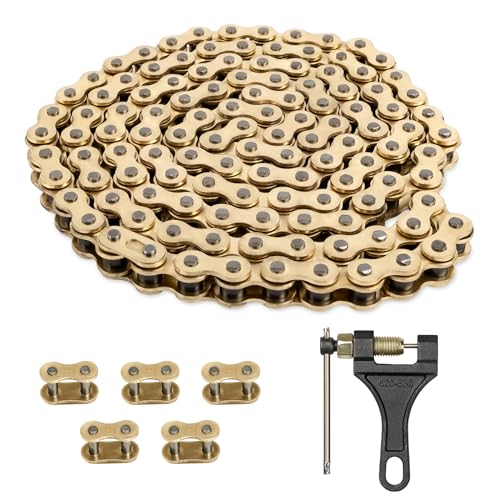
- 【Compatible with】Fit for most of 250cc 300cc Pit Dirt Bike Motorcycle 4 Wheeler ATV Quad Go Kart…
- 【Rugged and Reliable】Engineered for demanding conditions and high-speed riding, the 520 gold…
- 【Premium Construction】Crafted from superior materials, this mini bike chain is meticulously…

- Professional V series O-ring chains are high-quality O-ring chains with excellent wear resistance
- Features solid bushings with reinforced rollers for great impact resistance and the longest possible…
- The projected wear life is 2500 times longer than a standard chain under similar conditions
Last update on 2026-10-07 / Affiliate links / Images from Amazon Product Advertising API