

When choosing between #40 and #420 chains, you need to match pitch (both 1/2″), roller width, and sprocket fit precisely to avoid excessive side-to-side play and premature wear.
#40 chains have wider rollers and thicker pins, offering superior static strength but less shock resistance.
#420 chains excel under dynamic loads with narrower rollers, fitting snugly on proper sprockets to guarantee smooth engagement.
Understanding these distinctions helps optimize drivetrain durability and performance for your application.
More detailed comparisons clarify when each excels.

- ANSI #40 Roller Chain 10 Feet with 2 Connecting Links for Go Karts, Mini Bikes, Scooters, ATV, MTV…
- Precision Heat-Treated Components – Engineered with heat-treated pins, side plates, and rollers…
- Optimized for Reduced Wear- Designed with high-quality steel and advanced manufacturing techniques…
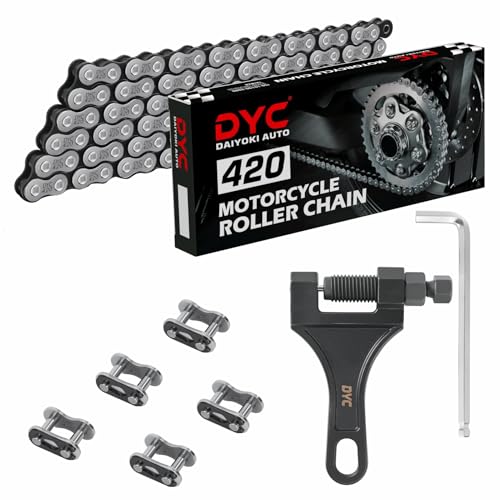
- 1. Complete 420 Chain Kit – Includes 132 link 420 chain 5 clip master links and chain breaker tool…
- 2. Cut to Fit Design – Start at 132 links and remove links with the included breaker to match your…
- 3. Fits Popular Small Engine Setups – Commonly used on mini bikes pit bikes dirt bikes ATVs and go…
Key Takeaways
- Both #40 and #420 chains have a 1/2-inch pitch but differ significantly in roller width and pin diameter.
- #40 chains are wider with thicker pins, offering greater static tensile strength and load capacity.
- #420 chains are narrower, optimized for dynamic loads, shock resistance, and better durability under fluctuating stresses.
- Using mismatched #40 and #420 chains and sprockets causes lateral slop, poor seating, accelerated wear, and engagement issues.
- #40 suits static industrial applications; #420 is preferred for motorcycles up to 450cc for superior dynamic performance.
#40 Chain vs #420 Chain: Complete Side-by-Side Comparison
| Feature | #40 Chain | #420 Chain |
|---|---|---|
| Chain Pitch | 1/2 inch (12.7 mm) | 1/2 inch (12.7 mm) |
| Roller Width | Wider | Narrower |
| Pin Diameter | Larger (approx. 3/16 in.) | Smaller (approx. 9/64 in.) |
| Overall Width | Wider | Narrower |
| Static Strength | Higher | Moderate |
| Dynamic Load Performance | Good | Excellent |
| Shock Resistance | Moderate | Better |
| Tensile Strength | Higher static tensile strength | Better suited for fluctuating loads |
| Sprocket Compatibility | Requires #40 sprockets | Requires #420 sprockets |
| Chain-to-Sprocket Fit | Loose on #420 sprockets | Precise fit on #420 sprockets |
| Side-to-Side Play | More when mismatched | Minimal with correct sprockets |
| Wear Resistance | Excellent in steady-load applications | Better under high-RPM and shock loads |
| Typical Applications | Industrial equipment, go-karts, minibikes | Motorcycles, dirt bikes, go-karts |
| Horsepower Suitability | Best for moderate horsepower | Suitable for engines up to approximately 450cc |
| Weight | Heavier | Lighter |
| High-Speed Performance | Good | Better |
| Main Advantage | Greater static strength and load capacity | Superior dynamic performance and smoother engagement |
| Main Drawback | Poor fit on #420 sprockets and lower shock resistance | Lower static strength than #40 |
40 vs. #420 Chains: What You Need to Know?
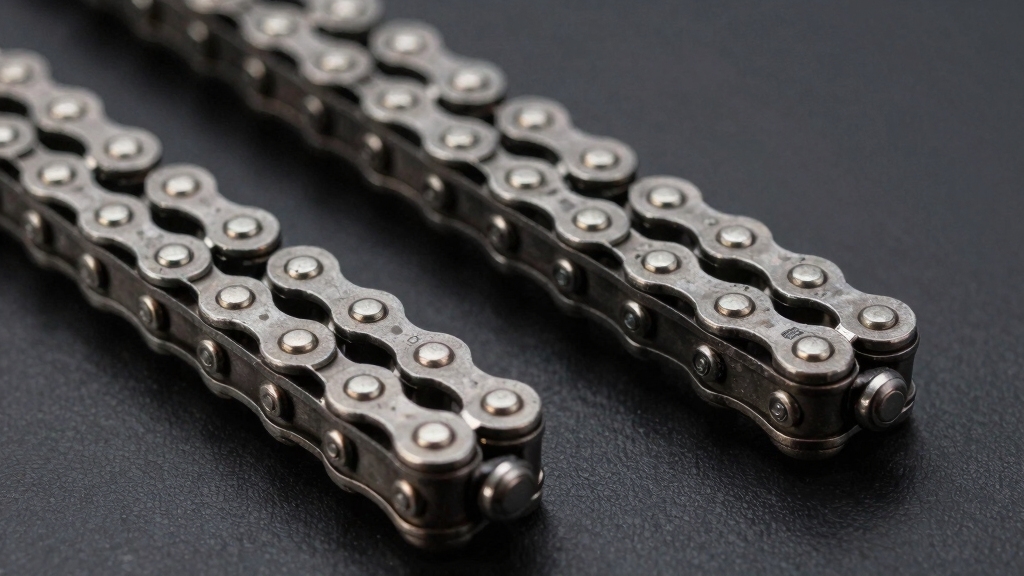
While both #40 and #420 chains share a 1/2-inch pitch, their dimensional differences critically affect compatibility and performance.
The #40 chain has a wider roller and pin diameter (typically 3/16-inch) compared to the narrower #420’s 9/64-inch pins.
This width variation means #40 chains rarely fit #420 sprockets without excess lateral slop, compromising engagement and wear resistance.
Conversely, #420 chains can’t properly seat on #40 sprockets, causing misalignment and premature failure.
You’ll find #40 chains excel under static, high-load applications due to robust pin size and tensile strength.
Meanwhile, #420 chains outperform dynamically with superior shock resistance despite smaller pins.
Understanding these structural distinctions is essential for selecting the correct chain to match sprocket design, load profile, and operational speed without risking mechanical inefficiency or damage.
Proper chain and sprocket selection is crucial for drivetrain durability and to prevent accelerated wear or failure.
Physical Dimensions of #40 and #420 Chains
You might’ve noticed that both #40 and #420 chains have a 1/2-inch pitch. That’s a common feature, but there’s a big difference when it comes to their widths and pin diameters. For instance, the #40 chain has wider rollers and pins. This can actually cause some fit issues if you try to use it with narrower #420 sprockets. You might end up with some side-to-side slop, which isn’t ideal. Understanding how material strength affects chain durability can help you choose the right chain for your application.
Chain Pitch And Width
Because chain pitch and width directly affect compatibility and performance, understanding the physical dimensions of #40 and #420 chains is essential. Both chains share a 1/2-inch pitch, but their widths differ significantly, influencing sprocket fit and operational stability.
The #40 chain features the widest roller and overall width, suited for industrial uses, while #420 is narrower, designed for motorcycles and karts. This width difference causes slop when mismatched with incompatible sprockets, impacting chain seating and wear.
| Specification | #40 Chain | #420 Chain |
|---|---|---|
| Pitch | 1/2 inch (12.7 mm) | 1/2 inch (12.7 mm) |
| Roller Width | Largest (~1/4 inch) | Narrower (~3/16 inch) |
| Overall Width | Widest (~0.375 inch) | Narrow (~0.28 inch) |
| Sprocket Fit | Requires wide sprockets | Fits #41 sprockets |
| Side-to-Side Slop | High on narrow sprockets | Minimal |
Proper maintenance, such as applying grease to the spindle, helps ensure smooth chain and sprocket operation and extends component life.
Roller And Pin Dimensions
Examine the roller and pin dimensions closely to understand how they influence chain strength and compatibility. The #40 chain features a 1/2-inch pitch with a wider roller and a larger pin diameter, typically 3/16-inch. This contributes to its industrial-grade strength.
In contrast, the #420 chain also has a 1/2-inch pitch but with narrower rollers and smaller pins, about 9/64-inch. This optimizes it for dynamic loads common in motorcycles and go-karts.
Consider these key points:
- The #40 chain’s wider rollers provide greater surface contact, enhancing load distribution and durability under static loads.
- The #420 chain’s smaller pins and rollers reduce weight and allow higher RPM use with less inertia.
- Pin size affects tensile strength. The thicker pins in #40 chains support static loads better, while #420 pins handle shock loads dynamically.
Many mini bike and small-engine kits utilize the 420 chain size for its balance of durability and torque enhancement.
Sprocket Fit And Slop
While both #40 and #420 chains share a 1/2-inch pitch, their differing widths affect sprocket compatibility and fit. The #40 chain is markedly wider, causing side-to-side slop of about 2mm when used on #420 sprockets.
Conversely, the narrower #420 chain fits snugly on #420 sprockets but fails to seat properly on #40 sprockets due to clearance issues. The sprocket width mismatch is critical for performance and longevity, especially under dynamic loads.
Proper fit and minimal slop help reduce wear and maintain optimal power transfer, similar to how adjustable fit and secure placement in protective gear ensure stability and safety.
| Specification | #40 Chain | #420 Chain |
|---|---|---|
| Pitch | 1/2 inch | 1/2 inch |
| Roller Width | Largest | Intermediate |
| Pin Diameter | 3/16 inch | 9/64 inch |
| Sprocket Fit | Loose on #420 | Snug on #420 |
| Side-to-Side Slop | ~2 mm on #420 | Minimal |
Sprocket Compatibility for #40 and #420 Chains
When selecting sprockets for your chain, you’ll find that #40 and #420 chains demand careful matching due to their differing widths and pitch compatibility. Both chains share a 1/2-inch pitch, but #40 has a wider roller and pin diameter, making it incompatible with most #420 sprockets.
Conversely, #420 chains won’t seat properly on #40 sprockets because of the width mismatch. Consider these key points:
- #40 sprockets are wider, designed for the broader #40 chain; #420 sprockets are narrower, tailored for #420 chains.
- Using #40 chain on #420 sprockets can cause slop and uneven engagement.
- #420 chains fit #420 sprockets precisely but won’t work well with #40 sprockets, risking premature wear.
Match sprockets precisely to guarantee peak chain performance and longevity.
Problems With Mismatched Chains and Sprockets
When you pair a #40 chain with narrower #420 sprockets, you might run into some width compatibility issues. This mismatch can create about 2mm of side-to-side slop. That slop? It makes for inconsistent sprocket seating, which isn’t ideal.
Why does that matter? Well, reduced engagement can lead to increased wear on both the chain and sprockets. So, understanding these dimensional mismatches is super important. It can help you avoid premature failure, saving you time and money in the long run. Additionally, ensuring proper chain and sprocket compatibility contributes to better handling and overall motorcycle performance.
Width Compatibility Issues
Because #40 chains are noticeably wider than #420 chains, using them on sprockets designed for narrower chains leads to improper seating and excessive side-to-side slop, often around 2mm.
This width mismatch creates critical compatibility issues:
- #40 chain rollers exceed the width of #420 sprocket teeth, causing uneven load distribution and accelerated wear.
- #420 chains don’t fully engage #40 sprocket teeth, risking slippage and increased stress on pins and plates.
- Sprockets labeled #40/#420 often favor #420 dimensions, forcing #40 chains to ride loosely, compromising alignment and durability.
When you mismatch widths, you undermine chain-sprocket meshing integrity.
This results in premature failure and reduced power transfer efficiency.
Always verify both roller and sprocket tooth widths for best pairing.
For safe maintenance and handling, it is important to use proper tools and supports when working with chains and sprockets to avoid damage and ensure safety.
Side-to-Side Chain Slop
The #40 chain’s roller width exceeds that of #420 and #41 sprockets, creating approximately 2mm lateral movement during engagement.
This slop leads to inconsistent chain tracking, accelerated wear on sprocket teeth, and potential chain derailing under load.
You’ll notice the chain rocking side-to-side since the sprocket flanges can’t fully constrain the wider rollers.
Conversely, a narrower #420 chain on a #40 sprocket results in poor seating but less lateral slop.
Side-to-side slop compromises drivetrain precision and can induce premature fatigue in dynamic applications.
Minimizing this requires matching chain width to sprocket flange spacing, prioritizing dimensional compatibility over nominal pitch alone.
Choosing sprockets made of lightweight aluminum can improve handling but requires careful attention to compatibility to avoid such issues.
Sprocket Seating Problems
When chains and sprockets don’t match in width or pitch, proper seating is compromised. This leads to engagement issues that affect drivetrain performance. You’ll encounter problems like uneven wear, increased slop, and premature failure.
- Width Mismatch: The #40 chain’s wider rollers don’t seat properly in #420 sprockets. This causes lateral movement and unstable engagement.
- Pitch Compatibility: While both #40 and #420 share a 1/2-inch pitch, subtle variations in roller diameter and pin size degrade seating precision.
- Sprocket Tooth Fit: #420 chains often fail to engage fully with #40 sprocket teeth. This results in skipped engagement and accelerated sprocket tooth wear.
To avoid these issues, ensure chain and sprocket compatibility by matching both width and pitch precisely. This maintains drivetrain reliability and reduces maintenance demands. Proper chain tension and adjustment using chain tension gauges can also help mitigate wear and improve seating performance.
Strength and Durability of #40 and #420 Chains
Although both #40 and #420 chains serve different operational roles, you’ll find that the #420 chain outperforms the #40 in handling dynamic loads and shock loads due to its higher tensile strength and specialized design.
The #420 chain typically boasts tensile strengths up to 3,000 lbs, with the #420H variant offering even greater durability through thicker plates.
In contrast, the best #40 chains have working loads just over 1,000 lbs and tensile strengths exceeding 4,000 lbs primarily in static or moderate load conditions.
However, the #420’s design optimizes for abrupt torque spikes common in motorcycle and kart applications, providing superior resistance to fatigue and impact.
You’ll notice #40 chains excel in static industrial settings, but for shock resilience and longevity under fluctuating loads, #420 chains are the technically superior choice.
For applications like scooters and motorcycles, upgrading to a chain with higher tensile strength can significantly improve mechanical durability and overall performance.
Horsepower Ratings for #40 and #420 Chains
Understanding the strength differences between #40 and #420 chains naturally leads to examining their horsepower ratings, which reflect practical limits in power transmission.
You’ll find:
- #40 chain struggles beyond moderate horsepower levels and isn’t reliable for 40-60 HP applications.
- Standard #420 chain is marginal in the 40-60 HP range; for durability, the #420H variant is recommended.
- Both chains reach their limits near 60 HP, with #420 favored for dynamic loads in 250cc to 450cc engines.
If you’re dealing with high-horsepower setups, #35 chains usually fail before #420 or #40 chains.
For kart or minibike use, #420 suits typical engine sizes without failure.
However, you shouldn’t push either chain beyond their rated horsepower to avoid premature breakage.
How Roller Width Affects Chain and Sprocket Fit?
In chain and sprocket systems, roller width plays a crucial role in ensuring proper fit and function. The #40 chain features the widest roller width, which demands a sprocket with equally wide teeth to avoid side-to-side slop.
When you try fitting a #40 chain on a #420 sprocket, the excess roller width causes misalignment and lateral play of roughly 2mm. This degrades performance and accelerates wear. Conversely, the narrower #420 chain seats well on #420 sprockets, minimizing lateral movement and ensuring consistent engagement.
If you mount a #420 chain on a #40 sprocket, the sprocket’s wider teeth prevent proper seating. This can cause binding or increased noise. Hence, matching roller width to sprocket width is critical to maintain precise chain tracking, reduce premature wear, and optimize power transmission efficiency.
Dynamic Load Effects on #40 and #420 Chains
Proper roller width alignment between chain and sprocket directly influences how well the system handles dynamic stresses. When you mismatch #40 and #420 chains with incompatible sprockets, side-to-side slop increases impact loads and accelerates wear.
The #420 chain, narrower with a smaller pin diameter, absorbs shock better under rapid torque changes, making it preferable for dynamic loads. Consider these critical points:
- #420’s higher dynamic rating handles hard jerks and shocks more efficiently than #40.
- #40’s wider rollers reduce slop in static, industrial settings but struggle under sudden load spikes.
- Mismatched widths cause uneven load distribution, leading to premature fatigue and potential failure.
You’ll see that precise roller width matching optimizes durability and performance when dealing with dynamic loading conditions.
When to Choose #40 vs. #420 Chains?
When should you choose a #40 chain over a #420, or vice versa? Opt for a #40 chain if your application demands higher static load capacity and wider roller width to improve tooth engagement in industrial settings.
Choose a #40 chain for higher static loads and better tooth engagement in industrial applications.
Its larger pin diameter and overall width provide durability under steady torque without rapid dynamic stress.
Conversely, select a #420 chain when dealing with dynamic loads, especially in go-karts or minibikes where shock absorption and tensile strength are critical.
The #420’s narrower profile fits standard motorcycle sprockets better, reducing side-to-side slop and enhancing chain-sprocket mesh at higher RPMs.
Keep in mind, #420 chains handle jerks and horsepower up to moderate levels effectively, while #40 chains excel in low-RPM, high-torque environments but struggle with dynamic stress beyond those limits.
Picking the Right Chain for Go-Karts and Motorcycles?
When you’re picking a chain for go-karts and motorcycles, it’s important to strike a balance between strength and compatibility. So, should you go with #40 or #420? Well, here’s the scoop: #420 chains have a higher dynamic load capacity, which sounds great, right? But keep in mind that their narrower width means you need to ensure your sprockets are a perfect match.
Otherwise, you might end up with slop or improper seating.
Understanding these trade-offs is key. You want to make sure your chain fits well and can handle the specific power and load conditions of your vehicle. By taking the time to weigh your options, you can guarantee peak performance and durability. It’s all about finding that sweet spot!
Chain Strength Comparison
Choosing the right chain for go-karts and motorcycles hinges on understanding their strength characteristics under dynamic loads. The #420 chain generally outperforms the #40 in handling sudden shocks and jerks due to its higher dynamic load rating. The #40’s industrial-grade tensile strength exceeds 4,000 lbs. You should consider these key factors:
- Tensile Strength: #40 chains have a static tensile strength over 4,000 lbs. However, #420 chains offer better durability under dynamic stress.
- Working Load: Best #40 chains sustain about 1,000 lbs working load. #420 variants, especially #420H, handle higher abuse.
- Horsepower Limit: #40 is unreliable beyond moderate horsepower. #420 suits engines up to 450cc 4-stroke or 250cc 2-stroke without failure.
Selecting between them requires balancing static strength against dynamic resilience for your application.
Compatibility and Fit
Although the #40 and #420 chains share a 1/2-inch pitch, their differing widths and pin diameters create significant compatibility challenges.
The #40 chain, with its wider roller and larger pin diameter (often 3/16-inch), doesn’t fit snugly on #420 or #41 sprockets, causing side-to-side slop around 2mm.
Conversely, the narrower #420 chain, featuring thinner rollers and a 9/64-inch pin diameter, fails to seat properly on #40 sprockets due to excessive sprocket width.
When selecting a chain for go-karts or motorcycles, you must prioritize sprocket compatibility based on pitch and width to avoid premature wear and inefficiency.
While #420 chains suit dynamic, high-jerk applications with tighter fits, #40 chains excel in static, industrial setups but require matching sprockets to maintain alignment and longevity.
Frequently Asked Questions
How Do Environmental Factors Affect #40 and #420 Chain Lifespan?
Environmental factors like moisture, dirt, and temperature affect your #40 and #420 chains differently.
You’ll find that #40’s wider rollers trap more debris, accelerating wear, especially in dusty or wet conditions.
The #420’s narrower profile sheds contaminants better, extending lifespan under dynamic loads.
However, both chains require regular lubrication and cleaning to prevent corrosion and fatigue.
High humidity or salt exposure demands more frequent maintenance to maintain peak tensile strength and durability.
What Maintenance Routines Best Preserve #40 and #420 Chains?
Imagine you run a kart racing team; you’ll want to clean and lubricate your chains after every race to prevent grit buildup.
You should regularly inspect pin wear and sprocket tooth condition, adjusting tension to avoid slop or binding.
Use high-quality chain lube suited for your environment and replace chains showing elongation beyond specs.
Consistent maintenance like this extends chain life, ensuring reliable performance under dynamic loads and reducing unexpected failures.
Can #40 or #420 Chains Be Safely Used in Wet Conditions?
You can use both #40 and #420 chains in wet conditions, but you need to prioritize corrosion resistance and lubrication.
These chains are steel-based, so exposure to water accelerates rust and wear. Applying a water-resistant lubricant frequently is essential to maintain durability and prevent seizing.
For prolonged wet use, consider chains with corrosion-resistant coatings or synthetic lubricants.
Regular cleaning after wet exposure will help you preserve chain life and performance effectively.
Are There Significant Noise Differences Between #40 and #420 Chains?
You’ll notice #420 chains generally run quieter than #40 chains due to their narrower roller width and tighter fit on sprockets. This design reduces side-to-side slop by about 2mm.
That slop in #40 chains can cause more noise and vibration, especially at higher RPMs. If minimizing noise is critical, the #420’s design offers a smoother, more precise engagement with sprockets.
This leads to less mechanical clatter during operation.
What Lubrication Types Are Recommended for #40 and #420 Chains?
You should use high-quality chain lubricants designed for roller chains on both #40 and #420 chains.
Opt for synthetic or semi-synthetic oils with anti-wear additives to reduce friction and resist fling-off at high RPMs.
For industrial #40 chains, heavier grease or oil with EP (extreme pressure) properties works well under static loads.
On dynamic #420 chains, lighter, fast-penetrating lubricants maintain flexibility and minimize noise during operation.
Regular application guarantees peak performance.
- ANSI #40 Roller Chain 10 Feet with 2 Connecting Links for Go Karts, Mini Bikes, Scooters, ATV, MTV…
- Precision Heat-Treated Components – Engineered with heat-treated pins, side plates, and rollers…
- Optimized for Reduced Wear- Designed with high-quality steel and advanced manufacturing techniques…
- 1. Complete 420 Chain Kit – Includes 132 link 420 chain 5 clip master links and chain breaker tool…
- 2. Cut to Fit Design – Start at 132 links and remove links with the included breaker to match your…
- 3. Fits Popular Small Engine Setups – Commonly used on mini bikes pit bikes dirt bikes ATVs and go…
Conclusion
Choosing between #40 and #420 chains hinges on your specific application’s demands. You need to ponder sprocket compatibility, roller width, and dynamic load effects carefully.
While #40 offers greater strength and durability, #420 is lighter and suits smaller machines. Don’t overlook the risks of mismatched parts; can you afford the cost of premature wear or failure?
Ultimately, selecting the right chain guarantees peak performance and longevity for your go-kart or motorcycle.
Last update on 2026-10-27 / Affiliate links / Images from Amazon Product Advertising API