
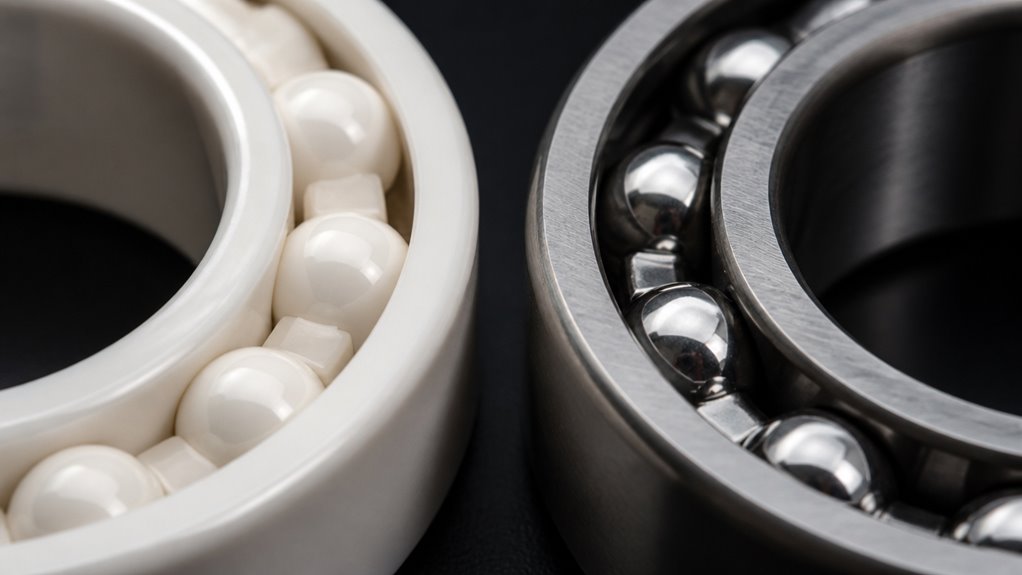
When choosing between ceramic and steel bearings, you’ll find ceramic bearings offer lighter weight, lower friction, and superior corrosion resistance. This boosts speed and reduces maintenance.
Steel bearings excel in load capacity, toughness, and impact resistance, fitting heavy-duty or shock-prone tasks. Ceramic’s electrical non-conductivity prevents erosion under stray currents.
Although ceramic costs more upfront, its durability and performance often justify the investment in demanding conditions. Explore further to understand how these factors affect your specific application needs.
Key Takeaways
- Ceramic bearings have lighter, harder balls with lower friction, enabling up to 20–40% higher speeds than steel bearings in optimized conditions.
- Steel bearings offer superior load capacity, toughness, and impact resistance, making them better for heavy-duty and shock-prone applications.
- Ceramic materials resist corrosion and electrical erosion, ideal for harsh, chemically aggressive, or electrically active environments.
- Ceramic bearings generate less heat and require less frequent lubrication, reducing maintenance and extending service life compared to steel.
- Ceramic bearings cost two to three times more initially but can provide better life-cycle value in high-speed or corrosive settings.
Ceramic or Steel Bearings: Side-by-Side Feature Breakdown
| Feature | Ceramic Bearings | Steel Bearings |
|---|---|---|
| Ball Material | Silicon nitride, zirconia, or alumina | Chrome, carbon, or stainless steel |
| Weight | Lighter | Heavier |
| Friction | Lower | Higher |
| Speed Capability | Up to 20–40% higher in optimized conditions | Standard industrial speeds |
| Practical Speed Gain | Often around 3% | Baseline |
| Load Capacity | Lower under heavy shock loads | Superior |
| Impact Resistance | Lower due to brittleness | Excellent |
| Hardness | Higher | Lower |
| Wear Resistance | Excellent | Good |
| Corrosion Resistance | Excellent | More prone to corrosion |
| Electrical Conductivity | Non-conductive; resists electrical erosion | Conductive; more vulnerable to electrical pitting |
| Heat Resistance | Excellent | Moderate |
| Heat Generation | Lower | Higher |
| Lubrication Needs | Less frequent | More frequent |
| Maintenance | Lower | Higher |
| High-Speed Performance | Excellent | Good |
| Heavy-Duty Performance | Moderate | Excellent |
| Upfront Cost | About 2–3× higher | More economical |
| Best Applications | High-speed, corrosive, high-temperature, or electrically sensitive environments | Heavy-duty, shock-prone, and standard industrial applications |
| Main Advantage | Lower friction, lighter weight, corrosion resistance, and reduced maintenance | High load capacity, toughness, impact resistance, and affordability |
| Main Drawback | Higher cost and greater brittleness under impact | Heavier, higher friction, and more susceptible to corrosion |
What Materials Make Up Ceramic and Steel Bearings?

When choosing between ceramic and steel bearings, understanding their material composition is essential because it directly influences performance and durability.
Ceramic bearings primarily use silicon nitride, zirconia, or alumina for the balls. Steel bearings use various hardened steels, such as chrome, carbon, or stainless steel, for both balls and races.
Many ceramic bearings are hybrids, combining ceramic balls with steel inner and outer races, maintaining standard geometry. Steel bearings typically feature steel balls and races throughout, forming a commodity design.
The core design difference lies in ball material rather than bearing form factor. This material distinction affects hardness, stiffness, and corrosion resistance, setting the foundation for performance variations without altering the bearing’s basic geometry or interchangeability with steel counterparts.
Due to steel’s superior fatigue resistance compared to aluminum and ceramics, steel bearings often provide greater durability under high cyclic loads, making fatigue resistance a critical factor in material selection.
How Ceramic and Steel Bearings Compare in Speed and Performance?
Achieving peak speed and performance hinges markedly on the choice between ceramic and steel bearings. Their differing material properties directly impact rotational efficiency and friction.
Ceramic balls are lighter and have a lower coefficient of friction, enabling up to 20–40% higher speeds in some cases. However, practical gains often max out near 3%.
Steel bearings weigh more and generate higher friction, limiting speed but maintaining consistent performance under varied conditions.
| Property | Ceramic Bearings | Steel Bearings |
|---|---|---|
| Rotational Mass | Lower (lighter balls) | Higher (steel balls) |
| Coefficient of Friction | Lower | Higher |
| Speed Capability | Up to 40% higher (theoretical) | Standard industrial speeds |
| Heat Dissipation | Better | Moderate |
Your choice affects efficiency and speed thresholds critically. Proper selection and maintenance of components, such as brake pads with specialized compounds for heat management and modulation, can further enhance overall bike performance and safety under demanding conditions, especially when using carbon rims with heat dissipation features.
Strength and Durability of Ceramic vs Steel Bearings
Although ceramic bearings offer higher stiffness and hardness, which enhances wear resistance and durability, you should consider their lower elasticity compared to steel when evaluating performance under heavy or shock loads.
Ceramic balls deflect less under load due to increased stiffness, reducing deformation and maintaining precision. However, their brittleness increases susceptibility to brinelling or raceway damage under impact.
Steel bearings, while softer, provide superior load capacity and elasticity, allowing them to absorb shock better and resist fracture in demanding applications.
Regarding wear life, ceramics generally outperform steel in moderate to high-speed conditions due to hardness and lower friction. However, steel’s toughness often makes it preferable where heavy, fluctuating loads or impacts are common.
Consequently, your choice depends on load type, impact risk, and operational demands.
Additionally, steel’s superior toughness and ductility contribute to its resilience in impact-prone environments, unlike ceramics which are more brittle.
How Corrosion and Heat Impact Ceramic and Steel Bearings?
Beyond load capacity and wear resistance, corrosion and heat materially affect bearing performance and longevity.
Corrosion and heat significantly influence bearing durability and overall performance beyond just load and wear factors.
When you choose ceramic bearings, you benefit from superior corrosion resistance due to their silicon nitride or zirconia composition. This prevents degradation in harsh environments.
Ceramics also tolerate higher temperatures, maintaining dimensional stability and reducing thermal expansion compared to steel.
Conversely, steel bearings, made from chrome or carbon steel, are prone to corrosion, especially without adequate lubrication. This accelerates wear and increases the risk of failure.
Steel’s greater thermal expansion can cause increased internal stress and heat buildup during high-speed operation, impacting service life.
Additionally, ceramic’s non-conductive nature minimizes electrical erosion and pitting, a common failure mode in steel bearings under electrical load.
Understanding these factors helps you optimize bearing selection for heat and corrosion-prone applications.
Regular maintenance and timely calibration of tools in harsh environments are essential to ensure performance and longevity, especially when exposed to extreme temperatures and corrosive conditions.
Maintenance Needs for Ceramic Vs Steel Bearings
Since ceramic bearings have smoother surfaces and lower friction coefficients, they typically demand less frequent lubrication compared to steel bearings.
You’ll find that ceramic bearings generate less heat during operation, reducing thermal expansion and minimizing lubricant degradation. This lowers your maintenance intervals and extends service life, especially in high-speed or harsh environments.
Conversely, steel bearings require more regular lubrication and corrosion prevention to maintain performance, as steel is prone to oxidation and thermal expansion.
You should also note that ceramic bearings often use C3 clearance, which affects preload and lubrication retention, while steel bearings commonly use CN clearance.
Ultimately, ceramic bearings reduce your maintenance workload and lubricant consumption, but system design and operating conditions still dictate the specific maintenance schedule you’ll need to follow.
For cleaning and maintaining bearings, using biodegradable degreasers can provide effective grease removal while minimizing environmental impact.
When to Choose Ceramic Bearings: Key Use Cases and Cost Considerations
You might want to consider ceramic bearings if your application needs high-speed performance. They really shine in situations where reduced friction and heat buildup are crucial. Plus, their excellent corrosion resistance and electrical insulation make them perfect for harsh or electrically sensitive environments.
Now, I won’t sugarcoat it—ceramic bearings can be a bit pricier upfront. But think about it: their longer service life and lower maintenance requirements can actually give you better value in the long run. So, it’s worth weighing those costs against the benefits!
Additionally, selecting components like high-tensile steel frames can complement ceramic bearings by enhancing overall durability and performance.
High-Speed Performance Benefits
Although ceramic bearings come with a higher initial cost, their advantages in high-speed applications often justify the investment.
You’ll find that ceramic bearings enable superior performance primarily due to their unique material properties and design benefits. When operating at high RPMs, you benefit from:
- Reduced rotational mass thanks to lighter ceramic balls.
- Lower coefficient of friction minimizing energy loss.
- Improved heat dissipation preventing thermal degradation.
- Higher stiffness reducing ball deflection under load.
- Extended wear life maintaining precision over time.
These factors combine to allow ceramic bearings to sustain speeds 20–40% greater than steel counterparts in optimized setups.
While the theoretical friction reduction is modest, practical gains manifest in smoother operation and less maintenance. If your application demands consistent high-speed reliability, ceramic bearings are a technically sound choice despite their upfront cost.
For cyclists, pairing ceramic bearings with durable waterproof bike bags can enhance overall equipment reliability and performance on demanding rides.
Corrosion and Electrical Resistance
Corrosion resistance and electrical insulation are critical factors when selecting bearings for harsh or electrically sensitive environments.
You’ll find ceramic bearings excel here, as their silicon nitride or zirconia composition offers superior corrosion resistance compared to typical chrome steel.
This makes them ideal in chemically aggressive or moist settings where steel bearings risk rust and degradation.
Additionally, ceramic materials are electrically non-conductive, preventing current flow through the bearing.
This property markedly reduces electrical erosion and pitting common in steel bearings subjected to stray currents in motors or variable frequency drives.
If your application demands minimal maintenance and extended bearing life under corrosive or electrically active conditions, ceramic bearings provide a robust solution.
Their inherent resistance to corrosion and electrical damage directly enhances reliability and operational continuity in these specialized environments.
For example, brake fluids with superior corrosion protection similarly highlight the importance of materials that guard against chemical and moisture-induced degradation.
Cost Versus Long-Term Value
When balancing initial expense against operational benefits, ceramic bearings often justify their higher cost through superior performance in demanding conditions.
You’ll find that their advantages shine when long-term value outweighs upfront investment. Consider situations where ceramic bearings excel:
- High-speed applications requiring reduced friction and heat buildup
- Corrosive or electrically sensitive environments needing non-conductive materials
- Scenarios with limited lubrication or difficult maintenance access
- Operations demanding greater wear resistance and longer service life
- High-temperature contexts where steel bearings degrade faster
While steel bearings are economical for general use, choosing ceramic bearings can reduce downtime, maintenance, and replacement frequency.
You should assess total life-cycle costs rather than purchase price alone to optimize bearing selection for your specific operational requirements. Additionally, selecting components with advanced durability and protection features can further enhance long-term performance and reliability.
Cost and Value Comparison of Ceramic and Steel Bearings
Because ceramic bearings often come with a purchase price two to three times higher than steel bearings, you need to carefully evaluate whether their performance advantages justify the upfront investment.
Ceramic bearings cost significantly more than steel, so assess if their benefits outweigh the higher price.
Ceramic bearings provide lower friction, reduced rotational mass, and superior corrosion resistance, which can translate into longer service life and enhanced efficiency in demanding environments.
However, these benefits are most pronounced in high-speed, high-temperature, or corrosive conditions.
For standard industrial applications with moderate loads and clean conditions, steel bearings offer a more economical and reliable choice due to their higher load capacity and easier sourcing.
Ultimately, you must weigh the initial cost premium of ceramic bearings against potential savings in maintenance, downtime, and operational efficiency to determine the true value in your specific application.
It is also important to consider that wider rollers can trap more debris and impact wear, a factor relevant when selecting components like bearings or chains in harsh environments.
Choosing the Right Bearing Type for Your Application
Selecting the appropriate bearing type hinges on a detailed assessment of your application’s operating conditions and performance requirements. You need to evaluate factors like load, speed, environment, and maintenance to make an informed choice.
Consider these critical elements:
- Load capacity and shock tolerance, where steel excels in heavy-duty use.
- Speed demands, favoring ceramic for high RPM and reduced friction.
- Exposure to corrosive or electrically sensitive environments, suited to ceramic’s resistance and insulation.
- Lubrication availability and maintenance cycles, with ceramic requiring less upkeep.
- Budget constraints, since ceramic bearings typically cost more upfront.
Frequently Asked Questions
Can Ceramic Bearings Be Used in Food Processing Equipment?
Yes, you can use ceramic bearings in food processing equipment. Their corrosion resistance and non-conductive properties make them ideal for wet, corrosive, or electrically sensitive environments common in food production.
They also require less lubrication, reducing contamination risk. However, you must guarantee the bearing seals and cages meet food-grade standards.
Consider cost and load requirements carefully, as ceramic bearings are pricier and less tolerant of heavy shock loads than steel alternatives.
How Do Ceramic Bearings Perform in Underwater Applications?
You definitely don’t want bearings that corrode underwater, right?
Ceramic bearings excel in underwater applications because they resist corrosion far better than steel.
Their non-conductive nature prevents electrical erosion, and their hardness guarantees durability despite constant exposure to moisture.
Plus, they require less lubrication, which washes away easily underwater.
So, if you need reliable, low-maintenance bearings submerged in water, ceramics perform impressively well.
This makes them a smart technical choice.
Are Ceramic Bearings Compatible With All Types of Lubricants?
You can use ceramic bearings with most standard lubricants, but compatibility depends on lubricant chemistry and operating conditions.
Ceramic materials are inert, so they won’t degrade with typical oils or greases. However, you should avoid lubricants containing corrosive additives that might affect steel races in hybrid designs.
Also, consider lubricant viscosity and thermal stability to match high-speed or high-temperature use.
Always verify lubricant specs to guarantee peak bearing life and performance.
What Is the Environmental Impact of Manufacturing Ceramic Vs Steel Bearings?
You’ll find that manufacturing ceramic bearings generally demands more energy and complex processes due to high-temperature sintering and advanced material handling. This leads to a higher carbon footprint than steel bearings.
Steel bearings benefit from mature, large-scale production with recycled steel inputs, reducing environmental impact per unit. However, ceramics’ longer service life can offset initial impacts by reducing replacements.
Can Steel Bearings Be Retrofitted With Ceramic Balls for Upgrades?
You generally can’t retrofit steel bearings with ceramic balls. Ceramic balls require precise raceway geometry and materials designed to handle different stiffness and load distribution.
Hybrid bearings are manufactured with ceramic balls and steel races together to guarantee proper fit and performance. Simply swapping balls risks improper clearance, increased wear, or premature failure.
For upgrades, it’s best to replace the entire bearing assembly designed specifically for ceramic balls rather than retrofitting steel bearings.
Ceramic or Steel Bearings? Find the Best Option
When deciding between ceramic and steel bearings, consider your application’s demands.
For instance, a high-performance racing bike benefits from ceramic bearings’ lower friction and heat resistance. This enhances speed and longevity despite higher costs.
Conversely, steel bearings suit heavy-duty industrial machines where durability and cost-effectiveness matter more.
By weighing speed, strength, maintenance, and budget, you can select the bearing type that best balances performance and value for your specific needs.