

You’ll find that many axle nuts on the driver side of certain trucks are reverse threaded to prevent loosening from forward wheel rotation.
Most passenger cars and motorcycles use standard right-hand threads on both sides.
Using correct tools like ratchet-type wrenches designed for reverse threads guarantees safe removal and installation without damage.
Over- or under-tightening can cause bearing failure, so proper torque application is essential.
Understanding specific vehicles’ threading patterns helps you avoid common maintenance errors.
Key Takeaways
- Some truck driver-side axle nuts use left-hand (reverse) threads to prevent loosening from forward wheel rotation forces.
- Passenger vehicles and motorcycles generally use standard right-hand threads on both sides.
- Specific Ford axles (Sterling 10.25″/10.5″, Dana 80) have dual-thread designs with reverse threads on the driver side.
- Reverse threads reduce reliance on torque or locking devices, enhancing bearing preload and safety.
- Identifying thread direction is essential for correct service and avoiding mechanical damage or failure.
Why Some Axle Nuts Have Reverse Threads?
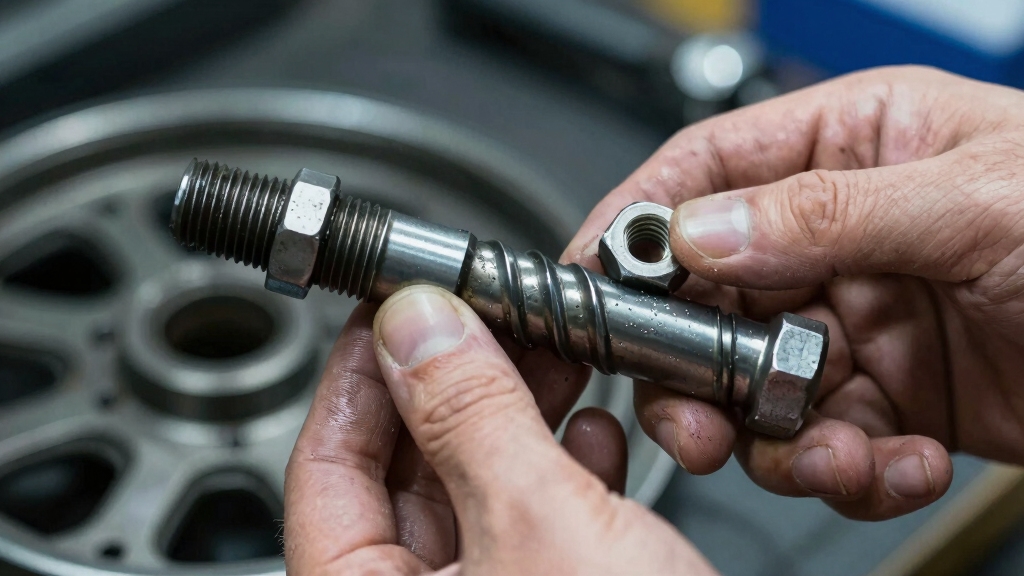
Although most axle nuts use standard right-hand threads, some feature reverse threads to prevent loosening from the wheel’s rotational forces.
While most axle nuts have right-hand threads, reverse threads help stop loosening from wheel rotation.
On certain heavy-duty vehicles, like Ford’s 10.25″ and 10.5″ Sterling rear axles, left-hand threads are applied to the driver’s side spindle nuts.
This arrangement counters the natural tendency of the axle to rotate and loosen the nut due to forward wheel spin.
By matching thread direction opposite the wheel’s rotation, reverse threads maintain secure fastening under operational stresses.
This design reduces the risk of nut loosening without relying solely on torque or locking devices.
You’ll find reverse threading mainly on the left side of specific truck axles, where rotational forces demand this countermeasure to ensure bearing preload remains consistent and prevent premature failure.
For maintenance and safety, it is essential to use durable and properly sized components, similar to how motorcycle wheel chocks require correct sizing and materials to ensure stability and prevent failure.
How to Identify Reverse Threaded Axle Nuts?
You can spot reverse threaded axle nuts by getting familiar with common thread direction patterns.
For instance, many Ford Sterling axles have left-hand threads on the driver’s side. It’s quite interesting how these details can vary from one vehicle to another!
Take Subaru and Honda Civics, for example. They usually stick with standard right-hand threads on all their axle nuts.
So, if you’re working on one of those, you can count on that consistency.
But to be absolutely sure about the thread direction for your specific vehicle, it’s always a good idea to check the factory service manual.
That way, you’ll have the most accurate information for your application!
When adjusting axle nuts without a stand, maintaining proper torque specifications is essential to avoid damage and ensure safety.
Thread Direction Patterns
When determining whether an axle nut uses reverse threading, you need to take into account the vehicle’s make, model, and axle type. Manufacturers apply specific thread directions to counteract wheel rotation forces.
Typically, left-side axle nuts on certain trucks, like Ford Sterling rear axles, use left-hand (reverse) threads to prevent loosening from forward wheel rotation. Right-side nuts maintain standard right-hand threads.
Passenger vehicles and motorcycles generally use standard right-hand threads on both sides. Identifying thread direction involves examining the axle type and consulting service manuals, which specify whether left or right-hand threads are employed.
For safe handling during maintenance, it is important to lift the motorcycle slowly and carefully from the frame, the strongest part, to avoid damage or accidents.
Vehicle-Specific Thread Identification
Understanding the specific thread direction of axle nuts requires examining the vehicle’s make, model, and axle configuration.
For example, Ford trucks with 10.25″ or 10.5″ Sterling rear axles use left-hand threads on the left side and right-hand threads on the right side.
In contrast, Subaru vehicles employ standard right-hand threads on both sides, confirmed by manuals and user consensus.
Motorcycles generally use right-hand threads on rear axles to prevent bearing damage.
Honda Civics from 1992 to 2000 also maintain standard threading on front axle nuts, reserving reverse threads for components like power steering pulleys.
To identify reverse threads accurately, consult factory service manuals or part specifications like QU40103/QU40102 for Ford axles, ensuring correct torque application and avoiding damage during installation.
Additionally, considering the importance of proper fit and adjustment can help avoid issues when working with axle nuts or related components.
Which Vehicles Use Reverse Threaded Axle Nuts?
Although many vehicles use standard right-hand threads for axle nuts, certain models incorporate reverse-threaded nuts to prevent loosening due to wheel rotation.
Some vehicles use reverse-threaded axle nuts to counteract loosening caused by wheel rotation.
Notably, Ford trucks with Sterling 10.25″ and 10.5″ rear axles use left-hand threads on the left (driver’s side) spindle nuts and right-hand threads on the right side.
This pattern extends to 1988-1991 F-350 Super Duty Dana 80 axles. The QU40103 and QU40102 ratchet-type nuts specify thread direction for different sides and models.
In contrast, most passenger vehicles, like Subaru and Honda Civics, use standard right-hand threads on axle nuts, reserving reverse threads for accessory pulleys only.
Motorcycles also typically employ standard right-hand threads to avoid bearing damage.
Always consult factory service manuals to verify thread direction and torque specifications for your specific vehicle to guarantee proper installation and prevent component failure.
If you encounter difficulty removing axle nuts, using proper tools and techniques can prevent damage and ensure safe removal.
How Ford Trucks and Passenger Cars Differ in Axle Nut Threads?
When you’re diving into the world of Ford trucks, there’s something interesting to note about the axle nuts. On the driver’s side, they often have left-hand threads, while you’ll find right-hand threads on the passenger side. This is especially true for Sterling and Dana axles.
Now, when it comes to most passenger cars—Ford models included—they generally stick with standard right-hand threads on both sides. It’s a little simpler that way!
Understanding these differences is pretty crucial. Why? Because the direction of the threads affects how you torque the nuts and helps prevent them from loosening during wheel rotation. So, keeping this in mind can save you a lot of hassle down the road! Additionally, the growing demand for automatic transmissions in motorcycles reflects a broader trend toward simplifying mechanical controls across vehicle types.
Ford Truck Thread Patterns
Ford trucks use a distinct axle nut threading pattern that differs markedly from most passenger cars, especially in their rear axles.
For instance, the 10.25” and 10.5″ Ford Sterling rear axles feature left-hand threads on the driver’s (left) side spindle nuts, while the passenger side uses right-hand threads.
This pattern also applies to 1988-1991 F-350 Super Duty Dana 80 rear axles.
Service parts like the QU40103 ratchet-type nut specify left-hand threading for the left side on 1985-2010 F-250/F-350 models, with QU40102 covering right-hand threads on the opposite side or later versions.
This dual-thread design counters axle rotation forces, preventing nut loosening.
When servicing, you must identify and use the correct thread direction tools to avoid damage and guarantee precise torque application.
For safe and stable transport of heavy loads such as axle components, it’s essential to consider anti-tilt and anti-rattle mechanisms to prevent movement during transit.
Passenger Car Thread Norms
Understanding axle nut threading on passenger cars requires recognizing how their standards contrast with those found on heavy-duty trucks like Ford’s Sterling and Dana axles.
Unlike Ford trucks, which use left-hand threads on the driver’s side spindle nuts to counteract wheel rotation, most passenger cars, including models like Subaru and Honda Civic, employ standard right-hand threads on both sides.
This means you’ll turn axle nuts counter-clockwise to loosen, regardless of side. Passenger car axles typically lack reverse threading, simplifying maintenance and reducing the risk of installation errors.
You should always verify torque specifications in factory manuals, as passenger cars demand precise preload to avoid bearing failure. Additionally, understanding the impact of thread size and compatibility is crucial when replacing axle nuts to ensure proper fit and function.
Thread Direction Impact
Although passenger cars typically use standard right-hand threads on both axle nuts, heavy-duty trucks like Ford’s employ a mixed-thread system. The driver’s side uses left-hand threads to counteract wheel rotation forces.
For example, Ford Sterling rear axles (10.25″ and 10.5″) and Dana 80 rear axles in ’88-’91 F-350 Super Duty models feature left-hand threads on the driver’s side spindle nuts and right-hand threads on the passenger side. This design prevents nuts from loosening during forward motion, enhancing safety and reliability.
In contrast, passenger cars, including models like the Honda Civic and Subaru vehicles, rely on consistent right-hand threads on both sides. This simplifies maintenance but requires careful torque application to avoid bearing damage.
Understanding these differences is vital for correct service and preventing mechanical failure. Proper tool use and technique, such as using a wrench or socket wrench, are essential to avoid damage when loosening or tightening axle nuts.
Thread Directions on Motorcycle and Subaru Axles (Reverse Threaded or Not)
When dealing with motorcycle and Subaru axles, you’ll find that reverse threading is generally not used. Both motorcycle rear axle nuts and Subaru axle nuts employ standard right-hand threads, meaning you tighten them clockwise and loosen them counter-clockwise.
Motorcycle and Subaru axles use standard right-hand threads, tightening clockwise and loosening counter-clockwise.
Subaru’s Haynes manual and multiple forum sources confirm no reverse-threaded axle nuts, with typical torque settings around 145 ft-lbs. Motorcycles follow a similar pattern, using right-hand threads to secure rear axles tightly while avoiding bearing overload by applying correct torque.
This standard threading simplifies maintenance and prevents damage caused by incorrect nut rotation. You should always use a torque wrench to meet manufacturer specifications and avoid bearing misalignment or premature wear.
These axles rely on conventional threading for reliable wheel retention and bearing preload control. Additionally, proper suspension maintenance, including checking shock absorber travel, helps maintain wheel alignment and overall vehicle stability.
Risks of Over-Tightening Axle Nuts and Bearing Damage
If you over-tighten axle nuts, you risk crushing the bearings and misaligning the races. This leads to premature bearing failure. Excessive torque compresses the bearing assembly beyond design limits, increasing friction and heat generation.
This deformation can cause uneven load distribution on the bearing rollers, accelerating wear and potentially causing spalling or brinelling. Additionally, over-tightening can distort the spindle, compromising axle alignment and wheel tracking.
It’s vital to apply the manufacturer’s specified torque to maintain proper bearing preload without inducing damage. Using a calibrated torque wrench guarantees you don’t exceed these limits.
Over-tightening not only shortens bearing life but also raises the risk of axle nut loosening or seizure. This can cause catastrophic axle failure during operation. Always follow precise torque specs to safeguard bearing integrity.
Tools and Techniques for Installing Reverse Threaded Axle Nuts Safely
Since reverse threaded axle nuts tighten counterclockwise, you need specialized tools and careful techniques to install them safely without damaging threads or bearings.
Use a ratchet-type nut wrench designed for left-hand threads, such as the QU40103 for Ford Sterling axles, to guarantee precise engagement and prevent slippage.
Apply torque gradually with a calibrated torque wrench, following manufacturer specifications to maintain correct bearing preload.
While tightening, apply light forward pressure on the axle to seat bearings properly but avoid forcing the wheel assembly, which can misalign components.
Confirm torque in increments, listening for torque wrench clicks or using a dial gauge.
Always verify thread direction before starting and avoid using standard right-hand tools on reverse threads to prevent stripping or cross-threading.
Common Mistakes to Avoid When Removing or Installing Axle Nuts
Using the correct tools and understanding thread direction are foundational steps.
Proper tools and thread direction knowledge are essential for safe and effective axle nut handling.
However, common mistakes during axle nut removal or installation can still cause damage or improper bearing preload. Avoid these pitfalls to guarantee proper function and safety:
- Ignoring Thread Direction: Don’t assume all axle nuts are right-hand threaded. For example, Ford Sterling left-side nuts use left-hand threads. Installing or removing nuts without confirming thread type risks stripping threads or damaging components.
- Over-Tightening or Under-Tightening: Use a calibrated torque wrench and follow manufacturer specs precisely. Over-torquing crushes bearings. Under-torquing causes bearing play and premature failure.
- Neglecting Axle Pull During Tightening: Always apply light forward pressure on the axle while tightening to maintain proper bearing preload. Failing to do this can lead to looseness or bearing damage.
Avoid these mistakes to maintain axle integrity and bearing lifespan.
Frequently Asked Questions
Can Using the Wrong Thread Direction Damage Axle Components?
Yes, using the wrong thread direction can damage axle components. When you force a nut with incorrect threading, you risk stripping threads or causing excessive preload on bearings.
Over-tightening or loosening in the wrong direction can misalign races, crush bearings, and lead to premature failure. Always verify thread orientation before installation to avoid damaging the axle spindle, bearings, or surrounding components.
This ensures proper torque and preload for safe operation.
How Can I Tell if My Axle Nut Is Stripping Without Removal?
You can tell if your axle nut is stripping by feeling for unusual looseness or play when you try to tighten it.
If the nut spins without increasing torque or slips under a torque wrench, that’s a clear sign.
Also, listen for grinding or unusual resistance indicating damaged threads.
Visual inspection through any accessible gaps might reveal thread deformation or metal shavings, signaling stripping without removing the nut entirely.
Are Axle Nut Torque Specs Different for Aftermarket Wheels?
Yes, axle nut torque specs can differ for aftermarket wheels because wheel material, design, and hub interfaces vary.
You need to consult the aftermarket wheel manufacturer’s guidelines to guarantee correct torque values.
Using factory specs blindly risks under- or over-tightening, which can lead to bearing damage or wheel loosening.
Always use a calibrated torque wrench and follow specific recommendations to maintain proper preload and safety.
What Signs Indicate a Loose Axle Nut Before Failure?
You’ll notice vibrations or unusual noises like humming or grinding near the wheel if the axle nut is loose.
The wheel might feel wobbly or have play during a shake test.
Uneven tire wear or a clunking sound when accelerating or turning also signals a loose nut.
Catch these signs early to prevent bearing damage or axle failure.
Always check torque specs to ensure proper tightness.
Can Axle Nut Thread Type Affect Wheel Bearing Replacement Intervals?
Thread type truly tweaks timing for bearing replacement. If your axle nut’s threading mismatches torque specs or loosens unintentionally, it can cause bearing backlash or binding, boosting wear and shortening service spans.
Using correct thread direction and torque guarantees stable preload, preventing premature failure. So, you should always synchronize thread types with factory standards.
Otherwise, inconsistent clamping can accelerate damage, forcing earlier wheel bearing interventions and increasing overall maintenance frequency.
Smart Mechanics Check Thread Direction First
Understanding that around 30% of axle nuts, especially on certain Ford trucks and motorcycles, use reverse threading can save you from costly mistakes.
Always identify the thread direction before removal or installation to avoid stripping or bearing damage. Use the proper tools and apply torque carefully. Over-tightening compromises axle integrity.
By mastering these technical details, you’ll guarantee safer repairs and longer-lasting vehicle components, making your maintenance both efficient and reliable.